
It’s hard to believe that it’s mid-summer now; July is over, August is here, and songbird migration is only a few weeks away. When it comes to insects, I’m not thinking as much about seeing the first species of the season as I am wondering whether each individual (except for the darners and meadowhawks) is my last of the season. There are some species I seem to have missed completely this year, such as Emerald Spreadwing (which has a flight season from mid-June to mid-August), Horned Clubtail (mid-May to early July), Stream Cruiser (late May to mid-July), and any of the hairstreak butterflies (the peak of their flight season occurs in the first half of July). This is the result of a combination of bad luck and bad weather; I missed most of these bugs when I went looking in places where I have seen them before, and when I wanted to return later, the cold, overcast and/or rainy weather on the weekends prevented me.
Even though August is here now and I have started checking the river for early migrants and birds that are now undergoing post-breeding dispersal, I am still devoting most of my attention to insects. I usually do my birdwatching first thing in the morning while waiting for the bugs to become active, though it has been so hot lately that there are usually some butterflies and dragonflies flying early in the day.
I started my morning today with a walk to the dyke at Shirley’s Bay. This time of year, before songbird or waterfowl migration has started, I prefer to walk along Shirley Boulevard to the DND gate (calling for permission first) and then inside the fence line to the trail through the woods. The mowed area along the fence line provides good edge habitat and lets in the sunshine, which makes it a great spot to see some interesting bugs. Usually there are darners here in the latter half of the summer; I spotted a Canada Darner which landed briefly on a sign attached to the fence. I also spotted several meadowhawks and one male Eastern Pondhawk, and heard a Gray Catbird calling from somewhere within the thickets.
I spent an enjoyable hour birding the dyke, but it wasn’t until my return trip that I started seeing more odes. I saw two more darners in this area; one landed briefly on my shirt before flying up into a tree, while the Canada Darner landed close enough to identify but too far overhead to photograph properly. The male Eastern Pondhawk was still hunting in the same area, and I got a better photograph of him hanging from a blade of grass.

By then I was in the mood to take my net and go dragon-hunting. I decided to head over to the Bruce Pit to look for spreadwings there; up to six species breed there, and I usually see a good variety on any visit. Unfortunately the cattails have completely taken over the southwestern corner of the pond where Chris and I used to find the Amber-winged Spreadwings and Saffron-winged Meadowhawks; although a couple of Common Gallinules squeaked at me from the depths of the cattails, their presence doesn’t quite make up for the disappearance of the odes that used to be found here.
There were some large odes flying over the pond and the western edge of the water, including many mosaic darners. I waited a long time for one to pass close enough by my net to catch, but despite several attempts all of them eluded the net. A few teneral Common Green Darners were present; I found them by scaring them up from the vegetation and watching to see where they would land.

One Common Whitetail and several Twelve-spotted Skimmers were also busy patrolling the area.

Eventually I found several spreadwings on the west side of the pond just to the left of where the path from the hill emerges. I caught and identified a couple of Lyre-tipped Spreadwings, one Northern Spreadwing, and one Sweetflag Spreadwing.

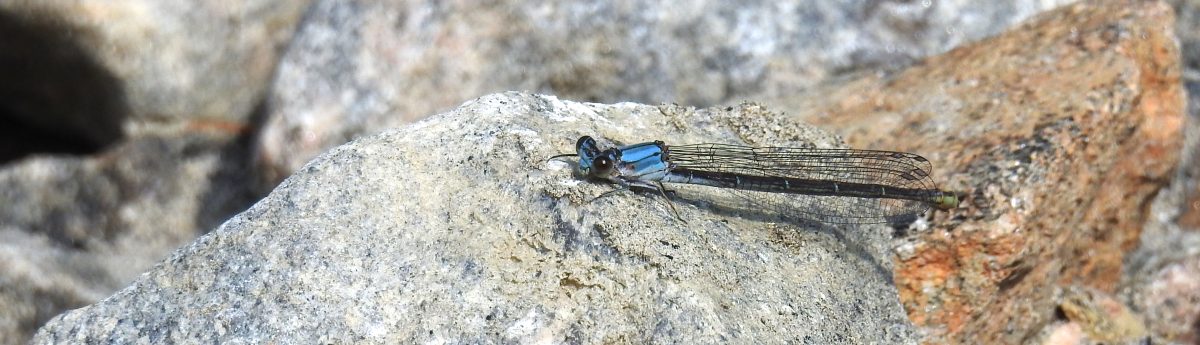
It would have been nice to have seen the Northern and the Sweetflag Spreadwings together. Unfortunately it did not occur to me to photograph their claspers as this would have have made a nice comparison. However, the photos that I took of the male Sweetflag and the male Lyre-tipped Spreadwings nicely shows their different appearances. The Lyre-tipped Spreadwing has blue eyes that are deeper in colour and also some stripes on the thorax. In contrast, the Northern and Sweetflag Spreadwings usually develop more pruinosity and appear whitish-blue in colour.

The other spreadwing that I photographed was a Slender Spreadwing – I didn’t need to catch it in order to identify it. It is closer to the Lyre-tipped Spreadwing in appearance but has a much longer abdomen.

I headed over to the north side of the pond where I found couple of butterflies – a White Admiral and what was probably a Mourning Cloak were both obtaining moisture from the ground.
I didn’t see as many odes on the open north side so I turned around and went back to the south side. I pushed my way past a couple of fallen trees and found a small opening onto the pond. I saw a Belted Whiteface and spent some time photographing it. As I did, a large darner came along and started ovipositing on the reeds lying in the water. It saw the handle of my net lying on the ground and attempted to insert some eggs into that, too, before realizing it wasn’t a suitable substrate!

The Belted Whiteface was cooperative, and I managed to get a close-up photograph of the wings. You can see the forewing triangle here and the three rows of cells to its right. Frosted Whitefaces only have two rows of cells. This is a neat identification feature, and one that I hope to look at more closely next year.

It was a great day for bug-watching, and I’m glad I was able to see so many different dragonflies and damselflies at Bruce Pit. The beginning of August is bittersweet for me, for it means that the flight season for many different insects is already over for the year and summer is continuing its relentless march toward fall. Although I will have to wait another year to see the bugs I missed this season, there are still at least two months of warm weather left to look for butterflies and dragonflies before bird migration takes up my attention once again.

 OdoNotations