All week I’ve been dodging rain showers to get out and find dragonflies to add to my Odolympics species total. It figures the sunniest day of the week was Tuesday, when I had to work downtown. Almost every other day was overcast, and it rained heavily on Thursday and most of Friday. Limited to checking only areas close by, my dreams of tallying a large number of species completely fizzled out in the sub-optimal weather.
When I got up this morning it was the type of day I’d been dreaming about all spring – already warm at 8:00, with dazzling sunshine, a clear blue sky, and lush green vegetation so vivid it finally burned the visions of the bare, brown woods and dull grey skies of early spring out of my memory. I’d been planning this excursion all week – I was heading to points west, starting at Sheila McKee Memorial Park, then onto the Bill Mason Center with maybe one final stop if I had time – I would be performing in a choir concert that night, and didn’t want to wear myself out or get home too late to get ready! I didn’t realize until later in the day that it was June 13th – the first day of the Odolympics, but even if I had it wouldn’t have changed my plans that much.
We are now about four weeks into dragonfly season here in Ottawa and my dragonfly woes continue. There just don’t seem to be the number of individuals present as there should be. On June 3rd I visited Andrew Haydon Park to see if there were more odes flying there. While there were plenty of teneral damselflies in the vegetation – too fresh and colourless to properly identify – I only saw three dragonflies. Not three species – three individuals. One was a Common Whitetail that escaped my camera. The other two were Common Green Darners laying eggs in the pond that didn’t. I walked around the two ponds and checked the eastern creek and the small beach at the mouth of Graham Creek (which was almost non-existent due to high water levels) but did not find nearly the number of dragonflies that I was expecting.
The dragonfly season for odes that emerge here in Ottawa (as compared to those that migrate from further south) usually begins for me on the May long weekend, if not earlier. Odonate larvae need the waters they inhabit to warm up to a specific temperature in order to begin the transformation process, and this usually requires several days of heat and strong sunshine. Unfortunately this year the temperature was slow to warm up, with many days of cloud and northern winds that made it feel cold even when the sun was shining – I didn’t put my winter coat away until the first day of the long weekend because morning temperatures were still quite cold!
The end of the 2025 dragonfly season came to an abrupt end for me. In 2023 and 2024 the warmth extended well into October, which extended the flight season of many species. That was not the case this year. While daytime highs were still quite warm, staying in double-digits until October 24th, nights got cold fairly quickly. A cold spell right in the middle of the month saw two nights fall just below zero; daytime highs were only about 13°C. After October 23 nights were all below 3°C, with five nights just below zero. As a result, I did not see as many dragonfly species this month as I had in previous years.
It was just a quick trip to Cambridge, Ontario, but the weather was so gorgeous I couldn’t resist dragging my dad out for a few nature walks. Although in his mid-70s now, he is still mobile enough to get out, and while I’m looking up for birds and dragonflies, he is usually looking down for snakes and turtles or turning over logs for salamanders.
Because it was late in the season I had checked iNaturalist ahead of time to see what odes had been recorded at the beginning of October. I was blown away when I realized that American Rubyspots were still flying, and that they lived along the Grand River! Their range does not extend to eastern Ontario – they are a southern Ontario bug, though funnily enough there is a population in Montreal.
I was quite happy when I learned that this year’s North American Odolympics were to take place in mid-August this year. This would be my third year participating; the 2023 Odolympics ran from August 19-27 while the 2024 Odolympics ran from September 7-15, so I was worried that this year’s bioblitz would be held in October! However, with a start date of August 16th (and running till August 24th) it would be my earliest bioblitz yet!
Unfortunately there was one problem with that date: I would be driving to Nova Scotia with my partner and three cats during the entire first weekend! Then came the second blow: while I was excited to participate in my first Nova Scotia Odolympics, a forest fire was burning out of control in Annapolis County (not too far from where our trailer is located); the fire risk was extremely high all throughout the province due to the prolonged drought conditions; and the government had closed the woods to recreational activities, including trails in provincial and national parks. The reason for the closure was to prevent additional human-caused forest fires, which meant hiking, camping, fishing, and driving recreational vehicles on both Crown and private property were all prohibited. This decision was based on the amount of dry, flammable material present which could easily start a fire, and the fine for violating the ban was $25,000. Immediately my dreams of looking for odes along forest creeks – which were already terribly low from a lack of summer rainfall – were dashed, and even places like Miner’s Marsh were out of the question as the marsh had entirely dried up, leaving the dry, cracked muddy bottom completely exposed.
Chris Traynor and I planned a wonderful outing in the Kazabazua area for the August long weekend. He’d been reviewing some of Chris Lewis’s notes about expeditions to the Kazabazua area about an hour north of downtown Ottawa, in particular to a small fen near Danford Lake where she and Bob Bracken had found Zigzag Darners, a Forcipate Emerald and and an Incurvate Emerald. The dates of their expeditions and findings are as follows: August 3, 1998 (several Zigzag Darners and one Forcipate Emerald); August 15, 1999 (several Zigzag Darners and one Incurvate Emerald); August 21, 2000 (6 Zigzag Darners); and August 10, 2002 (5 Zigzag Darners). He’d also dug out some notes from Benoit Menard who had found Subarctic Bluet (the damselfly) and Subarctic Darner (the dragonfly) in the fen. The Incurvate Emerald would be new for Chris; and the Subarctic Bluet, Zigzag Darner, Subarctic Darner, and Forcipate Emerald would be new for both of us, so we were keen on going even if it was a bit early in the season for the dragonflies. This area has the added attraction of being close to the Kazabazua River where we had seen Zebra Clubtails in 2023. I jokingly told Chris I was looking forward to writing a blog post called “Of Zigzags and Zebras” as these species at least seemed almost a sure thing, but the reality was very different.
On the Friday before the long weekend my workplace allowed employees to log off work an hour earlier. This meant I had a beautiful, sunny afternoon to myself starting at 3:30. Andrew Haydon Park and the colony of Vesper Bluets I’d found there two years ago were on my mind, so I drove over right after I closed my laptop. I’d searched for them there the previous weekend, to no avail….I was probably there too early in the day for them and the Orange Bluets as I saw neither species at the water. With the sun setting a little earlier each evening as the earth tilts its way toward the equinox, the shadows were long when I arrived and I thought I might have a chance of seeing both species. I was also looking for Skimming Bluets, darners, and skimmers, though of course any cooperative ode would be welcome!
The forecast for Saturday looked gorgeous, but hot and humid. It’s been one heat wave after another this summer, and while it’s certainly preferable to the rain and smoke we’ve had previous years, I find I get tired faster in the heat.
Chris and I have been planning another trip to Quebec. He’s been eager to explore a section of Meech Creek with hidden rapids and waterfalls that looked good for clubtails and snaketails. I wanted to go with him, but I was worried about exploring a new place when I didn’t know how high or fast the water might be, how much bushwhacking we might have to do, or how long we would be out. So on Friday night I suggested that Chris do an exploratory scouting mission while I headed to a couple of places I haven’t spent too much time yet this year – Sheila McKee Park or Marlborough Forest.
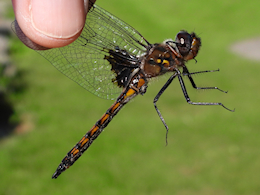
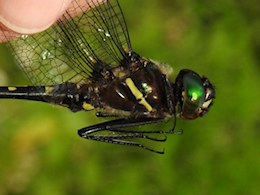
In addition to the Somatochlora emeralds, I saw some other interesting dragonflies at Jack Pine Trail over the past few weeks. The first species was a large dragonfly called the Arrowhead Spiketail. I’ve seen this species many times over the years along the stream at the back of the trail, usually between the first and third weeks of June. Normally I only see them on one or two visits, making me wonder how long their flight season actually is – while the Ottawa Checklist says they fly from early June to early July, I don’t think I’ve actually seen any beyond the third week of June. While the range of dates surely applies to all populations within the Ottawa region, I was certain that individuals lived longer than a single week, and checked the stream each time on my visits to see how many spiketails I could find.
Sarsaparilla Trail is always worth a quick visit in the warmer months, even with the limited access to the water. The pond is fairly large, and I’ve often wondered just how many species actually live and breed here away from the boardwalk – the only point of access to the water. On June 18, 2025 I added a new species here to the list of Stony Swamp odes, a female Horned Clubtail that landed on the boardwalk and stayed long enough for some photos. After seeing that magnificent dragonfly I wasn’t expecting to add another new species to the list anytime soon, but that is what happened on one of my visits this month.
The circular trail through the woods is short – the inner loop is only about 0.5 km – so most times I only stop by for a quick walk on my lunch break while working from home, or a short visit after returning from somewhere else. My July 8 visit was a lunchtime visit, and although there were lots of clouds in the sky, the odes were flying around the pond as usual.
I don’t see Swift River Cruisers very often, and even when I do, I seldom get the opportunity to catch or photograph one. I used to see them fairly regularly at Mud Lake, but now it seems the best place to see them – aside from my recent outing to Quebec with Chris Traynor – is Sheila McKee Memorial Park. However, even here I only see them in flight, either far out on the water or soaring high above the trees with the Prince Baskettails. Swift River Cruisers love feeding in large, sunny clearings near the rivers they breed in, dancing in the sky with graceful twists and turns too rapid to follow with the eye. They do, however, perch fairly regularly, though I have never seen one doing so at Sheila McKee Park. As such, I have not been able to enter any of my sightings into iNaturalist as photographing them is next to impossible while they are in flight.
Burritt’s Rapids has been on my radar as a low-priority place to visit for about a year now, and if I hadn’t missed a turn on my way to the southwestern corner of Marlborough Forest I wouldn’t have ended up there on a nice warm day in mid-July. I had been curious about what species I might find at the rapids there, and was hoping to find a few new species to add to iNaturalist as it didn’t have many when I first started thinking about going there. One species I was curious about was Swamp Spreadwing, which had been found a short distance east at Rideau River Provincial Park back in 2022. The only place I’ve seen this species in Ottawa is Petrie Island, and it would be fantastic to find another one closer to home. I was also wondering if the river and rocky rapids might host some of our common clubtails, such as Dragonhunter or Black-shouldered Spinyleg.
A day without seeing a dragonfly is like a day without chocolate – sure, it’s completely survivable, but utterly lacking in joy. I had to work downtown on both the Wednesday and Thursday after Canada Day, and decided to go for a lunchtime walk along the canal to the river on Wednesday to see if I could find any weekday odes. I’d seen Prince Baskettails and Common Green Darners flying up and down the canal, and a Midland Clubtail on the rocky shore behind Parliament Hill many moons ago, so the downtown core is not completely devoid of odonates. Still, I wasn’t expecting much, and got lucky on Wednesday when I saw first a Common Green Darner flying by, then a Prince Baskettail. Then something small fluttering above one of the mats of vegetation caught my eye – a female Eastern Amberwing ovipositing in some floating vegetation! After a few more minutes of watching, I saw a pair of males fly by. I waited for several minutes for one to land but they never did.