
The forecast for Saturday looked gorgeous, but hot and humid. It’s been one heat wave after another this summer, and while it’s certainly preferable to the rain and smoke we’ve had previous years, I find I get tired faster in the heat.
Chris and I have been planning another trip to Quebec. He’s been eager to explore a section of Meech Creek with hidden rapids and waterfalls that looked good for clubtails and snaketails. I wanted to go with him, but I was worried about exploring a new place when I didn’t know how high or fast the water might be, how much bushwhacking we might have to do, or how long we would be out. So on Friday night I suggested that Chris do an exploratory scouting mission while I headed to a couple of places I haven’t spent too much time yet this year – Sheila McKee Park or Marlborough Forest.
Sheila McKee Park has been surprisingly good for a variety of uncommon dragonflies turning up, but most of these have been one-time wonders like the Williamson’s Emerald, the Mottled Darner, and the Black-tipped Darner. I suspect it’s because very few of these dragonflies breed in the park – so where they are emerging is a mystery.
I had a couple of options for a second destination: Morris Island, the rail trail, Blakeney Rapids, or Marlborough Forest. Marlborough Forest, though enticing, was a fair drive from the Ottawa River. Morris Island or the rail trail to Quebec are closer and could be productive for a variety of odes, but I remembered my trip to Blakeney and failure to find a Rusty Snaketail that day, so that was where I planned to go once I was done scouring Sheila McKee Park.
I arrived early, at 9:30 am – it was already hot and sunny, and although it was a bit early for dragonflies, the sun would be shining directly toward the base of the cliff. I planned to search the rocks and vegetation for basking clubtails first, then head up to the meadow and sunny corridors through the woods. However, I began to feel worried when I didn’t see a single ode on my way to the beach – not even a Powdered Dancer. A few people were enjoying the water, and a dog-walker actually recognized me from my previous visit – I guess because very few people carry large white insects to the beach! He asked if I was still searching for dragonflies, and I said yes. After a pleasant conversation I continued my walk down the beach and found nothing. I didn’t even see any friendly Powdered Dancers on the ground or large dragonflies flying over the water. The water was still very high, leaving very little shoreline which might account for the lack of odes.
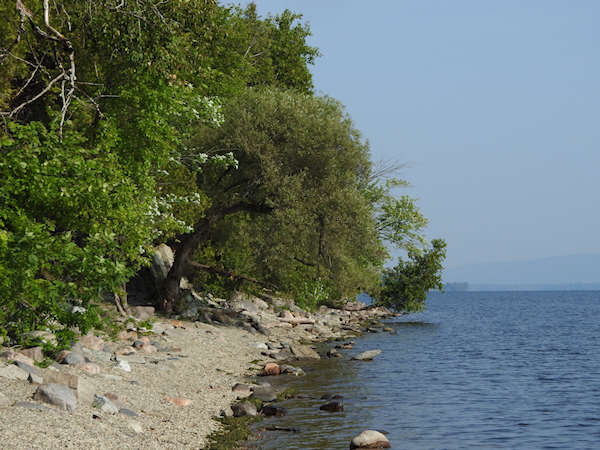
Hoping that it was still too early, and that there would be more to see on a second pass a little later, I made my way up to the meadow. Surely there would already be dragonflies feeding in the heat of the meadow, and sure enough I spotted a few darners flying high above the middle of the clearing. I walked the perimeter of the clearing, scaring up one or two others, but they landed too high for me to identify.
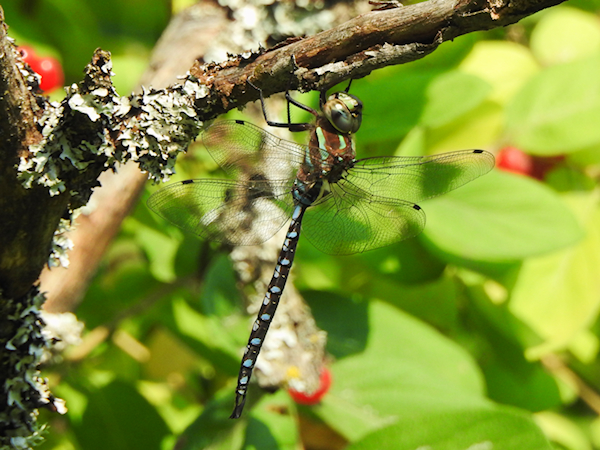
My first identified odonate was a skimmer flying in the usual group of shrubs near a fallen tree – a teneral Widow Skimmer. It was the only one I saw. I looked for Blue Dashers and also saw none. However, I was able to identify some of the darners that hung up in the shrubs – one Canada and a few Lance-tipped Darners. A couple of Autumn Meadowhawks were perching around the edges of the meadow, and I found a female Eastern Pondhawk resting on a leaf low to the ground.
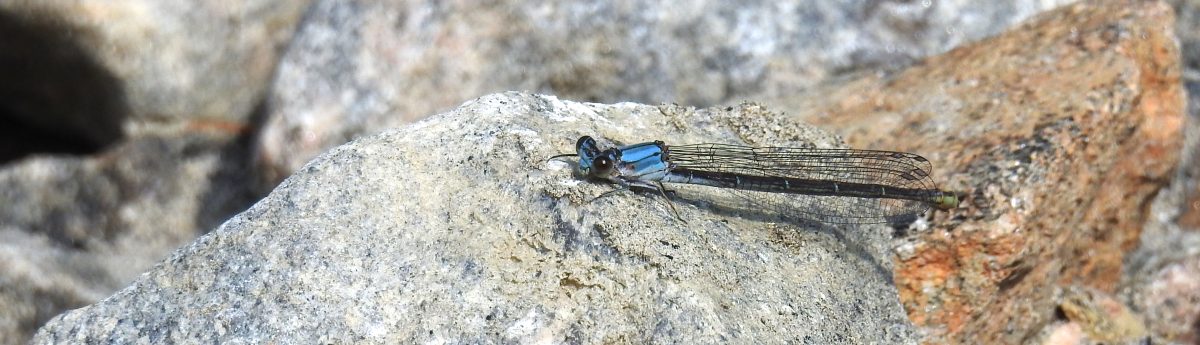
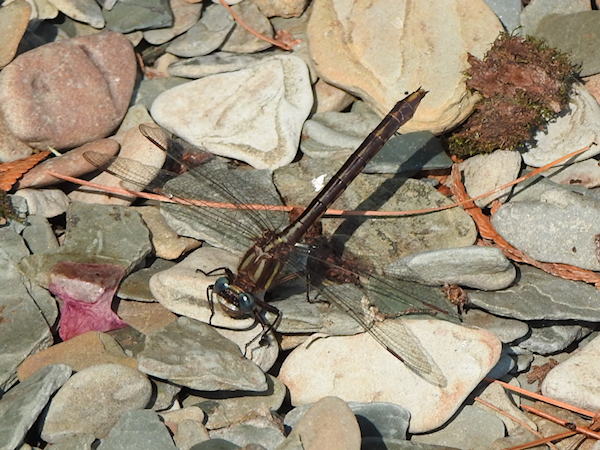
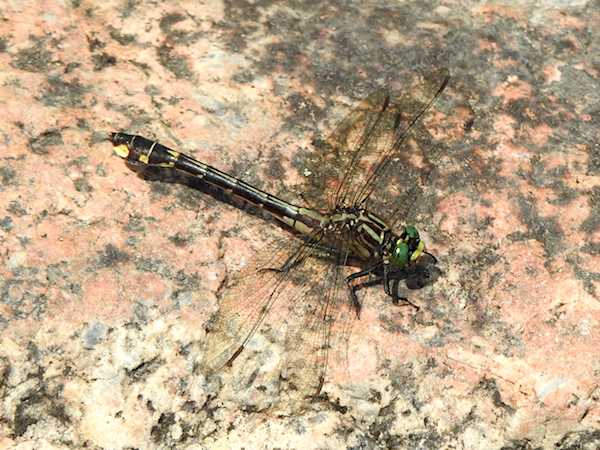
With little to see in the meadow, I decided to return to the beach and this time I found a Lancet Clubtail and a Cobra Clubtail resting on the rocks. I also found a pair of Tule Bluets in tandem, my second ever sighting of this species here – and second bluet species seen at Sheila McKee (the first was a Stream Bluet photographed on July 28, 2019). It seemed my luck was changing!
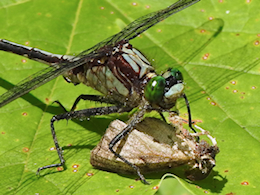
I headed up to the meadow one last time before I headed out, and found some more odes of interest: first a Brush-tipped Emerald perching about 15 up in a tree, my only emerald of the day, then a Black-shouldered Spinyleg resting on a leaf! It was surprisingly unconcerned as I approached it for a photo, and then I saw why – it was busy munching on a moth!
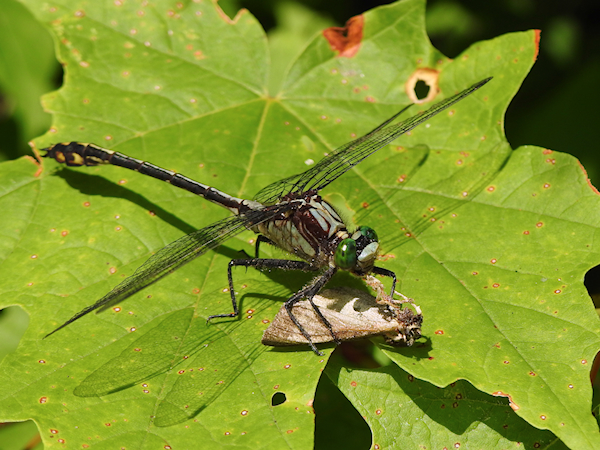
I was able to get close enough to see the mandible working, but then it turned away from me, allowing a better view of the top of the abdomen. The Black-shouldered Spinyleg can be identified by the thin yellow streak on the top (dorsal side) of the abdomen, the thick club at the tip, the yellow capital “I” on top of the thorax centered between two ovals, and the long spines on their legs that help capture prey.
Thrilled with the find and not certain I would find anything new with another circuit of the park, I drove over to Blakeney Rapids next, arriving shortly after noon.

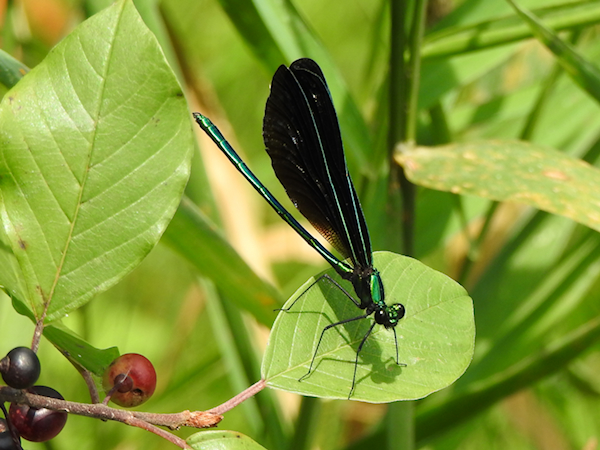
The usual Violet and Powdered Dancers were perching on the rocks around the shoreline. I didn’t find any River Jewelwings on my walk, but there were plenty of Ebony Jewelwings. A few Stream Bluets, Skimming Bluets, and Eastern Forktails were the only other damselflies that I saw.
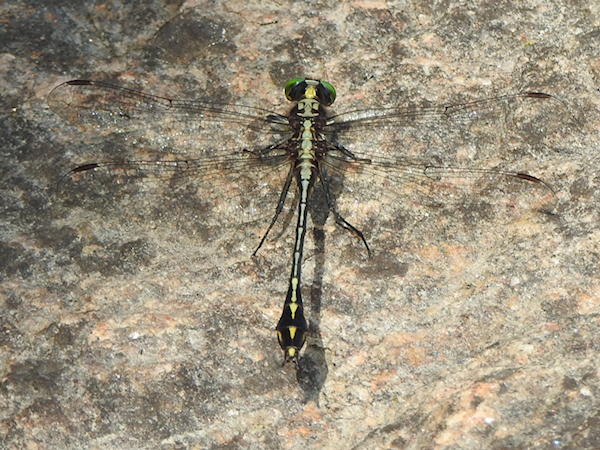
I waded into the water then – so refreshing! – to look for clubtails perched on rocks. At the mouth of the small channel I found a single Eastern Least Clubtail, which I was happy to see – I wasn’t sure whether any would still be flying, though their flight season extends into August according to the Ottawa checklist. I scanned the large rocks in the middle of the swirling rapids but saw no other clubtails.
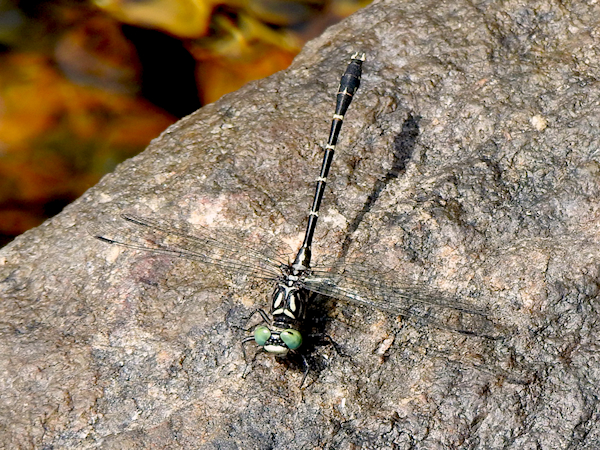
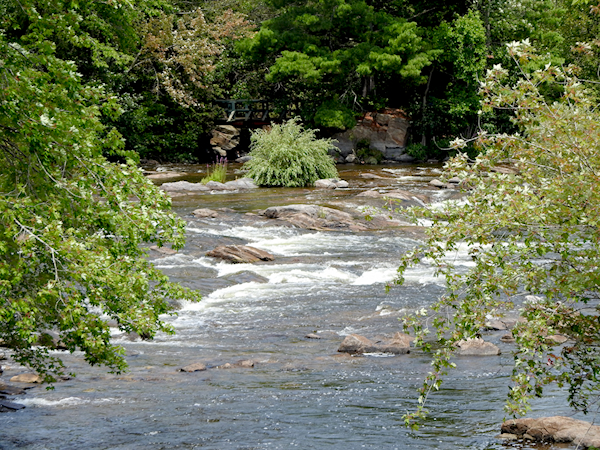
From there I waded back to shore and crossed the bridge, still looking for a Rusty Snaketail. According to iNaturalist, the one from July 4, 2023 was seen on the opposite side of the river on the north side of the bridge. As I crossed the bridge, I saw a few clubtails resting on the rocks below but they all turned out to be Black-shouldered Spinylegs. I had high hopes of finding more odes along the rocky shore of the opposite bank, but decided to turn around when I saw the mat of poison ivy growing along the path to the water – in my shorts and sandals I was sure to brush up against these plants, and I still vividly remember the last time I came into contact with this plant…that turned out to be a devastating way to find out that I did not in fact inherit my grandmother’s immunity to the plant! I turned around and made my way to the large slab of rock jutting out into the calmer waters of the Mississippi River above the rapids instead.
I waded out into the water to get to a small island of vegetation just offshore, and here I found several Eastern Pondhawks, a couple of Skimming Bluets perching on the lily pads, four Widow Skimmers, and at least five Slaty Skimmers in the vegetation.
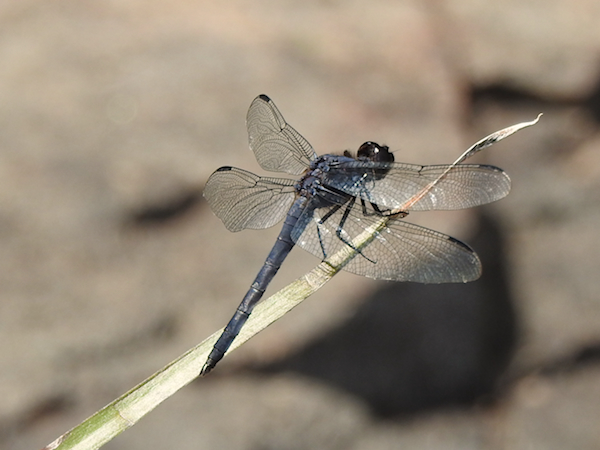
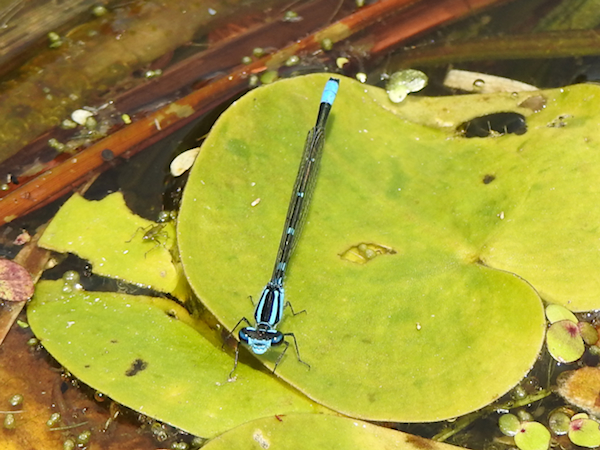
I was also delighted when a Black-shouldered Spinyleg landed on the slab of rock, and made my way over to capture a photo.
I enjoyed wading in the water, but eventually returned to shore when I ran out of species to add to my day’s list. I decided to head back over to the rapids one last time to see if I could find anything new, wading into the water once again. This time I spotted a large clubtail perching on a rock in the middle of the rapids. I waded closer, but the rocky substrate of the river was too uneven and the water too deep to risk getting closer. I got close enough to identify it as a Dragonhunter, one of our largest dragonflies, but it must have sensed my intentions for it flew just then. I followed its flight, thinking it was going to disappear, but instead it landed on a rock on the shore right in front of me!
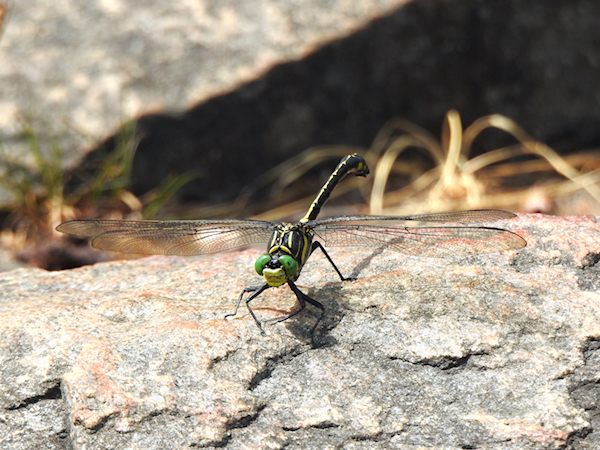
This sighting meant I had seen both the smallest and largest clubtails in the same spot – not something that happens often on this side of the Ottawa River! Though size is difficult to gauge in the photos, the Eastern Least Clubtail reaches a maximum length of 36 mm, while the Dragonhunter usually maxes out at 90 mm! It would be amazing to see them on the same rock together, though this might not be good for the tiny Eastern Least Clubtail given that the Dragonhunter would definitely see it as an afternoon snack. Although I was disappointed that I still hadn’t found any Rusty Snaketails at Blakeney, seeing so many clubtails at both Sheila McKee and the rapids made it a fantastic day, and photographing the Dragonhunter was the perfect way to end it.


