
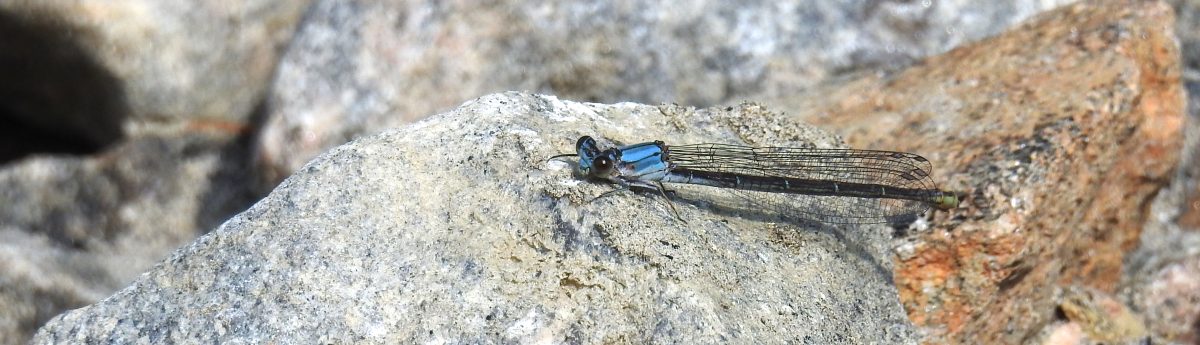
On the Friday before the long weekend my workplace allowed employees to log off work an hour earlier. This meant I had a beautiful, sunny afternoon to myself starting at 3:30. Andrew Haydon Park and the colony of Vesper Bluets I’d found there two years ago were on my mind, so I drove over right after I closed my laptop. I’d searched for them there the previous weekend, to no avail….I was probably there too early in the day for them and the Orange Bluets as I saw neither species at the water. With the sun setting a little earlier each evening as the earth tilts its way toward the equinox, the shadows were long when I arrived and I thought I might have a chance of seeing both species. I was also looking for Skimming Bluets, darners, and skimmers, though of course any cooperative ode would be welcome!
There were hardly any people in the park when I arrived. This surprised me as it was a lovely summer day and many people take the Friday before a long weekend off. I started my walk with a lovely stroll up the “stream” to the waterfall, hoping to find some darners patrolling the pool below the man-made falls, but there were none. I walked back to the western pond and began scanning the reeds for odonates. The usual Eastern Forktails were present, as were quite a few Tule Bluets.
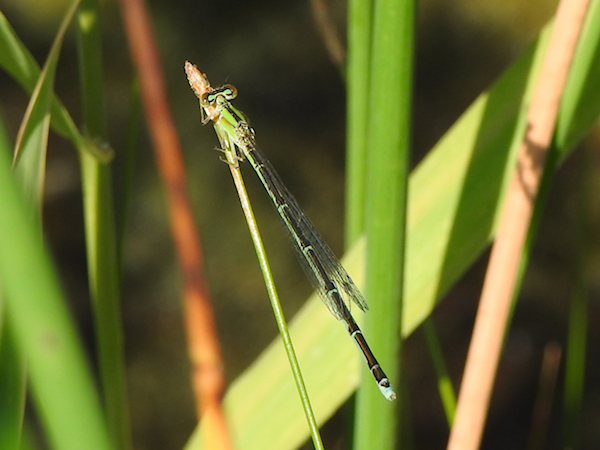
One my first pass around the pond I didn’t notice any Orange or Vesper Bluets on the pond, so I was surprised when I spotted a damselfly perching in the reeds with a bright yellowish-green thorax and blue-tipped abdomen. It was a Vesper Bluet, the first one I’d ever seen at Andrew Haydon Park not perching on a lily pad at the water’s surface.
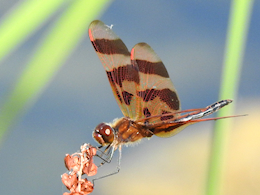
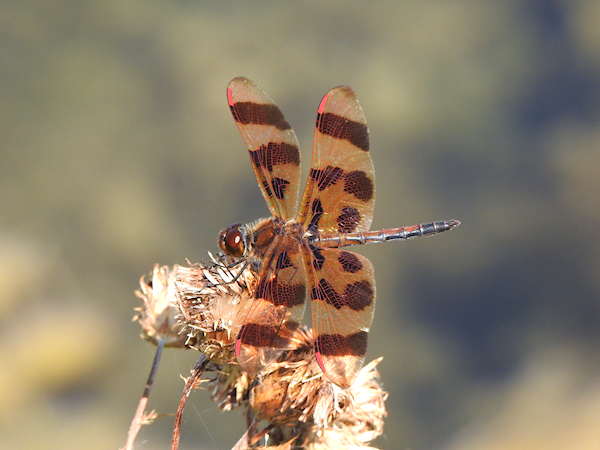
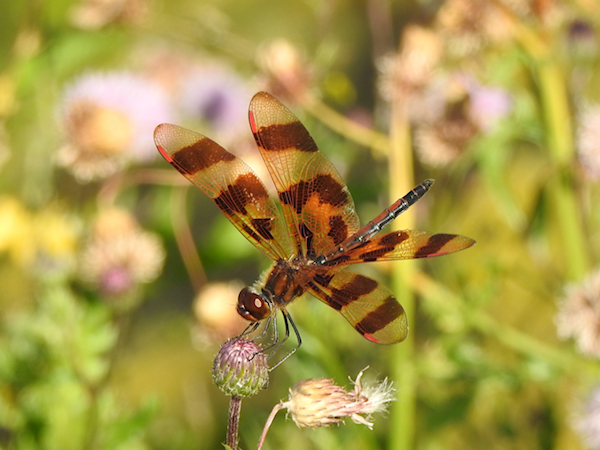
I was happy to find a Wandering Glider flying over the river (my first of the season) and a startling number of Halloween Pennants and Blue Dashers in the vegetation along the ponds. Andrew Haydon Park has become a great spot to find these two particular skimmers, but I was surprised to find one or two every couple of feet!
I saw the first Halloween Pennant right along the shore of the river, perching just above the water – a spot where I usually don’t see them. There were more fluttering in the vegetation overlooking the pond.
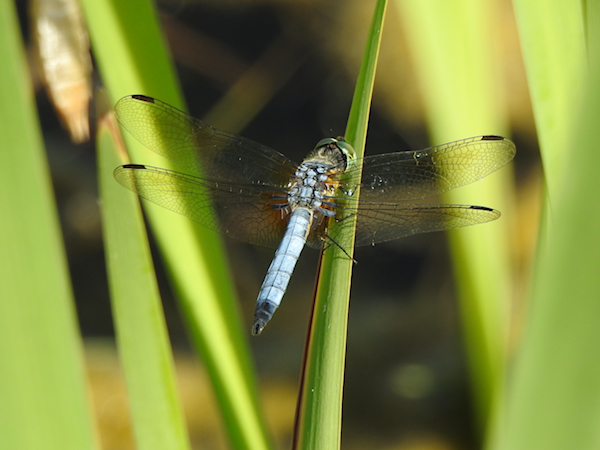
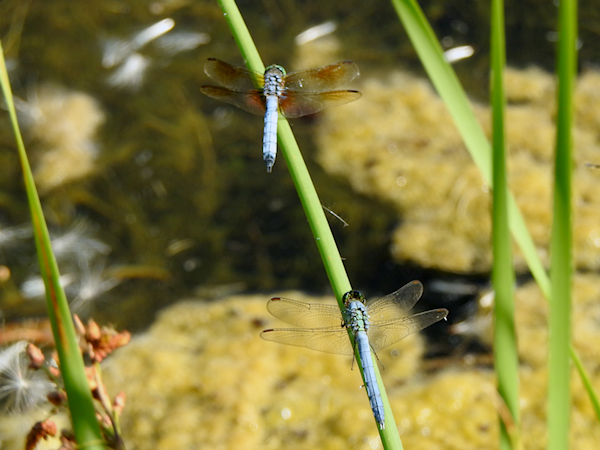
Then I started noticing the Blue Dashers. There were about two or three every couple of feet! They perched lower in the vegetation than the Halloween Pennants, so it’s possible I missed some in the vegetation right up against the shore. I even spotted two females, which are usually found in vegetation away from the water.
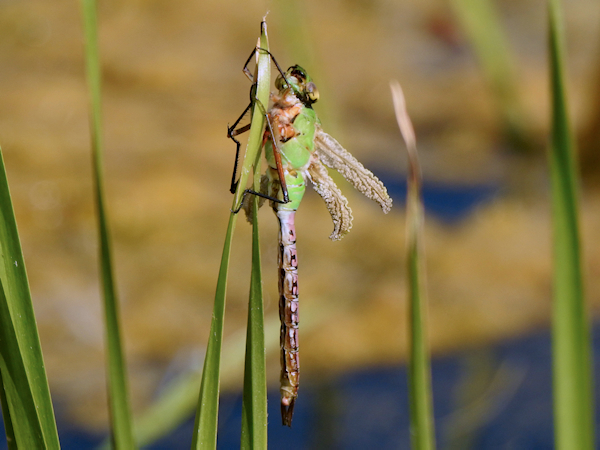
I saw one Common Green Darner fly by and found another one hanging on a stem above the water of the western pond – it had just emerged, and when I got my binoculars on it I saw that it was in for a tragically short life – none of its wings had expanded after emergence.
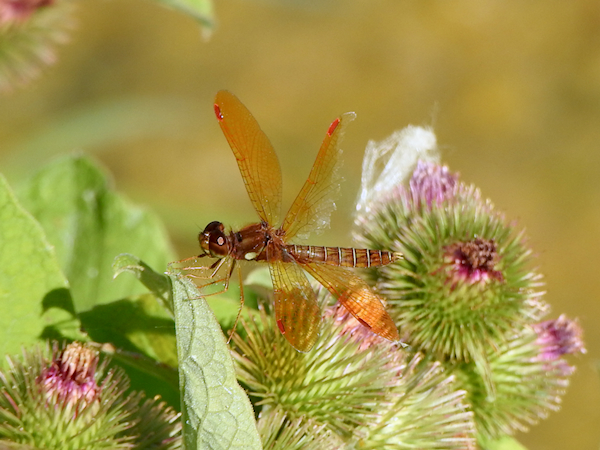
A few male Eastern Amberwings zipped by me low over the eastern pond as I made my way around it. There were a few Halloween Pennants here, as well as a few Eastern Pondhawks. Altogether I counted six pondhawks, which is likely a high count for me at this location. One was fighting with a male Blue Dasher for the same perch.
I circled the eastern pond and found a few Autumn Meadowhawks, two Prince Baskettails gliding above the water, and a single Widow Skimmer perching in the reeds – this was the only “king skimmer” I saw. From there I returned to the bridge between the two ponds, which is where I’d had such good luck with the Orange Bluets, Vesper Bluets, and Skimming Bluet last year. To my delight I found five Orange Bluets resting on the lily pads, including a female ovipositing while still in tandem with the male!
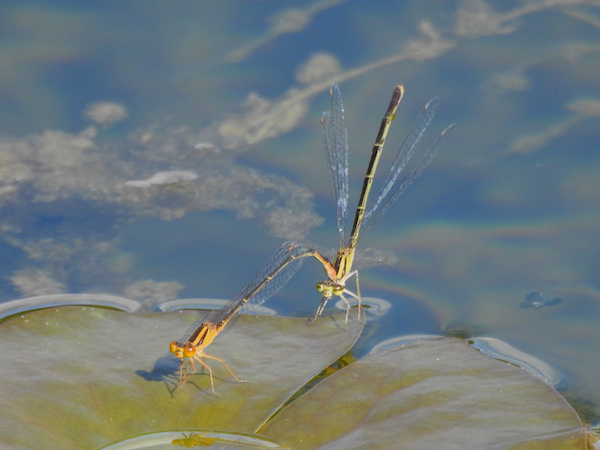
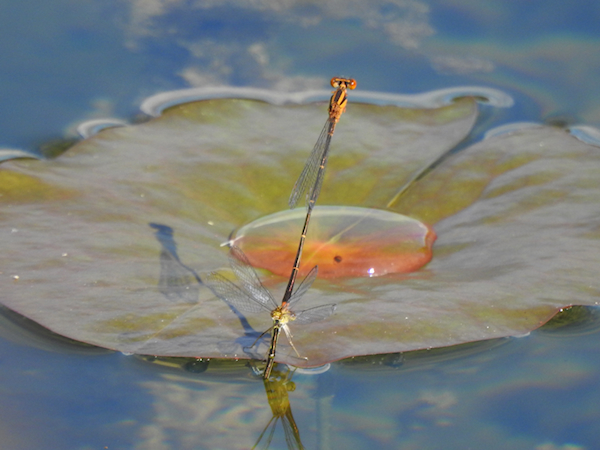
I didn’t see any other bluets here so I headed back to my car following the south shore of the western pond. It was there that I finally came across another Vesper Bluet – a male perching on an emergent plant near the edge of the water! It flew up onto the grassy bank and I took some photos of it head-on to capture that brilliant yellow face.
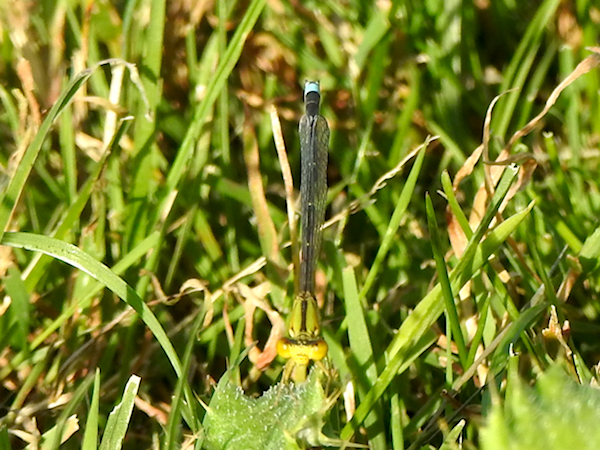
I found one other Vesper Bluet in the western part of the pond. I had been watching a couple of Stream Bluets perching on slender stalks of vegetation a few feet out from the shore when a male Vesper Bluet flew in and tried to bump one off! It failed, and landed on the mat of vegetation instead.
I was elated to see this species up close after only observing them on distant lily pads on previous visits – while it seems that after 5:00 p.m. is the best time to observe them at the water, I have not had any luck finding them in the vegetation away from the water earlier in the day where they are easier to photograph.
When I left, I still couldn’t believe the number of Halloween Pennants (est. 15) and Blue Dashers (est. 80!) were present – they, along with the Eastern Amberwings, Vesper Bluets and Orange Bluets, made it a very colourful visit.
I was eager to see some Calico Pennants, so the next day I spent a few hours at Bruce Pit. I was happy to see that the water was returning to its 2023 levels – perhaps I would see Saffron-winged Meadowhawks perching on the sand a little later in the month now that there was a shore. The sandy shore was still quite mucky, though, and I didn’t see anything perching on the ground.
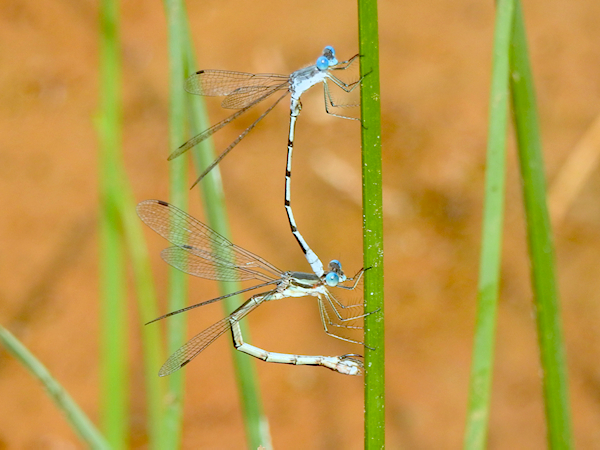
Worse, the water had receded from the grass-like blades of vegetation near the shore on which the pennants and Azure Bluets liked to perch. I saw Widow Skimmers, Twelve-spotted Skimmers and Common Whitetails chasing each other over the water but no flashes of orange or red wings whatsoever. Even the bluets were much reduced in number – I only saw a handful of those, likely Familiar Bluets, as well as a couple of spreadwings. My favourite spreadwing sighting was that of a Sweetflag Spreadwing pair in tandem – the female was laying eggs on a reed, and the female’s ovipositor extended well past the tip of the abdomen. This trait separates it from all other local spreadwing species. You can see the sharp blade of the ovipositor about to pierce the stem below:
Disappointed, I headed to the meadow at the back of the trail to look for darners. I scared up a Common Green Darner and a few meadowhawks, mostly Autumn Meadowhawks – but then I saw one with a thicker body and a deep red face. I wanted to catch it to see if it was a Cherry-faced Meadowhawk, but it was skittish and kept flying away from me. The second time it flew off I lost it against the greenery.
From there I returned to the paved path, making my way to the bridge where I found a handful of Blue Dashers flying over the mat of algae that had blown up against the eastern shore – this was the only place I found them, and there were only about five or six. This was similar to numbers of Common Whitetails (5), Widow Skimmers (4) and Twelve-spotted Skimmers (6) that I observed around the pond, all of which are common species at Bruce Pit.
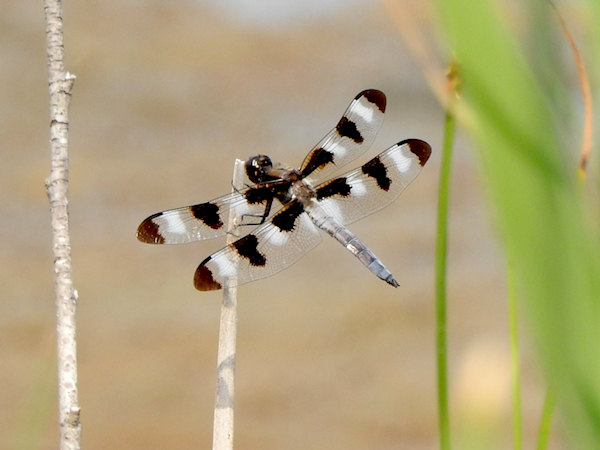
It was amazing how one pond (Andrew Haydon) was so abundant in pennants and while the second pond had none. While the Bruce Pit population had arrived fairly recently – with one individual found in 2023 and more observed the following year – perhaps it failed to thrive due to less-than-ideal water or environmental conditions, such as pollutants, receding water levels, or predators. The pond is full of fish, as evidenced by the number of herons, kingfishers, cormorants and mergansers that it supports during both migration and during the breeding season.
Blue Dashers, on the other hand, are known for colonizing ponds with poor water quality, including those with a moderate level of pollution such as storm water containment ponds, so I was surprised not to see more of these even if both pennants were entirely absent. Perhaps the lower water levels and resultant lack of emergent vegetation played a part in their low numbers – they love perching on stems and twigs and even lily pads just above the water, and the only place I saw them was at the large mat of algae along the shore.
As with most things, only time will tell whether these species will thrive or continue to diminish in numbers.


