
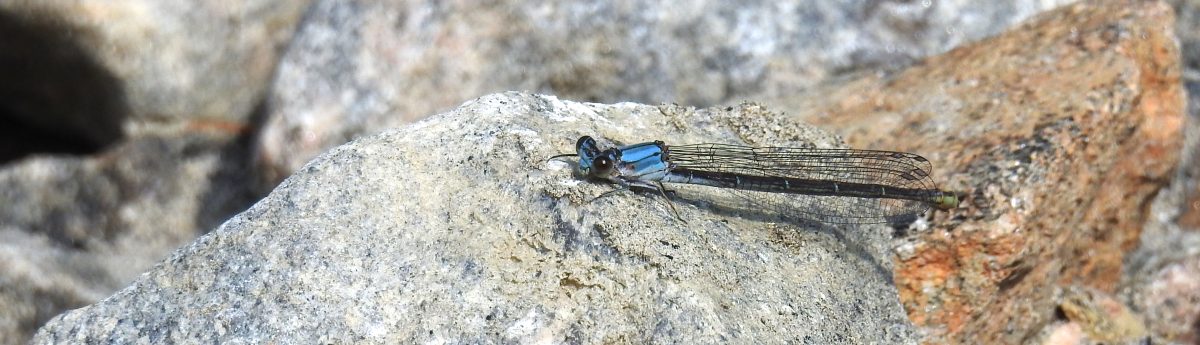
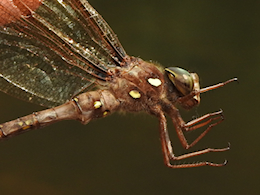
Chris Traynor and I planned a wonderful outing in the Kazabazua area for the August long weekend. He’d been reviewing some of Chris Lewis’s notes about expeditions to the Kazabazua area about an hour north of downtown Ottawa, in particular to a small fen near Danford Lake where she and Bob Bracken had found Zigzag Darners, a Forcipate Emerald and and an Incurvate Emerald. The dates of their expeditions and findings are as follows: August 3, 1998 (several Zigzag Darners and one Forcipate Emerald); August 15, 1999 (several Zigzag Darners and one Incurvate Emerald); August 21, 2000 (6 Zigzag Darners); and August 10, 2002 (5 Zigzag Darners). He’d also dug out some notes from Benoit Menard who had found Subarctic Bluet (the damselfly) and Subarctic Darner (the dragonfly) in the fen. The Incurvate Emerald would be new for Chris; and the Subarctic Bluet, Zigzag Darner, Subarctic Darner, and Forcipate Emerald would be new for both of us, so we were keen on going even if it was a bit early in the season for the dragonflies. This area has the added attraction of being close to the Kazabazua River where we had seen Zebra Clubtails in 2023. I jokingly told Chris I was looking forward to writing a blog post called “Of Zigzags and Zebras” as these species at least seemed almost a sure thing, but the reality was very different.
We parked on the side of a dirt road on Chemin MacLeod just off of Highway 301 around 10:00 am. It was warm, but not hot, and although the sun was shining in a clear sky a thin haze of smoke from wildfires further north diluted the light. It was a bit humid but not intolerable, and a breeze sprang up which was not unpleasant. It was a great weather for ode-hunting, and I couldn’t wait to see our first dragonfly.
We put on our waterproof boots, then descended a slope through a screen of trees and found ourselves in the fen. Tall grasses extended across the open area to the forest at the back, with low-growing shrubs clumping together in the middle. The ground was dry, but we came across what looked like a narrow, damp streambed consisting of black, oozing mud. We followed this black channel through waist-high vegetation where it eventually became a narrow waterway which branched out into several different channels of black muck. The going was not easy as we ascended several clumps of moss-covered mounds and worked our way over or around fallen trees. We were disappointed not to see any darners flying over the fen; a few White-faced Meadowhawks were all we found.
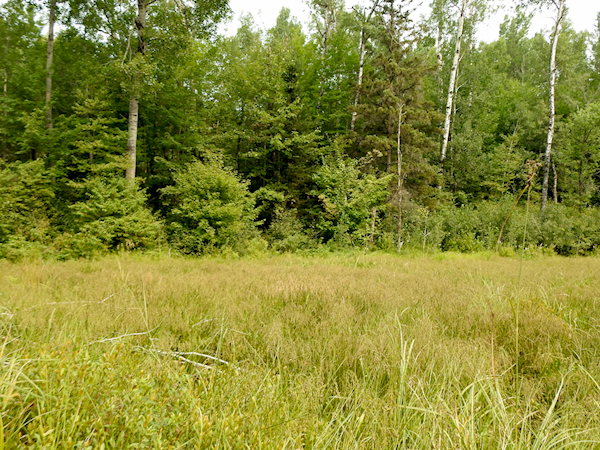
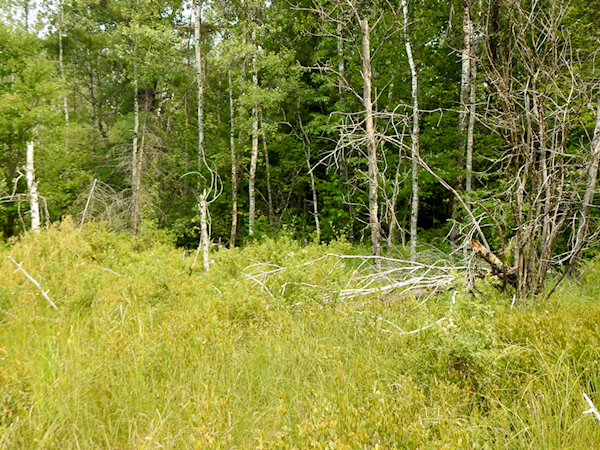
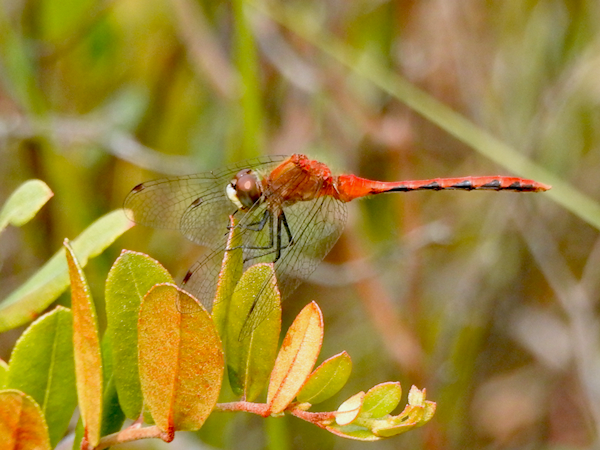
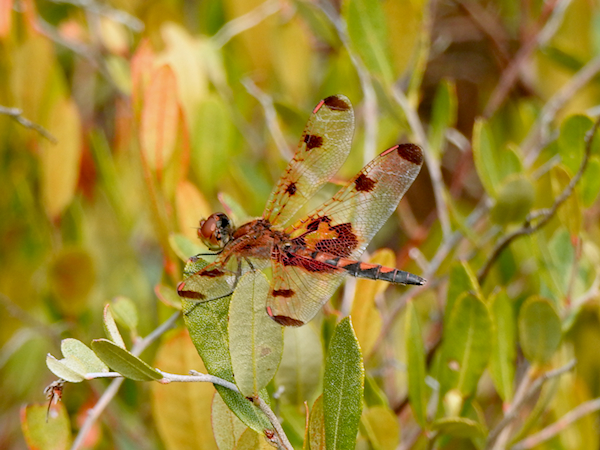
Chris said on his previous visit – in which the fen was wetter, hence his suggestion of bringing boots – he’d had more darners flying over the east end of the fen. This area was accessed through a forest track heading east from Ch. MacLeod, then heading through a thin section of forest. We walked through the woods which were nearly empty of birdsong and devoid of odes. The screen of trees here was easier to navigate, as was the slope down to the fen. We ended up walking all the way across the fen back to the car, and the going was much tougher than I had imagined. We slogged up and down large mounds of moss, over fallen trees buried within the waist-high grass, and through small shrubs with interlacing woody branches that brought my heart rate up almost immediately. I needed to rest several times; there were so few odes in the fen that I could find almost nothing to stop and photograph. There were more White-faced Meadowhawks, a Twelve-spotted Skimmer that flew away after being flushed, a couple of Calico Pennants, and four or five darners near the tree-line which did not come anywhere near our nets. One appeared to have straight thoracic stripes – perhaps a Black-tipped Darner.
In fact, there weren’t many insects at all. There were no damselflies and few bees. I saw a couple of worn skippers and several fresh Common Wood Nymphs near the tree-line and that was it for butterflies. The only flowers that seemed to be blooming were pink Spirea blossoms.
Chris and I figured it must be too early for much to be flying – darners tend to fly later in the day – and decided to head to the Zebra Clubtail spot on the Kazabazua River past the road to the Eco-Center (which is garbage or recycling facility, NOT an eco resort!). There we saw numerous Ebony Jewelwings along the bank and perching on various sticks and vegetation in the water. We did not see any Zebra Clubtails there; however, one mosaic darner kept flying up and down the river well above head-height and at least two Fawn Darners kept patrolling the shoreline, investigating every downed tree and nook and cranny just above the water’s surface. I tried several times to catch one, to no avail.
We did see a couple of small clubtails flying low over the surface of the water further down the river, but they remained too far to see any detail even with binoculars, and too far down the river to get close.
Frustrated, we ended up leaving. It was after 12:00 so things should have been flying; we did see a few darners along the grassy trail leaving back to the Eco-center, but all flew off when we stopped to see if we could catch any. Chris then tried a few side trails to see if we could get closer to the river. The first track he took ended too far from the water with no walkable trail so we turned around; the second one took us almost right to the river…the first thing we heard was the rush of water churning through a series of rapids! The trail ended at a small cliff looking down at the top of the rapids, and I scanned the rocks below but could not find any clubtails perching on the rocks. A darner was still patrolling over the water, sometimes below us, sometimes above.
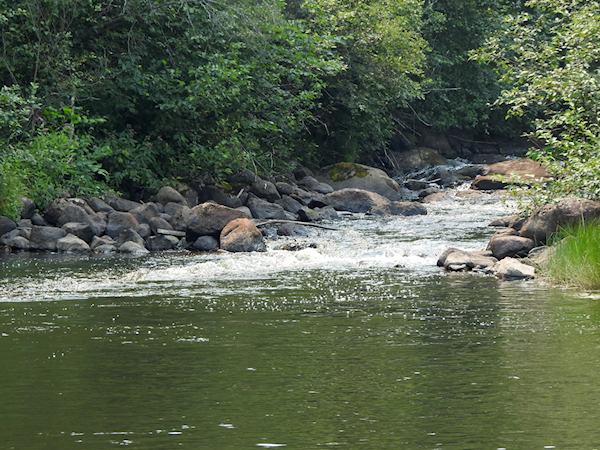
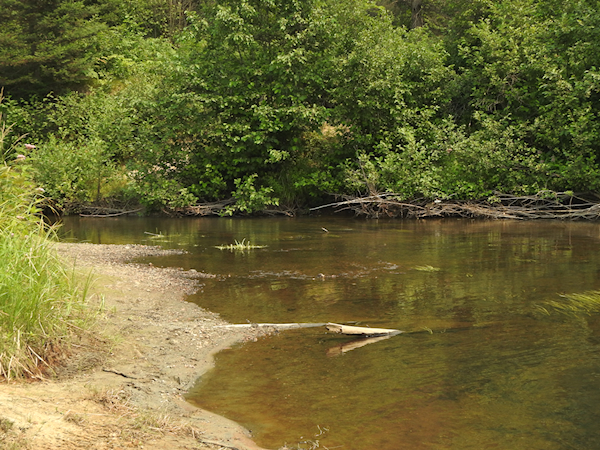
We returned to the car where we noticed another trail branching off to the left. It followed the shore below the rapids, though a thick screen of trees blocked the view. The trail led to a narrow sandy beach that curved with the bend of the river, and here we found plenty of Ebony Jewelwings, a Dragonhunter (which Chris scared off the ground; it spent the rest of the time hunting from various perches on the other side of the river), a single Powdered Dancer, and a few Fawn Darners patrolling the shoreline. We saw a few small clubtails zooming over the water, and set up a few sticks and rock piles in the water to entice them to land….they refused. Nor did we see any Zebra Clubtails flying over the river, though the mysterious mosaic darner flew up and down the river a few times, and a Swift River Cruiser hurried by.
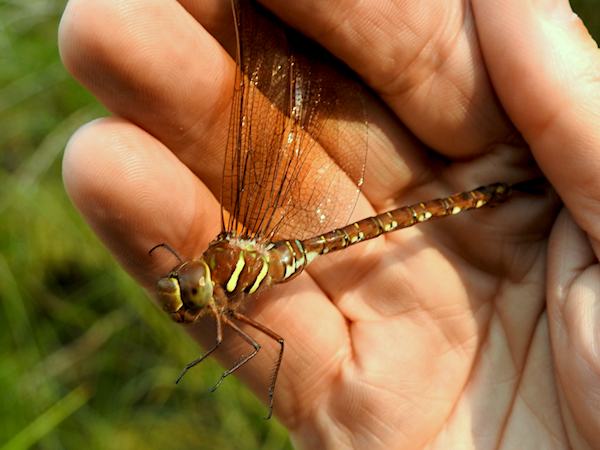
I was just happy to see the Fawn Darners, and spent a good 20 minutes trying to catch one. It took several attempts, but I finally managed it! It’s been a long time since I’ve held one in my hands or photographed one – since 2019, according to iNaturalist.
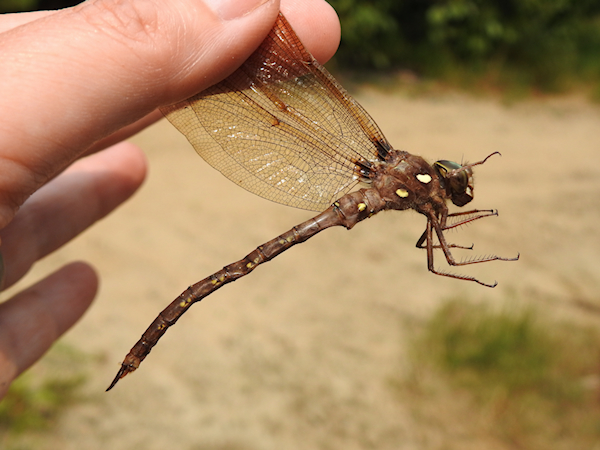
Once I was done photographing the Fawn Darner in my hand I placed it on a branch where it stayed for a few minutes. Although posed, this the only “natural” photograph I have one perching.
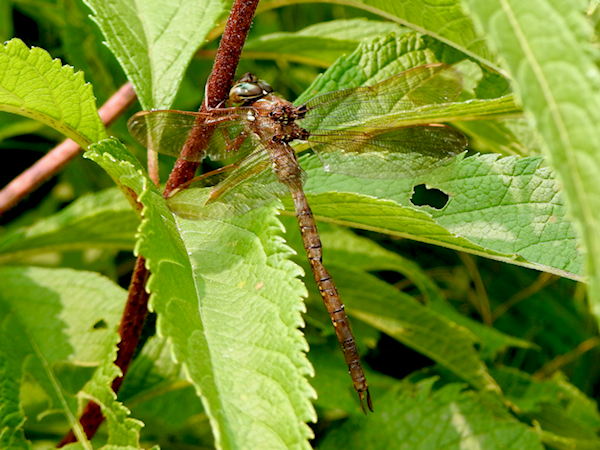
We ate a late lunch on the bend of the river – which will henceforth be known as “Dragonbend” – and although we saw nothing new, the small clubtails flying over the river kept drawing our attention. Through my binoculars I could see a large club at the tip of the abdomen, which was quite thin where it attached to the thorax; it appeared mostly dark when viewed from the side, with the exception of two yellow spots on the thick club. When viewed from the top, I could see a hint of yellow markings down the abdomen, as well as a bright yellow area on the back of the thorax – the part where the wings attach. What intrigued me most was that they never landed – most clubtails are perchers, and either rest horizontally on the ground or a stick conveniently set up in the water, or hang from leaves and branches (genus Stylurus). These clubtails were doing neither. And neither Chris nor I had any mental template to work with in order to identify them. He took a few distant photos when they came within camera range, and then we packed up our gear to head to the next spot of the day: the Véloroute des Draveurs, a paved cycling path that led to a bridge where we could access the Kazabazua River.
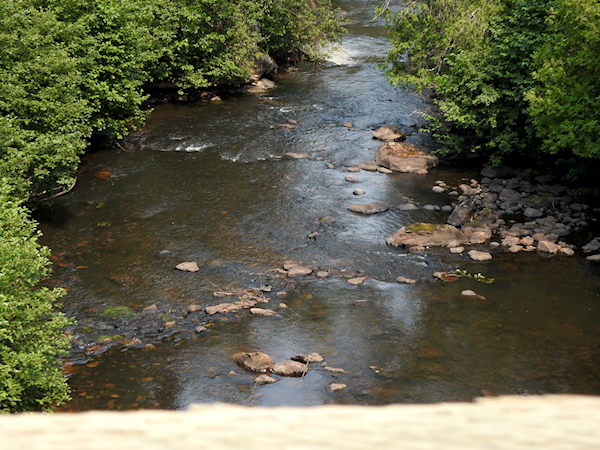
This cycling path forms part of the Trans-Canada Trail, covering a distance of more than 72 km between the municipalities of Blue Sea and Messines. It was a quick walk from the parking lot to the bridge – not even half a kilometer – and while we were amazed by the view from the bridge, the river was quite far below with no easy way to get to the water. We could see a few Ebony Jewelwings fluttering their black wings over the water and a large dragonfly zooming down the river, and that was it. I scanned the rocks for visible clubtails and saw none.
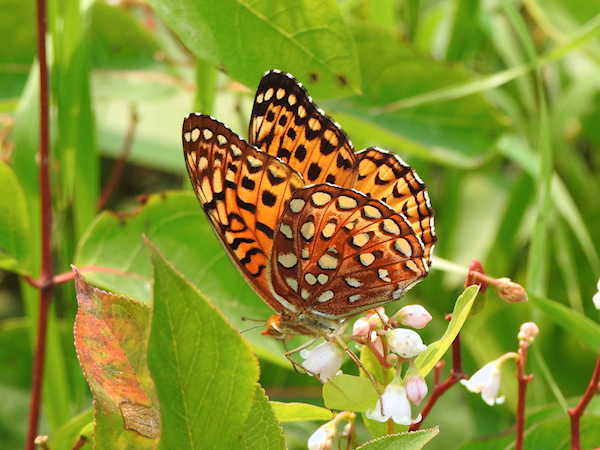
The stop wasn’t a complete waste of time – I found a couple of fritillaries feeding on the flowers, and recognized two species: an Aphrodite Fritillary nectaring on dogbane flowers and a Great-spangled Fritillary nectaring on Common Milkweed.
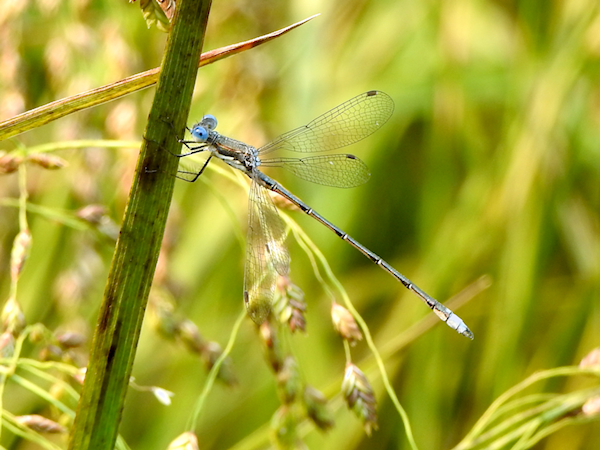
It was getting late in the afternoon and we had to decide which spot we wanted to return to: the river or the fen. Given that the fen was the chief attraction of our trip, and given that many darners emerge to feed in swarms late in the afternoon, it was an easy choice to make. We returned to the spot closest to the road, and scurried down the slope once again. At first we couldn’t see any odes flying over the fen – then, a pair of large wings shimmering in the distance drew our attention. We plunged into the waist-high vegetation once more, spotting more meadowhawks and several spreadwings in the dense sedges. I caught a male and tentatively identified it as a Sweetflag Spreadwing based on the shape of its claspers. Several spreadwings were flying in tandem through the vegetation, all looking identical, and the female of one pair that I saw had a large ovipositor that extended past the tip of the last segment of the abdomen, which identifies it as a Sweetflag Spreadwing and distinguishes it from the similar-looking Northern Spreadwing.
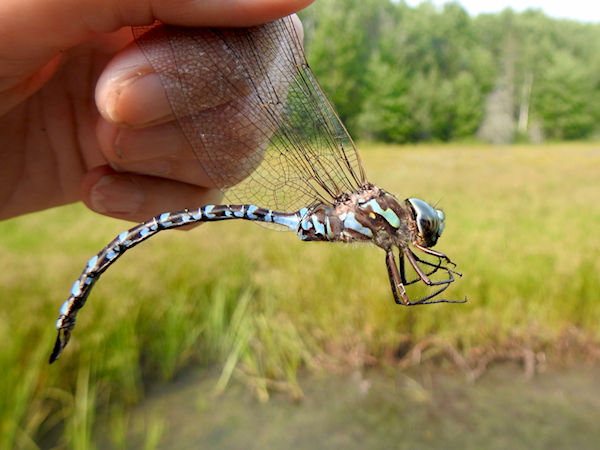
In the meantime, more and more darners were flying over the fen – low enough to catch. Chris caught a Shadow Darner and called me over to see it; I caught a Canada Darner and called him over to see it. Zigzag darners are small darners, and although some dragonflies flew close enough to the small channels of water where I was standing, all of them appeared to be large. We didn’t see anything that looked like a Zigzag darner, so reluctantly we decided to leave.
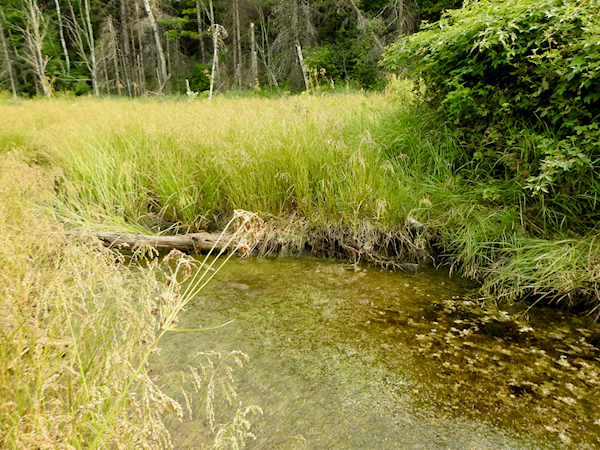
That’s when it happened. I’d ended up on the wrong side of the main stream, having to cross many channels of thick, black mud to get back to the road. I found one with a medium-sized trunk forming a natural bridge, started to cross – and then my boot slid off, right down into the muck. It plunged into the soft bottom of the fen and then kept going. My other foot landed in the mud as well, but fortunately was closer to the “shore” where it only sank a few inches. My first foot in my waterproof boot, however, had vanished. The top of the boot was only an inch or two below the surface of the mud, but my foot had ended up below the tree trunk making extraction difficult. I had to call Chris to come over to help me, and we struggled for a few minutes without any success. I was beginning to fear that I’d have to leave my boot behind when it occurred to me that instead of trying to raise my foot straight up, I should sit back on the bank and slide out backwards at an angle. Fortunately, this worked, and my foot, my boot, and a good portion of fen substrate oozed out of the channel. I joked to Chris that falling into a fen had long been an item on my bucket list, though preferably after I had seen one or two new dragonfly species!
We returned briefly to the first spot on the Kazabazua River to rinse ourselves of the bog mud then headed home. Although I was really happy to catch the Fawn Darner, the rest of the outing felt like a bit of a letdown in terms of hitting our targets. The mysterious clubtails were the most exciting odonate we had seen, even if we didn’t get good looks. When I got home I pulled out my trusty Algonquin guide and started looking through the clubtail section to see if anything matched the description and the behaviour. A couple of species looked like they might match, but one species’ behaviour stood out: “Medium to large rivers, with a sand, gravel or muddy bottom. Apparently, this species usually forages in the canopy and is therefore usually seen only when males make patrols over rivers. Not recorded from Algonquin Park or the surrounding area but known from nearby southwestern Quebec.“
That species: Riverine Clubtail (Stylurus amnicola).
This species wasn’t even on my radar; according to the official Ottawa checklist, is it considered “very rare” and has only been found on the Quebec side of the 50K circle. Its known flight season runs from late June to mid-July, where it inhabits small to medium-sized rivers with a moderate current and a beach zone consisting of sand, gravel or cobble along the shore. Well, the conditions at Dragonbend certainly match those preferred by the Riverine Clubtail, as did the behaviour. I messaged Chris with my suggested identification, and I wasn’t surprised when he came up with the same ID independently based on the few half-decent photos he was able to get. So although we didn’t get either the Zigzags or Zebras I was hoping for, it turned out we had found something much better – a genuinely rare, little-known dragonfly that was a lifer for both of us!
Now all we needed was some better photos as definitive proof, and we’re already making plans to return next weekend to get some!


