It was just a quick trip to Cambridge, Ontario, but the weather was so gorgeous I couldn’t resist dragging my dad out for a few nature walks. Although in his mid-70s now, he is still mobile enough to get out, and while I’m looking up for birds and dragonflies, he is usually looking down for snakes and turtles or turning over logs for salamanders.
Because it was late in the season I had checked iNaturalist ahead of time to see what odes had been recorded at the beginning of October. I was blown away when I realized that American Rubyspots were still flying, and that they lived along the Grand River! Their range does not extend to eastern Ontario – they are a southern Ontario bug, though funnily enough there is a population in Montreal.
The drought this summer has been awful – we’ve had less precipitation than normal every month from May through September, and not only are ponds and creeks drying up, but people’s wells are running dry. Ottawa received 48 mm of rain in July, (typical average: 88 mm), 48.2 mm of rain in August (typical average: 79 mm), and 32 mm so far in September (typical average: 90 mm) with still no rain in the forecast. A visit to Richmond Lagoons revealed only a puddle of water in the middle cell – the one which normally has the most water – and the Jock River behind the former sewage lagoons had been reduced to a trickle of water. Meanwhile, Bruce Pit has a large sandy shore which has made it impossible to find odonates that like to perch on emergent plants and stems. I went to Roger’s Pond on September 14th expecting more of the same, but was still shocked by how very little water was present.
On Sunday, August 10 Chris and I returned to Kazabazua, determined to obtain better photos to confirm that the clubtails we’d seen patrolling above the Kazabazua River were indeed Riverine Clubtails. We started a little later in the day, and headed to the dead-end road past the Eco-Centre around noon. When we got there the only dragonflies flying over the river were Fawn Darners. One hung up on a shady branch in front of me, so I caught it – a great start to the day.
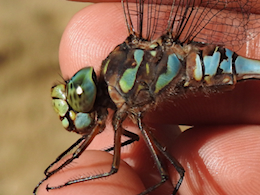
Darner (genus Aeshna) season typically begins in July in the Ottawa-Gatineau region. The two most common mosaic darners, Lance-tipped and Canada, emerge early in the month, along with the slightly less common Shadow Darner. These three species are the most widespread members of this group, and if you see a mosaic darner flying along a forest trail or in an open clearing in the greenbelt it is most likely to be one of these. Lake Darner, Variable Darner, and Black-tipped Darner are considered “uncommon” in the Ottawa-Gatineau region, with the first being a localized species and the latter two species considered to be widespread. I suspect they may be easier to find on the Quebec side of the region, as there are more lakes and suitable bodies of water in Gatineau Park, and Black-tipped Darner has been relatively easy to find there. Finally, the Mottled Darner and Green-striped Darner are both considered “very rare”, with only a handful of records of each. I’ve been lucky to see a few Green-striped Darners in Stony Swamp in recent years, with one individual at Bruce Pit in September 2019 and two individuals at the Beaver Trail in September 2021. I’ve never seen a Mottled Darner, and hope to catch up with this species one day.
By mid-August most dragonfly species are on the wane. A few families are still quite abundant, particularly the darners and meadowhawks, while small numbers of other skimmers and a few clubtails often linger into September. Forktails, bluets, and some spreadwings are also still common in the appropriate habitats in August and September. This makes it worth going out to good dragonfly habitats such as large rivers, lakes and marshes to see a decent variety of species.
Large dragonflies this time of year are particularly interesting; while Common Green Darners are the most frequently encountered large dragonflies of late summer, you might come across a Black-shouldered Spinyleg basking on the rocks along the river, a Wandering Glider zipping over a meadow, a Twelve-spotted Skimmer flying above a pond, or a group of mosaic darners swarming through the air late in the afternoon. The mosaic darners are a particular favourite of mine; they are large brownish-black dragonflies with mottled spots of blue, green or yellow depending on the sex. While they spend most of their time flying through the air hunting for small insects, I often come across them perching vertically on thick stalks of vegetation below knee-height in open grassy areas early in the morning. We have several different species in Ottawa, and trying to find something other than the ubiquitous Canada and Lance-tipped Darners is a fun exercise.
By the time September rolls around, most odonate species are done for the year in the Ottawa region – gone are the Aurora Damsels and Elegant Spreawings, the Spiny Baskettails and Ebony Boghaunters, the Arrowhead Spiketails and Horned Clubtails, the Chalk-fronted Corporals and Four-spotted Skimmers. This is the time of year when the number of meadowhawks and darners begin to peak, and southern species such as Spot-winged and Wandering Gliders may blow into our region with the warm south winds. A few bluet and spreadwing species may persist, as well as the common and widespread Eastern Forktail, though each day sees fewer and fewer individuals. This is a summary of species I saw and photographed around Ottawa during September 2019 – due to my trip to Edmonton and some cool, cloudy weekends, I didn’t visit as many places as I had hoped and missed a few common species.
During the third week of August I spent some time at my Dad’s trailer in the Pinehurst Lake Conservation Area near Glen Morris, Ontario. Although more of a campground/recreation area than a conservation area, it is nevertheless a great spot to spend a few days and see some “southern” wildlife. The last time I was here (August 2014) I was treated to the antics of a couple of juvenile Broad-winged Hawks, found a small pond where female Black-tipped Darners laid their eggs in the late afternoon, observed a Blue-winged Warbler on a morning walk, saw my first Red-spotted Purple butterfly, and even saw a bat near one of the washroom lights after dark. I didn’t see any Broad-winged Hawks or cool southern bird species this time, but I still ended up with 28 bird species over three days – the same number I saw in 2014 – and saw several interesting odes, including a lifer!



 OdoNotations