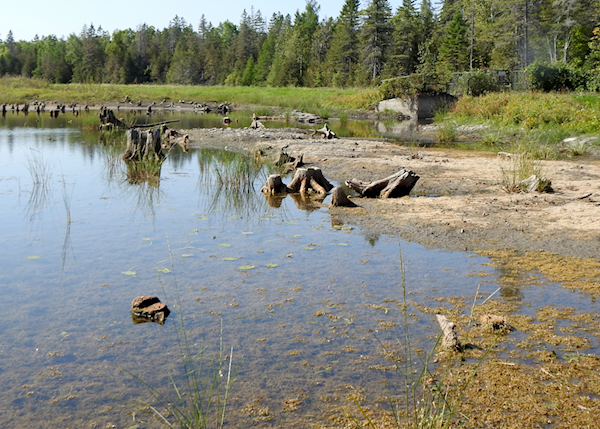
The drought this summer has been awful – we’ve had less precipitation than normal every month from May through September, and not only are ponds and creeks drying up, but people’s wells are running dry. Ottawa received 48 mm of rain in July, (typical average: 88 mm), 48.2 mm of rain in August (typical average: 79 mm), and 32 mm so far in September (typical average: 90 mm) with still no rain in the forecast. A visit to Richmond Lagoons revealed only a puddle of water in the middle cell – the one which normally has the most water – and the Jock River behind the former sewage lagoons had been reduced to a trickle of water. Meanwhile, Bruce Pit has a large sandy shore which has made it impossible to find odonates that like to perch on emergent plants and stems. I went to Roger’s Pond on September 14th expecting more of the same, but was still shocked by how very little water was present.
It wasn’t a small lake any more. Instead, the pond had diminished to a large puddle near the bridge connected to several smaller puddles further out via a series of channels.
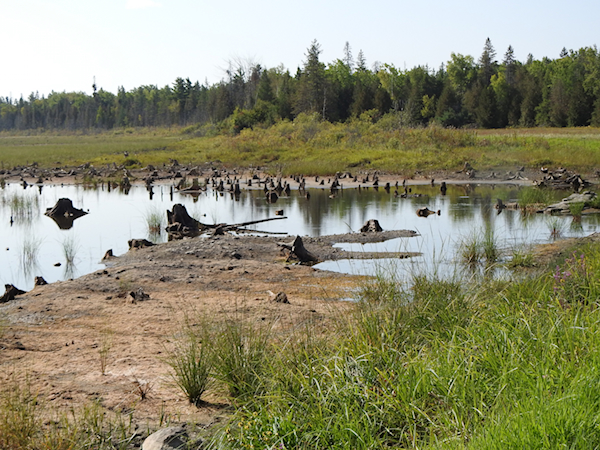
So many sedges had sprung up that the middle of the pond looked just as green as the middle cell of the Richmond Lagoons. The largest pool of water appeared to be the puddle closest to the trail, and the number of tree stumps visible along the bottom of the pond was astonishing – it appeared that forest once grown where the pond now lies.
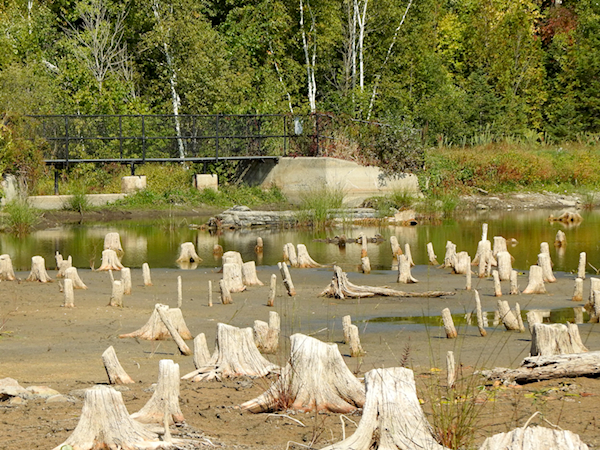
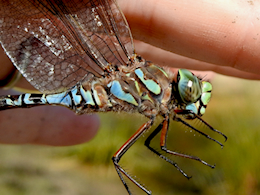
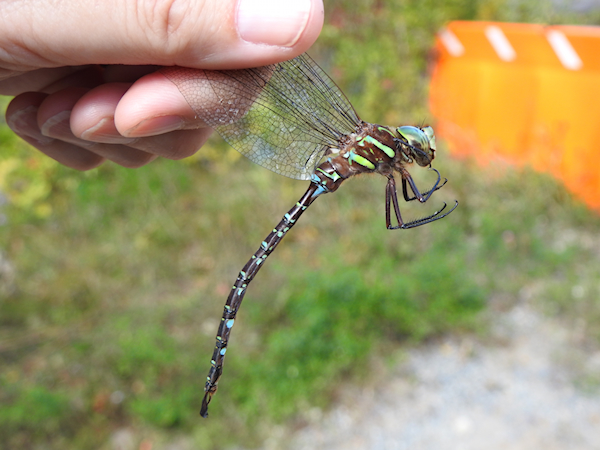
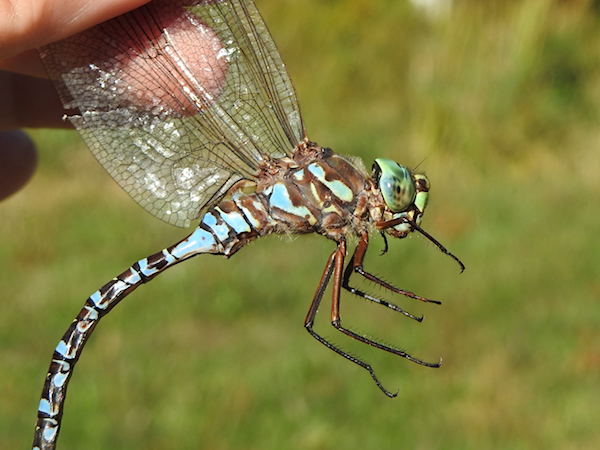
I was heartened to see several darners flying over the water along with dozens of meadowhawks – mostly Autumn Meadowhawks, I presume, though I did spot a White-faced Meadowhawk among them. Many of the meadowhawks were either flying or ovipositing in tandem. I walked along the shore and set myself in position to catch one of the darners flying by. It didn’t take long before I snapped up a Lake Darner in my net.
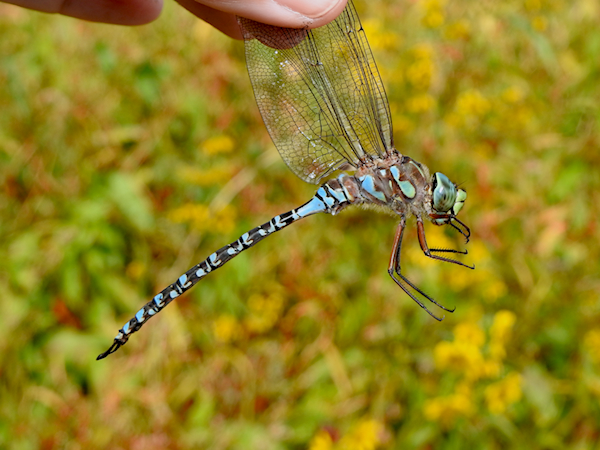
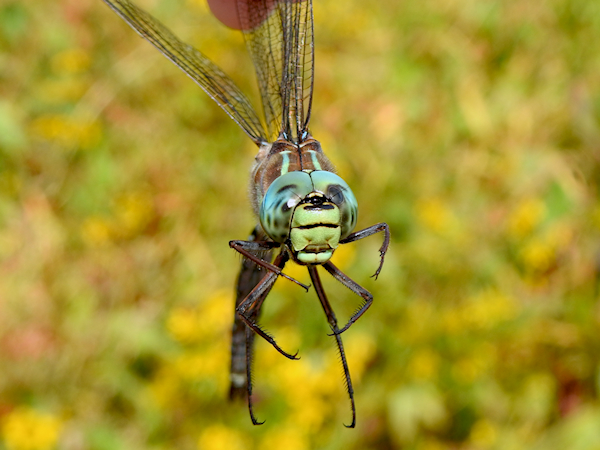
The shape of the first thoracic stripe is diagnostic: the tooth-shaped flag at the top is not attached to the stripe, and the indent nearly pinches the first thoracic stripe in half. Another field mark to look for is the black cross-stripe on its face: both Canada and Lance-tipped Darners lack this feature.
I walked along the edge of the pond for a while, being careful not to step too far out as the mud was thick and sticky. I didn’t want to get my boot stuck or worse, fall in and not be able to get up! It was fun watching the darners fly by, and see the butterflies feeding on the flowers of the bank: along with the usual Clouded Sulphurs and Bronze Coppers among the blossoms I spotted a Viceroy mud-puddling near the shore.
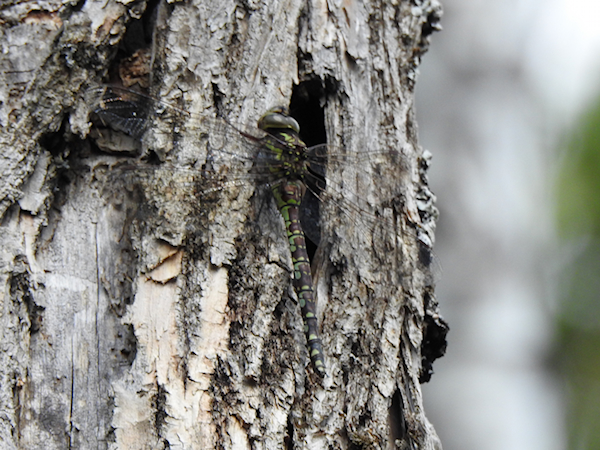
I wasn’t able to turn up anything else of interest, so I headed back to my car to try somewhere else. On my through the cedar forest I noticed a darner flying over a small area which normally holds water earlier in the season. It landed on the trunk of a tree, so I walked in and took a photo. I wasn’t sure I’d be able to identify it, but the first thoracic stripe clearly identified it as a Green-striped Darner – my first in Marlborough Forest!
From there I drove to Flood Road, where I caught the Fawn Darner mentioned in my previous post, and then on to Heaphy Road to look for other darners. The water there was low, but not as low as at Roger’s Pond – perhaps because Brassils Creek flows through first pond. The usual White-faced and Autumn Meadowhawks were present, and although I saw a few darners on my walk, I only caught one patrolling the area next to the bridge – a Shadow Darner. This was the first one I had seen in Marlborough Forest, so it made the stop worthwhile.
I returned to Roger’s Pond twice more in September to check on the water levels. On September 21st I noticed that the waterfall below the bridge had entirely dried up, as had the watery ditch on the other side of the bridge and the creek flowing out from the dam. I walked along the ditch and was startled when I almost stepped on an Eastern Newt. It was in its juvenile terrestrial form known as a “Red Eft;” adults are aquatic and live in the water. I have seen both forms at the Cedar Grove Nature Trail before.
Meadowhawks and darners were still flying, and frogs were still active trying to catch prey – I found a Mink Frog and a Green Frog sitting in the shallow water of the pond.
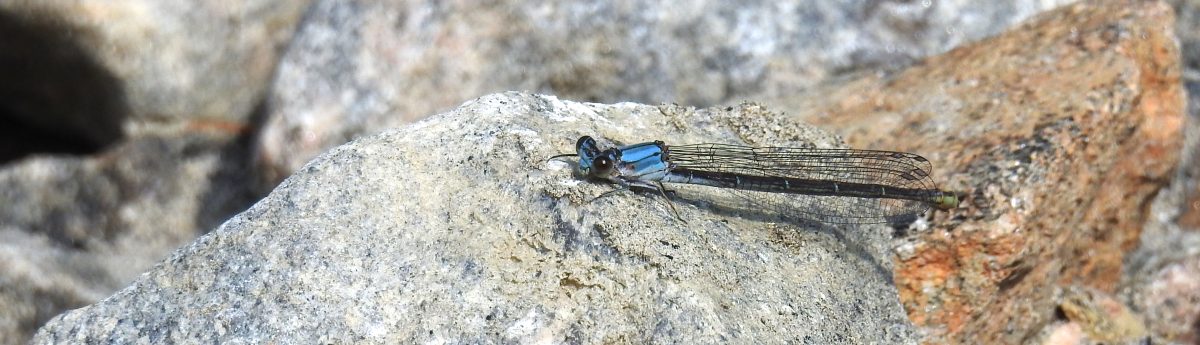
The activity was much the same on my last visit on September 28th. I visited with Chris Traynor, and was delighted to find the usual darners and meadowhawks, as well as an Eastern Forktail and a couple of bluets in tandem. The weather was still warm, in the low 20s, so activity was high.
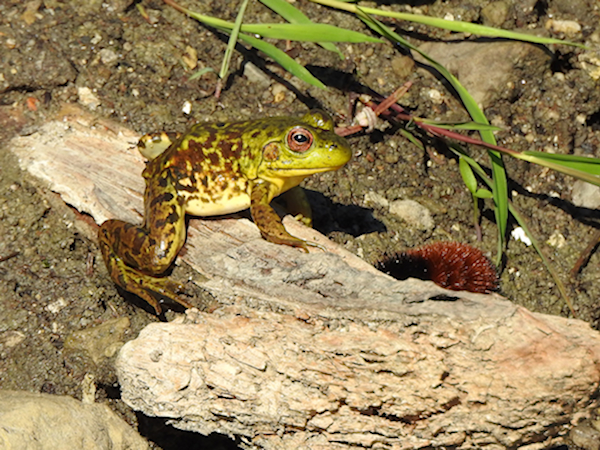
My best sighting that day was that of a Mink Frog trying to catch a Woolly Bear caterpillar. I noticed movement on the shore, and when I looked I noticed a Mink Frog that had leapt out of the water landing quite close to the caterpillar. It’s not common to see Mink Frogs out of the water, so I took quite a few photos.
Then the frog attacked – I didn’t quite see what happened, but apparently the caterpillar was not to its liking for the frog ended up on the driftwood where the caterpillar had just been, while the caterpillar casually crawled away on the ground. Presumably the caterpillar’s bristles provided a distasteful deterrent!
Even with the terrible drought conditions, there is still a lot to see if you go out and look for it! I was happy to get some new darners for my Marlborough Forest list and see the Lake Darners – an uncommon species in my part of Ottawa – that call Roger’s Pond home. The butterflies and amphibians were also enjoyable to watch. Hopefully the region will receive enough snow this winter to allow water levels to recover – I’m not sure how the low levels will affect all the insects and amphibians that need deeper water to hibernate or overwinter, but I’m sure we will find out next year!