
It was just a quick trip to Cambridge, Ontario, but the weather was so gorgeous I couldn’t resist dragging my dad out for a few nature walks. Although in his mid-70s now, he is still mobile enough to get out, and while I’m looking up for birds and dragonflies, he is usually looking down for snakes and turtles or turning over logs for salamanders.
Because it was late in the season I had checked iNaturalist ahead of time to see what odes had been recorded at the beginning of October. I was blown away when I realized that American Rubyspots were still flying, and that they lived along the Grand River! Their range does not extend to eastern Ontario – they are a southern Ontario bug, though funnily enough there is a population in Montreal.
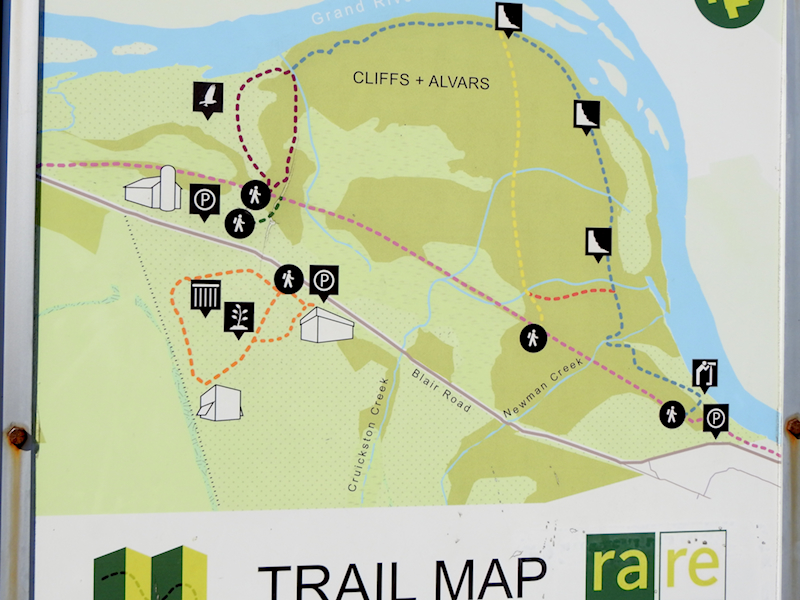
Most of my visits to southern Ontario have usually coincided with spring migration or Thanksgiving; better for birding than odeing, so I had never really looked into odeing opportunities until now. I found a sighting from the rare Nature Reserve (that’s its name – it does not capitalize the “r” in “rare”) from only a few days earlier, by a person whose name I recognized – she has identified quite a few of my butterfly observations. I sent a message off to her, and before I received a response we headed out to our first trail of the day: Shade’s Mills Conservation Area.
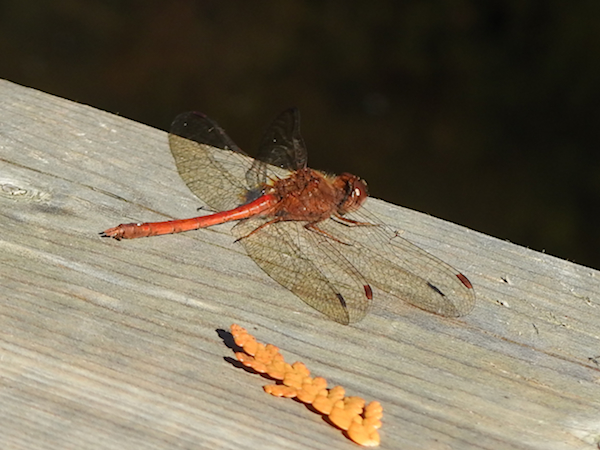
I had never been there before, but it looked intriguing, with a lake for swimming and boating, a small creek emptying into the lake, and trails running through the forest. It was still a little cool when we arrived, but it didn’t take long to find a few Autumn Meadowhawks near the boat launch.
A small trail led from the boat launch to the beach, passing through a wooded area that was alive with kinglets. I saw what was likely a Spotted Spreadwing in the vegetation but it flew off before I could get my camera on it.
From there we followed the trail along the creek. The stream was narrower than I thought it would be, with enough downed trees and tangles along the edges to keep an inquisitive Fawn Darner busy for hours.
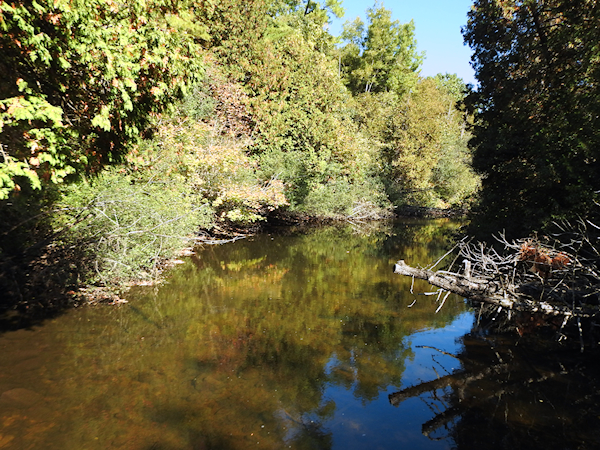
I didn’t see any, nor did I see much in the woods. There were more kinglets bouncing in the conifers, and we found a couple of Winter Wrens near the bridge where we decided to turn back. Although the stream looked promising for odes, we only saw one Autumn Meadowhawk one the bridge.
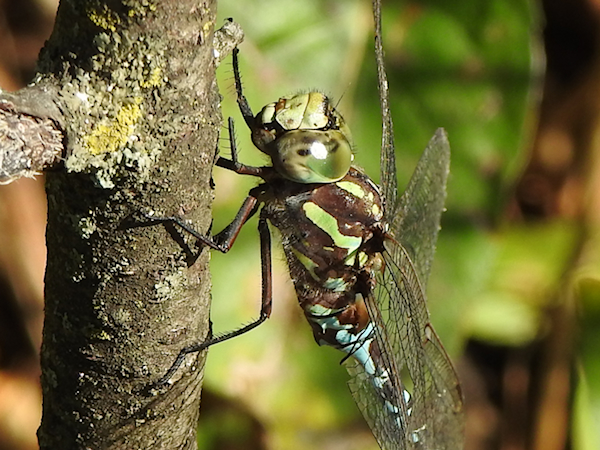
When we returned to the car, however, I decided to take a look at the water one last time. I scared up a darner perching in the vegetation lining the trail. It zipped around the corner and flew a short distance down the path toward the beach, then landed in the weeds at about knee-height. I cautiously crept up to it but it stayed put while I took photos from two different angles. It was a Green-striped Darner, a species I first saw in southern Ontario in the Cambridge area!
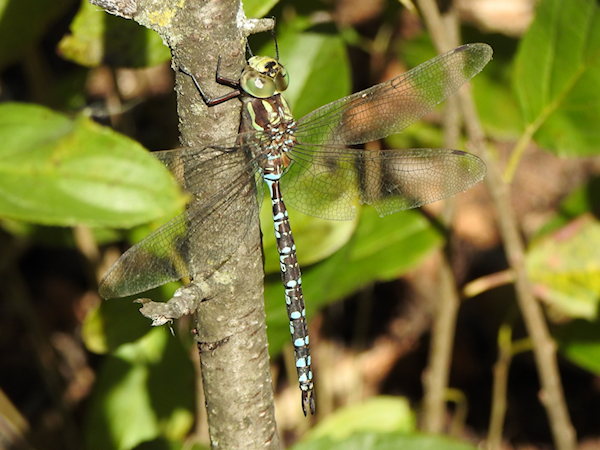
This is a handsome dragonfly. The combination of green and blue spots is quite pretty. I used to have trouble identifying it, but the thick flag on the first thoracic stripe is a good field mark.
After that we got some lunch and returned home for a break. I received a message from my friend and was thrilled when she told me the rubyspots would likely still be around and gave me precise directions to their location on the river. My dad and I headed out; it had warmed up considerably and was a gorgeous early fall day. We started our walk through a field of tall grasses and other shrubs; I saw a Common Green Darner flying over the field but no other darners or gliders.
I was hoping to find a snake or two lazing in the sun – my dad prefers reptiles and amphibians to birds or bugs – but had to settle for a few butterflies instead. I was intrigued by some sulfurs that were strikingly orange in flight. The only ones I managed to photograph were some Clouded Sulfurs.
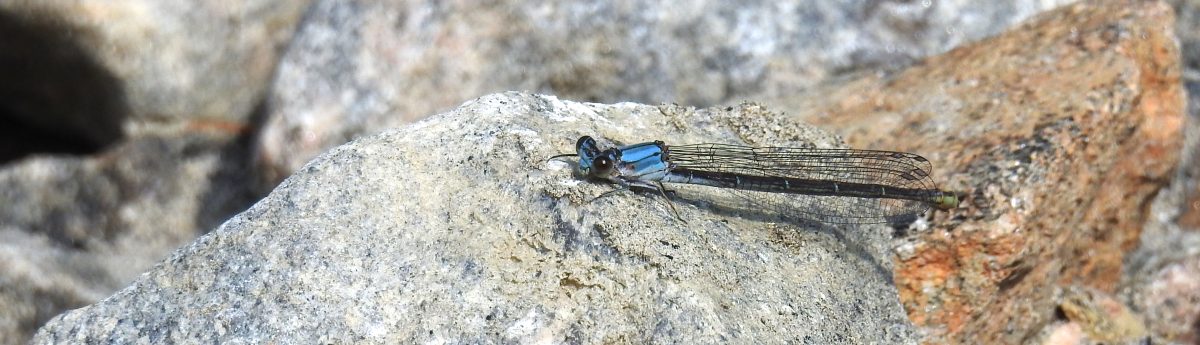
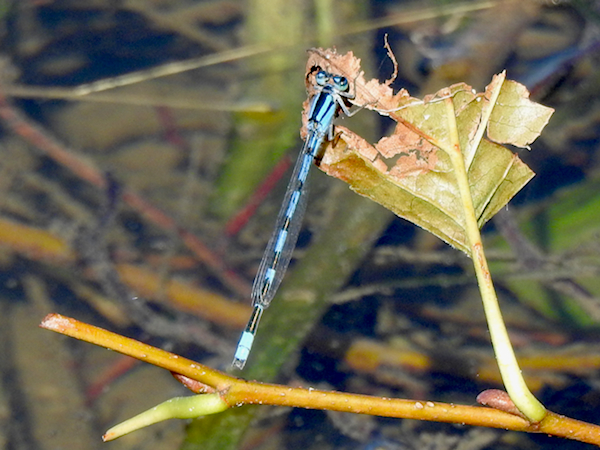
We made our way to the first lookout where my dad found himself enamoured with a beautifully pristine Great Egret. There were a few damselflies flying in the shallows of the river, all bluets that I suspected were Familiar Bluets. Only one photo showed the distinct cerci of the males, but at this time of year very few other species are likely to be flying.
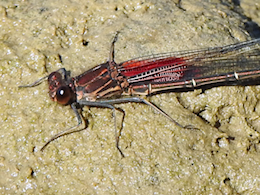
We made our way to the next lookout on the river, and when I looked down I immediately noticed the ruby-red colours of a damselfly resting on a rock. I was thrilled at how easy it was to find, and spent a few minutes trying to get some close-ups of this beautiful bug.
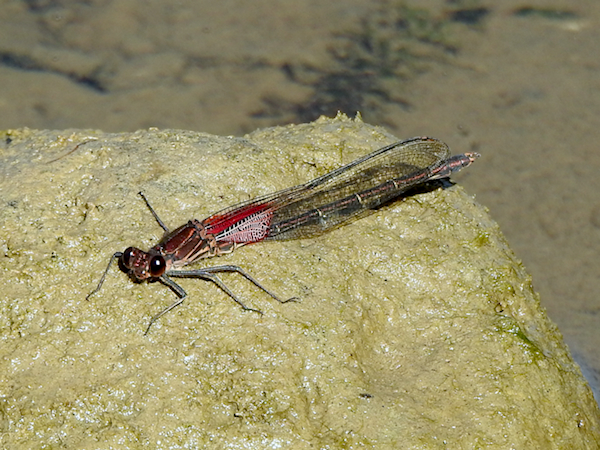
The American Rubyspot (Hetaerina americana) is a brightly colored damselfly belonging to the same family as the jewelwings, though its wings are not nearly as broad as the two jewelwings of our region. Sporting brilliant metallic colours, males are cherry red, while females are chiefly green. The name “rubyspot” comes from the large red patch at the base of the wings in both sexes.
Like the jewelwings, the American Rubyspot inhabits streams, creeks, and large rivers which have aquatic vegetation and a moderate current. The riffles along a creek are a good spot to look them, as they like to perch in the vegetation along the shore or rocks protruding from the water – just as this one was doing. This was only the second time I’ve seen this species, and I regretted not making more of an effort to look for them on previous trips to southern Ontario.
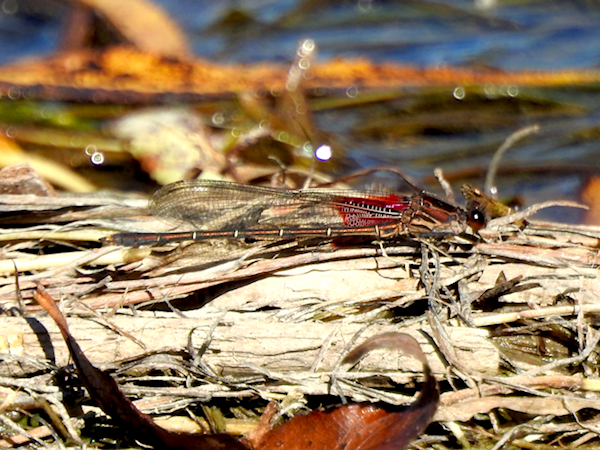
Although there wasn’t much of shoreline, I walked on the rocks to the next little lookout where I spotted another male American Rubyspot resting on a mound of twigs and dried leaves. Even with the cherry-red thorax and wing patch, it blended in well with its perch. It was fantastic to discover this spot along the Grand River where they are reliable past the end of the summer – and relatively close to my dad’s house, too!
The next day we visited a few other places looking for reptiles and odonates. We didn’t find much to look at the Sudden Tract Forest trails south of Cambridge – a Red-backed Salamander and the Red-spotted Purple variant of White Admiral were our best finds – but nearby Bannister Lake was rather pleasant. There were plenty of Autumn Meadowhawks along the trail, and in the woods a couple of Yellow-rumped Warblers were foraging low to the ground. At the top of the observation tower, we saw a Pied-billed Grebe and were delighted when an Osprey circled over the lake and landed in a tree fairly close to us.
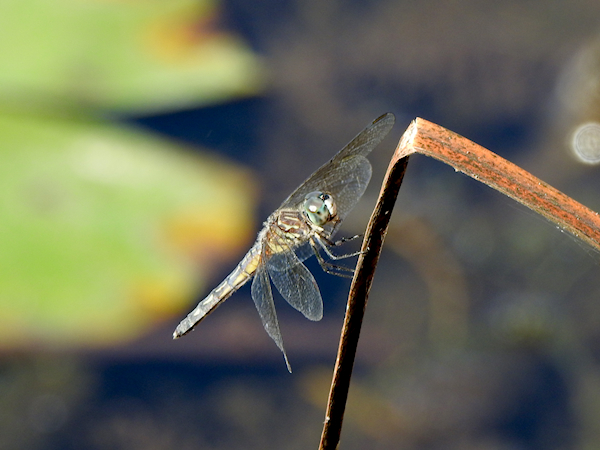
There was a small sandy patch below the tower where I could get close to the water’s edge, and I spent some time scanning for dragonflies. To my amazement a Blue Dasher flew in and landed in front of me! These guys are normally not seen after the first week of September in Ottawa, though I did get lucky this year and found one at Andrew Haydon Park on September 15, 2025 – my latest one to date. Apparently it’s not uncommon for them to still be flying in early October in southern Ontario, although it’s not typical.
It was just a quick trip to Cambridge, Ontario – but I’m really glad I discovered the American Rubyspots there, as they were the highlight of my visit!


