
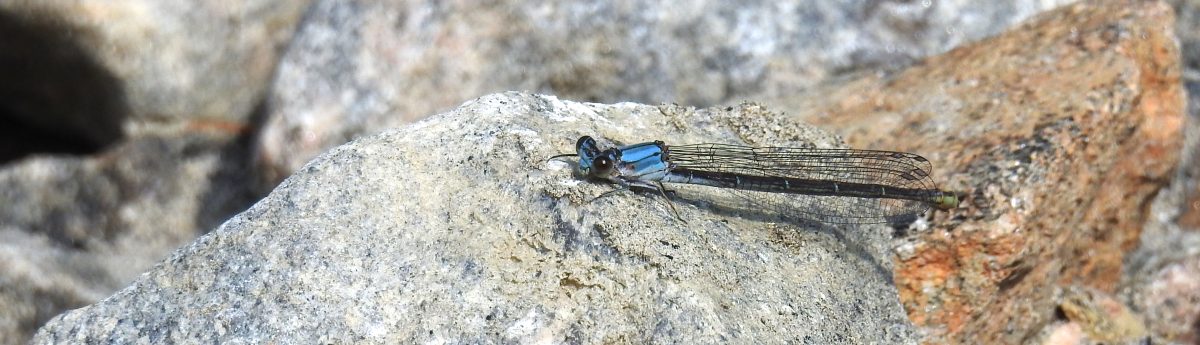
I wasn’t planning on looking for dragonflies when I got up early on the morning of August 27th and went for a short drive to Bridge Street just around the corner. I was curious about what type of bridge I might find – and what kind of stream or creek flowed below – as Google Maps showed an open marsh to the north of the bridge and a wooded creek to the south; I was hoping that I could access the water in case it turned out to be a good spot for odonates.
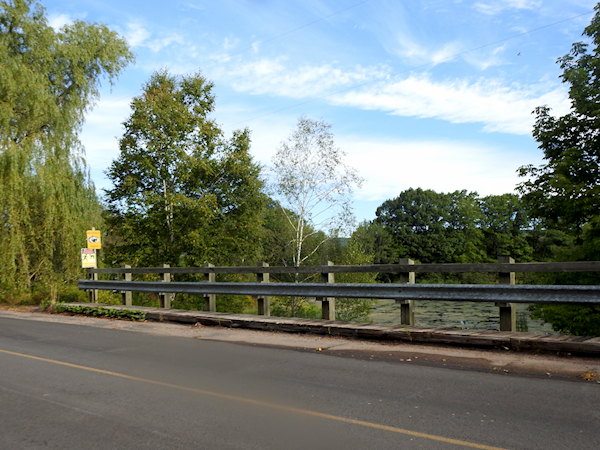
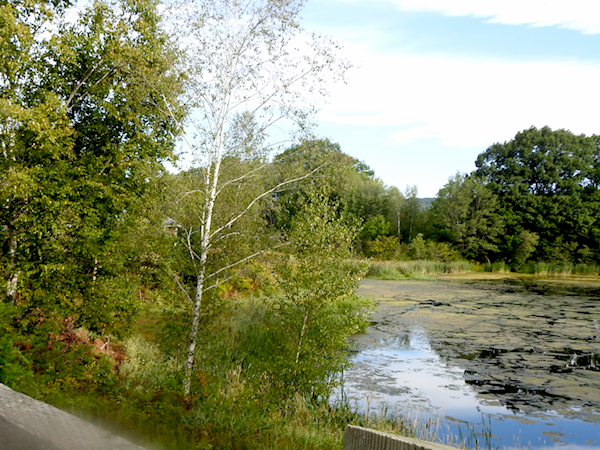
Unfortunately, there was no way to get to the water. The land on surrounding the marsh was entirely private, and the water emptied into a gulley on the other side of the bridge with banks too steep to climb down.
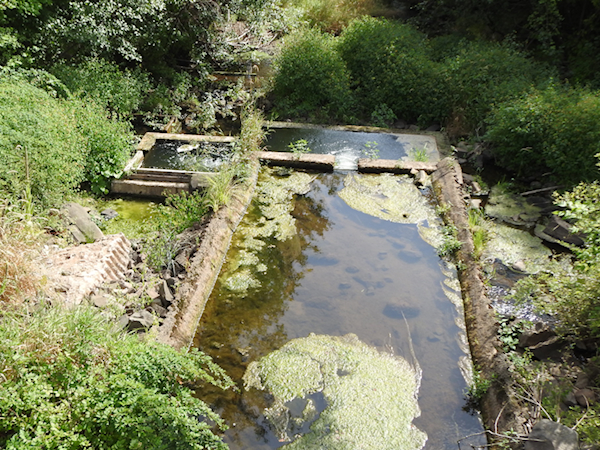
Interestingly, the stream below the bridge appeared to be contained within series of rectangular concrete “locks” – perhaps these locks are completely submerged when water levels are normal and the stream is in full spate. I will have to check again next year to see if this theory is true, but in the meantime it looked like an interesting place to go exploring!
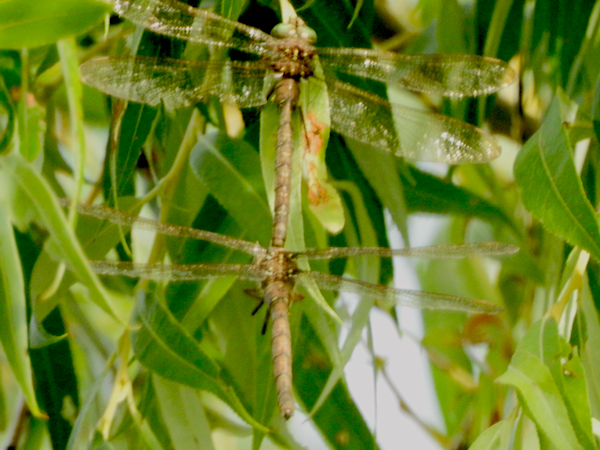
Despite the lack of water access, it turned out to be a great spot for birds, and I spent almost half an hour there before I had to log onto work. A flock of early migrants was making use of the trees above the marsh, and I saw several Cedar Waxwings, at least two Rose-breasted Grosbeaks, two Gray Catbirds, a Ruby-throated Hummingbird, an Eastern Wood-Pewee, and several warblers including Black-and-white, Yellow-rumped, and Black-throated Green. It was a good thing there were so many birds to watch as I would have missed a pair of darners in a mating wheel fly by if I’d left earlier. I was surprised as it was not even 20°C and still quite cool for odonates; perhaps one of the birds startled them out of the trees. They zoomed around for several seconds locked together, letting me get a long enough look to confirm them as some sort of darner. My first thought was that they were Shadow Darners, as they were quite dark in appearance and lacked the large abdominal spots of other Aeshna darners. Then, to my delight they landed; however, they landed well above my head where I had a tough time seeing them and even more difficulty photographing them. This was the best image I could get, and the brown colouration and mint-green eyes of the male (top dragonfly) made me realize they were NOT Shadow Darners.
There are two brown darners in eastern North America, usually called spotted darners due to the distinctive yellowish-white spots on the thorax. These medium-sized darners prefer shady forested streams where they often fly late in the day, patrolling in dimly-lit wooded environments. The Ocellated Darner tends to prefer faster streams than the Fawn Darner, usually with rocky bottoms. Both species are found in Europe, where they are referred to as “spectres”- a much cooler name!
I had seen plenty of Fawn Darners in Quebec but had never seen an Ocellated Darner before. They can be tricky to tell apart, but the Ocellated Darner is more grayish overall while the Fawn Darner is a warmer shade of brown -often looking yellowish in flight. The Ocellated Darner has a very small brown patch at the wing base while the Fawn Darner has larger brown patches. The pale spots on the abdomen and are larger and more prominent in Ocellated Darners. The mature Ocellated Darner has eyes that are brighter and greener than those of the mature Fawn Darner. The cerci of the female Fawn Darner are longer than the cerci of the female Ocellated Darner, which are short enough to mistakenly believe they have broken off.
Although my photo isn’t crisp, it shows enough detail to identify these as Ocellated Darners – a lifer for me! The female’s cerci are short, the male’s eyes are bright green, and both lack brown patches at the base of the wings. In addition, the spots along the abdomen are clearly visible in the male, while those of the Fawn Darner are usually too small to detect from a distance. This ID was confirmed on iNaturalist- my 56th species in Nova Scotia!
It was incredible that I had found this species just around the corner from our trailer. Even better, I had found the male and female in tandem, something rarely seen…females are often difficult to find, and it is believed they lay their eggs after dark. Ocellated Darners prefer cooler temperatures than other dragonflies, flying later in the evening and also on cooler days which explains why they were active so early in the morning. This was definitely the best find of the trip, and now that I know they are there I will have to keep an eye out for them!


