
When I got up this morning it was the type of day I’d been dreaming about all spring – already warm at 8:00, with dazzling sunshine, a clear blue sky, and lush green vegetation so vivid it finally burned the visions of the bare, brown woods and dull grey skies of early spring out of my memory. I’d been planning this excursion all week – I was heading to points west, starting at Sheila McKee Memorial Park, then onto the Bill Mason Center with maybe one final stop if I had time – I would be performing in a choir concert that night, and didn’t want to wear myself out or get home too late to get ready! I didn’t realize until later in the day that it was June 13th – the first day of the Odolympics, but even if I had it wouldn’t have changed my plans that much.
I arrived at Sheila McKee Park at 9:25, a little earlier than expected, but the day was already warm and I had seen plenty of dragonflies flying over Cameron Harvey Drive where it cuts through the large marsh. There were none in the parking lot, but it didn’t take me long to find my first two species in the first sunny clearing – a Spiny Baskettail and a Racket-tailed Emerald, both of which hung up in a sunny shrub.
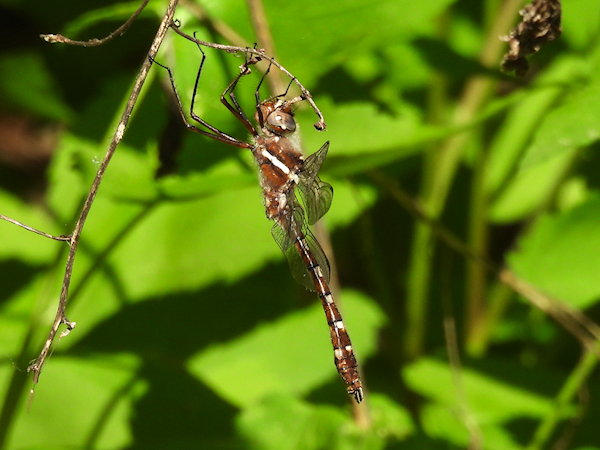
A few more dragonflies were flying in the first open corridor, but I wanted to get down to the beach and look for clubtails while the sun was shining on the base of the escarpment. However, a large dragonfly flying in the shadows about my ankles caught my attention as I started down the path toward the water; I stopped to watch it, and tracked it as it landed in the sun about a foot above the ground. It was my first Stream Cruiser of the year!
I then descended the stairs to the beach, where I checked the ground, but it wasn’t until I brushed against a leafy shrub that I scared a clubtail out of hiding. Fortunately I saw where it landed and identified my first clubtail of the Odolympics – a male Mustached Clubtail! It was a delight to see – with bright yellow markings and brown eyes, it clearly hadn’t emerged that long ago. This is now the third year that I have seen this species here, after one was first reported on iNaturalist in 2021. I still can’t believe they were this close to home all this time!
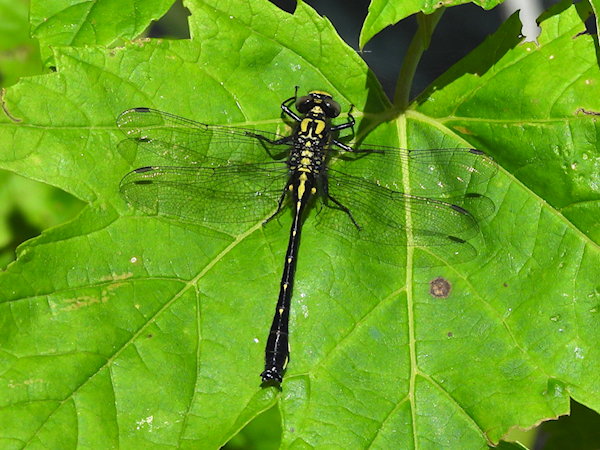
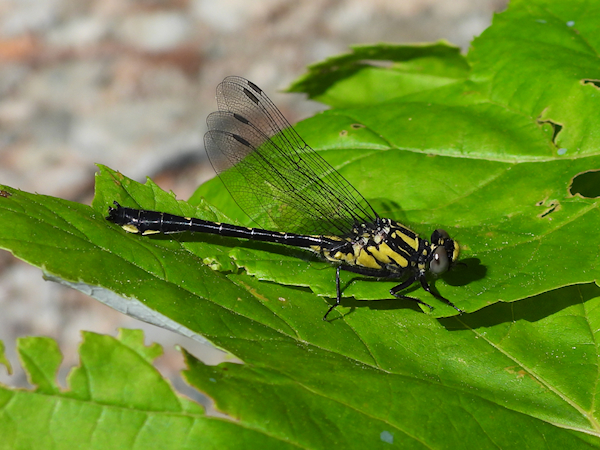
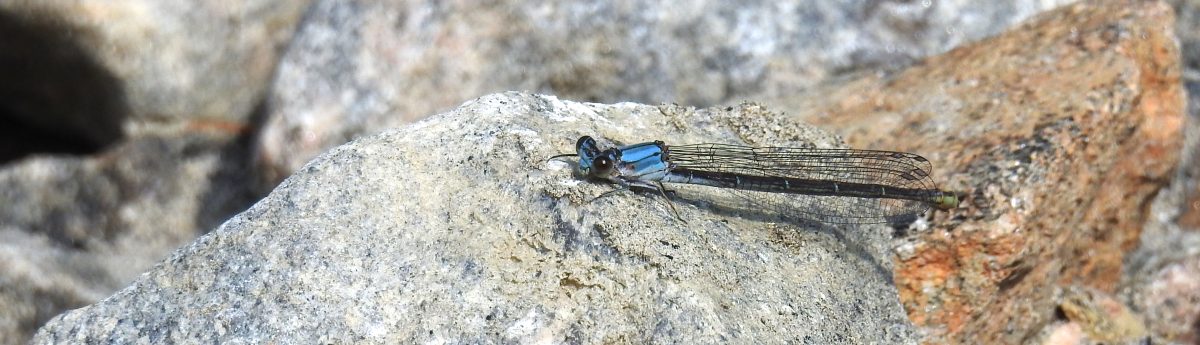
There were no damselflies along the shore at all – in fact, I didn’t see a single one at Sheila McKee; clearly only the Powdered Dancer actually breeds here. However, I spotted a Dot-tailed Whiteface on the ground and a huge swarm of emeralds in the air. I recognized a couple of Prince Baskettails, which appeared huge after photographing the tiny Mustached Clubtail, as well as several Common Baskettails. I caught one to add to iNaturalist, then placed it on a shrub.
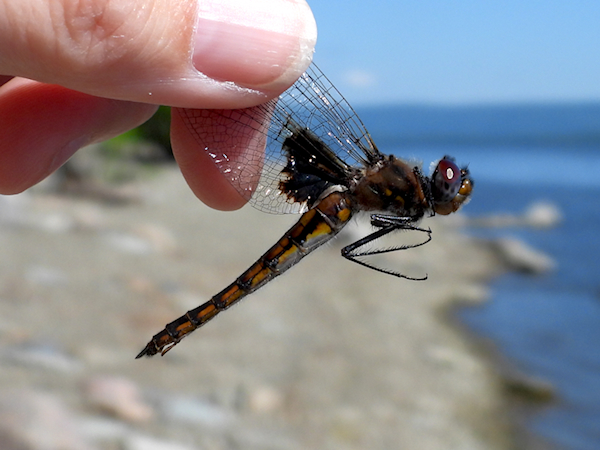
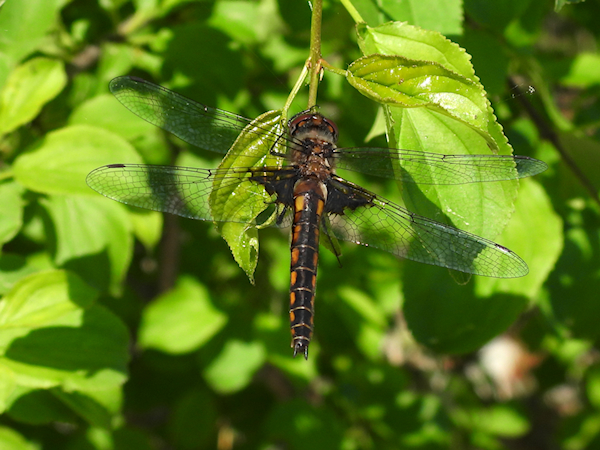
There were other Baskettails flying about which had no markings on the wings- I presume they were all Spiny Baskettails as I had never seen a Beaverpond Baskettail here before. There were so many that I couldn’t wait to head to the meadow to see what was flying there! I got my answer shortly: more baskettails! They all seemed to prefer the open part of the meadow while the Racket-tailed Emeralds stayed closer to the shrubs and trees lining the clearing. I tried but couldn’t catch one, and none would land.
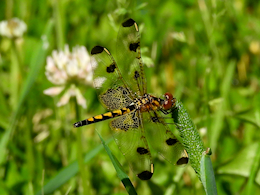
There were a couple of skimmers here as well – I saw another Dot-tailed Whiteface, a Common Whitetail and a Widow Skimmer, and there were several immature Calico Pennants resting in the grass! It is interesting how when I started visiting this spot in 2024 I found several Halloween Pennants in this meadow, and then last year all I found were Calico Pennants with no Halloween Pennants. The Calico Pennants are still doing well wherever they are breeding.
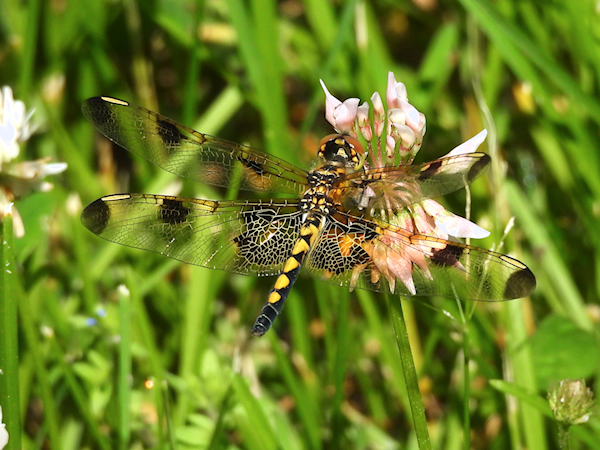
Starting the day at Sheila McKee was a wonderful idea. It finally felt as though the dragonfly season was back on track. I had high hopes for my next stop, the Bill Mason Center, but the weather changed and the clouds began moving in again. I was hoping to find a Crimson-ringed Whiteface along the trail or in the meadow now that the sand pit was off limits, but I saw very few odes in my walk. The usual Widow Skimmers, Dot-tailed Whitefaces and Racket-tailed Emeralds were present, but in low numbers. I did see two baskettails in the meadow once the sun came out but was not able to catch either of them. My first Eastern Pondhawk of the year was the only notable ode of my stop there.
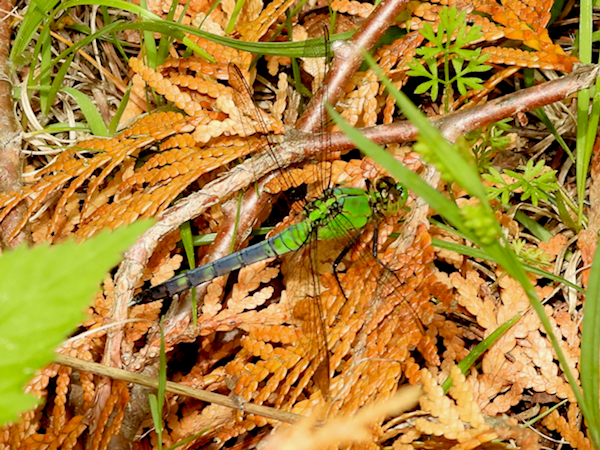
I wasn’t sure I wanted to spend too much more time in the field, but I still had about two hours before I needed to be home for my concert, so I decided to check out the Northern Mockingbird on Innovation Drive. It was a fairly easy bird to get – I just had to find the photographer following it from perch to perch – though I didn’t get any photos. It’s been a long time since I’ve had a good look at this bird in Ottawa, so it was worth the stop.
This was really close to the Monk Environmental Center and one of the streams I enjoyed checking out last year. I could afford to spend some time there, so I walked over. I caught a Racket-tailed Emerald for my iNaturalist project, but saw no skimmers and no jewelwings hanging out near the large pool below the bridge.
I didn’t even see any damselflies at the marsh. I walked into the woods a short ways and finally spotted an Ebony Jewelwing perching on a leaf above the water. I was taking its picture when suddenly a large black and yellow dragonfly zoomed past just above the water’s surface! It was the spiketail I had been hoping to find last year…but which one?
I waited for it to come back, but when it did I was unprepared and missed when I swung for it. After that it was back to waiting for it to complete its patrol and return. I waited and waited, eventually spying two Fragile Forktails in the emergent vegetation as well as a crayfish resting on the stone floor of the stream!
When the spiketail didn’t return I imagined it was hanging up somewhere out in the open further downstream. It is possible to follow the edge of the stream along the jumble of rock slabs to where it emerges out into the hydro corridor, and this is exactly what I did. When I ducked under an overhanging spruce branch I suddenly saw the spiketail flying over the water below me. It turned around and zipped further downstream.
I had no choice to follow. There wasn’t much of a bank here – the water was not quite a foot below the bank, but was overgrown with vegetation so thick it was difficult to push through it. Walking in the stream would have been a much easier route, except I didn’t have my water sandals on. However, there were enough rocks protruding above the surface of the water that I could make my way downstream with only minor difficulty.
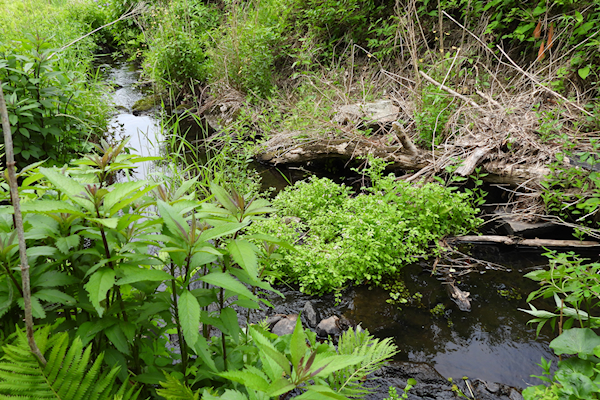
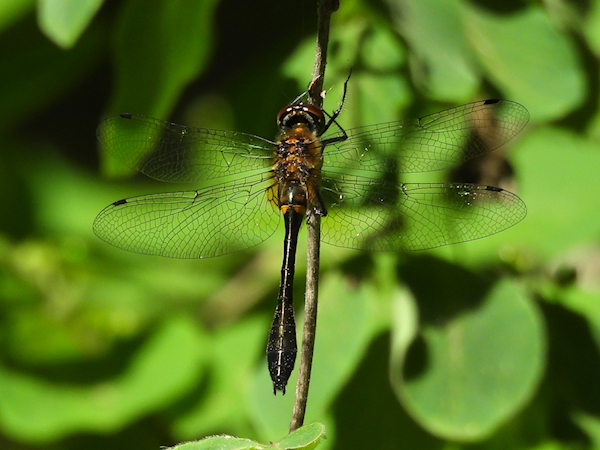
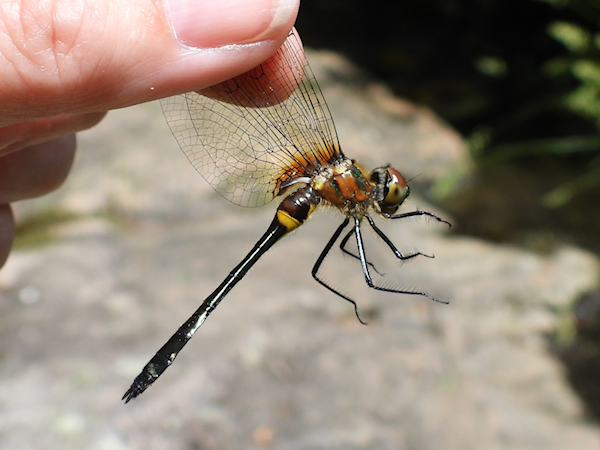
I saw the spiketail fly by me once again, but didn’t react in time to catch it. I walked a little further along the stream….just around a small bend that gave me a better view of where it might be flying. I decided to wait, and in time the spiketail came flying along….and hung up on a branch just above the water about 10 or 12 feet away from me! I grabbed a few shots but could only capture a side view of the dragonfly. This is not helpful when there are three species in our region and are best identified by the shape of the yellow markings down the top of the abdomen.
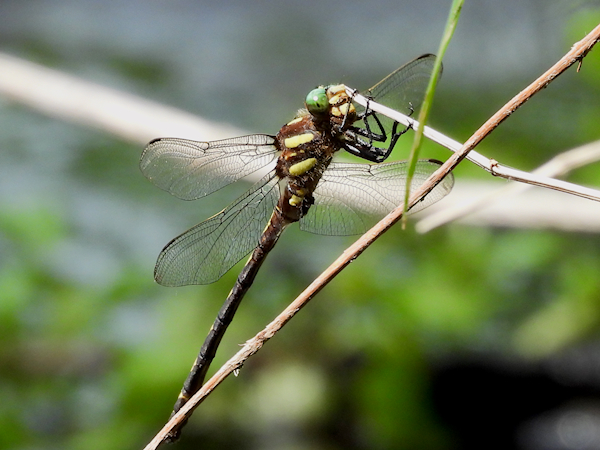
Then something magical happened. Another one came flying down the stream, passed the first one still hanging on its branch, turned around…and landed on a twig right across the stream from me!
This is not the first time this species has done this. In fact my very first Arrowhead Spiketail perched on a flower right in front of me as I was getting out of the car on a side road in Larose Forest for a bioblitz back in 2010! Since then I have seen them hang up in front of me at Jack Pine Trail, South March Highlands, and now at Shirley’s Brook in Monk Environmental Park.
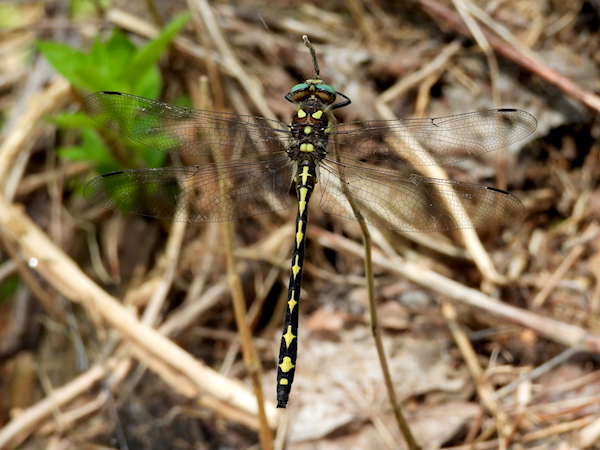
Getting this species was a fabulous way to end the day, especially after failing to find it on my visit last June while searching for creek-loving odonates in Kanata. It was also a great bug with which to end the first day of the 2026 Odolympics. I’d been looking forward to a June Odolympics since my first one three years ago, as the diversity of species is highest this time of year with many fabulous species on the wing. So far in one day I’ve seen a representative of every dragonfly family except the darners, and two of the three damselfly families – all except the spreadwings. With rain and unsettled weather on the horizon, however, it may be challenging to visit all the places that I’d like in order to find all the species flying this time of year.


