
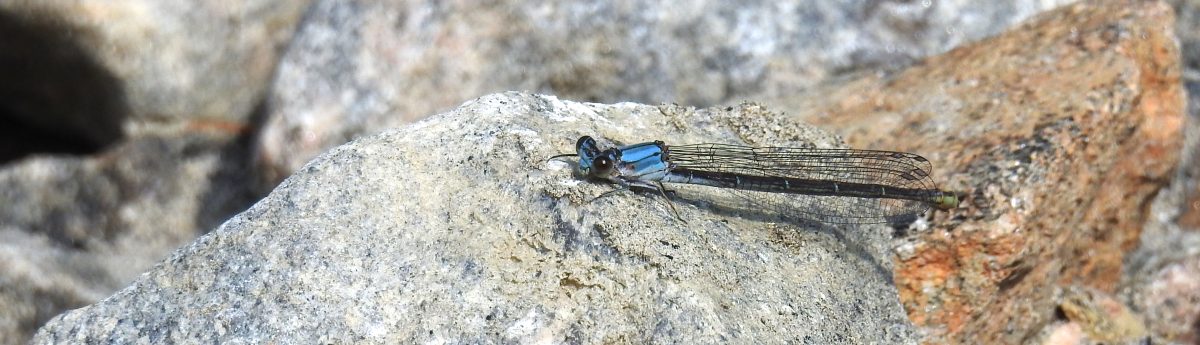
Terry Carisse may not have the highest diversity of odonate species, but it is worth visiting for the ones that inhabit this small park, namely Orange and Rainbow Bluets, Skimming Bluets, Stream Bluets, Elegant Spreadwings, and Fragile Forktails. Various skimmers show up along the edge of the water fairly frequently, particularly near the boat launch at the north end, but never in large numbers. My best skimmer find to date has been a Slaty Skimmer seen back in 2022 and then never since.
Other dragonfly families are less common. The only darners I’ve identified here are Common Green Darner and Lance-tipped Darner, while the only emeralds I have observed are Prince and Common Baskettails. I have never seen a clubtail, cruiser, or spiketail here, although I suppose there is a faint chance that individuals belonging to the first two families may show up here from suitable habitat nearby. The list as of this morning stood at 25 species, and I have never given much thought to what might show up next. Perhaps not all the darners cruising over the lawn in the late summer are Lance-tipped Darners, and there might be a Canada Darner among them. Perhaps a Wandering Glider would join them. Perhaps another type of spreadwing – such as Spotted or Northern – would show up at the water’s edge.
After a disappointing outing at Sarsaparilla Trail today at lunch, I decided to check Terry Carisse almost on a whim to see if more damselflies had emerged since my last visit. When I arrived I noticed a small, dark dragonfly circling the lawn near the dock almost immediately. I caught it, and was surprised to see that it wasn’t a Common Baskettail, but rather a Racket-tailed Emerald – the only emeralds I’ve seen flying over the lawns so far have been Common Baskettails and occasionally Prince Baskettails very high up. This was a new species for the park, but one so common I’m surprised it hadn’t occurred to me to keep an eye out for it. In fact, I didn’t even realize it was new at the time as I thought I had already recorded it here!
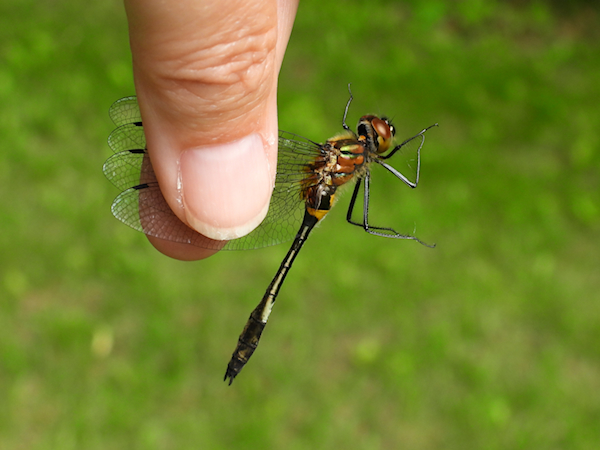
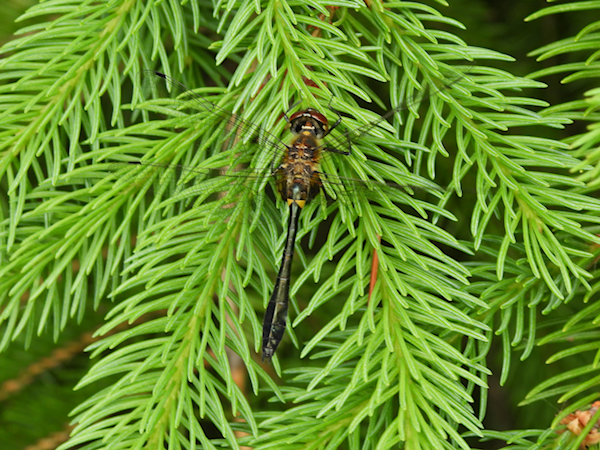
Its eyes were brown, so it hadn’t emerged all that long ago. I set it free, and it immediately flew over and landed in one of the spruce trees.
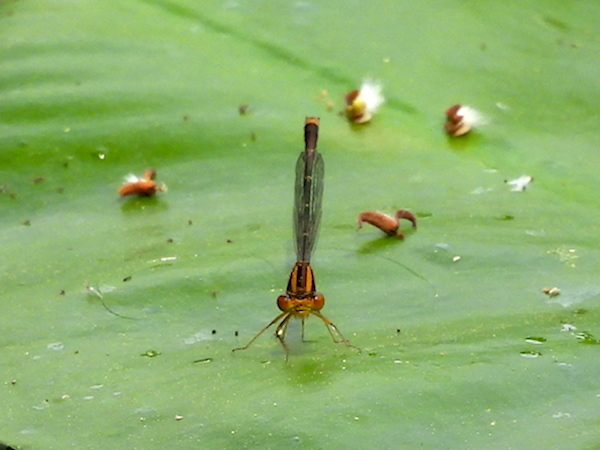
I didn’t see anything at the dock, so I continued to the next opening along the river, the small muddy beach where I can watch the odes right at water level. Along the way I saw a Widow Skimmer fly up onto a tree branch and a Fragile Forktail skimming close to the ground along the edge of the vegetation. At the “beach,” a few damselflies were fighting for territory on the few lily pads that had popped up just offshore. At first when I scanned them with my binoculars I could only identify a few dark female Eastern Forktails, but further out I spotted a damselfly with a bright orange thorax – with an orange-tipped abdomen! This could only be an Orange Bluet, a species I had only seen here in 2022 and 2024. I was happy to find one flying here, as they are not common.
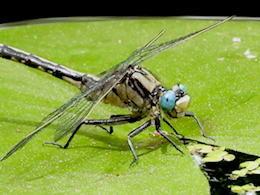
I also saw a Common Baskettail hovering over the small bay, zooming in and then rushing further out to hover over the water again. Then a larger dragonfly flew in, hugging the shore, and the baskettail went after it. The two of them flew out over the water, looping up toward the sky, before the larger one came back to shore and the baskettail resumed its patrol over the bay. I watched the larger one almost land on the trunk of the large tree that had fallen down at the southern end of the bay before flying right past me along the shore – I could tell that it was a clubtail, but not which species, but had an inkling a moment later when I saw it land on the lily pads further out! I thought it was a Lilypad Clubtail at first, and took several photos as I knew I would have to take a closer look at the details when I got home.
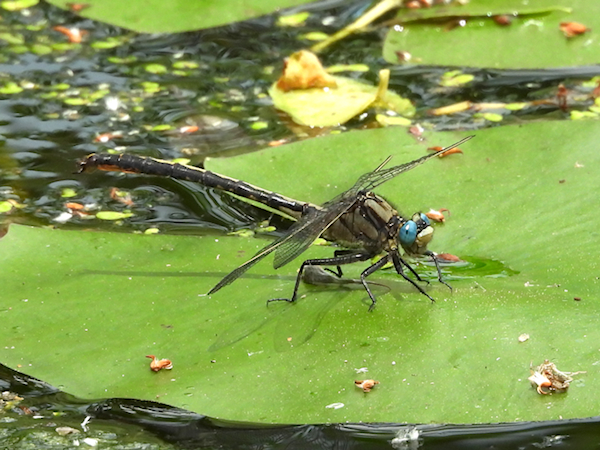
I was thrilled with the sighting as it was the first clubtail of any kind at Terry Carisse Park. With luck I would be able to identify it when I got home. I walked to the next opening onto the water from atop the bank to look for bluets, but saw none – this one spot is reliable for Stream, Skimming, and Rainbow Bluets in the grass, though it seems to be too early for them. However, when I checked the water below, I saw a clubtail resting in the vegetation! I am not sure whether it was the same one or a different one, but I was happy to get a photo from a different angle.
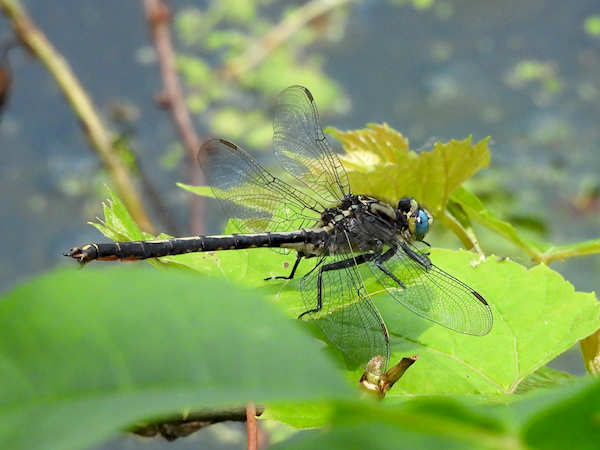
When I got home and got a good look at the claspers and the height of the occiput – the yellow structure between the eyes – I was able to confirm it as a Horned Clubtail. I was happy to have finally added this species to my year list, but even more thrilled to add it to the list of odonates found at Terry Carisse Park. This is another reason why I like going back to the same spots over and over again – something may just show up that I wasn’t expecting at all!


