

On August 16th Chris Lewis and I went to the Bill Mason Center to do some dragon-hunting. As the weatherman was predicting a steamy high of 30°C with 100% humidity, we met at 7:30 in the morning in order to beat the heat. For the second day in a row, a thick early-morning fog hung low over Ottawa, but once we arrived at the sand pit we found a bright, sunny morning with no trace of fog. It was really starting to warm up by then, but as it was still early in the day, all we saw at first were a couple of darners we accidentally scared up from the vegetation along the northwestern side of the pond. None were cooperative; instead of settling back down in a spot where we could see them, they zoomed off altogether.
At first we were unable to find any skimmers where the path from the woods emerges onto the sand pit. Usually there are plenty of Widow Skimmers, Twelve-spotted Skimmers, Eastern Pondhawks, Dot-tailed Whitefaces and Calico Pennants in this area; I suspected it was too late in the season for most of these species to still be flying. Then we started seeing a few meadowhawks: first an Autumn Meadowhawk, then a White-faced Meadowhawk. We scared up one off the ground, and when it landed we could see that it had a reddish face and black legs. I took a few pictures before Chris caught it, and after examining the hamules she declared it our third meadowhawk species of the day, a male Cherry-faced Meadowhawk.

The red-bodied, red-faced, black-legged meadowhawks are notoriously difficult to ID in the field, and are part of a baffling complex which includes White-faced and Ruby Meadowhawks as well as the Cherry-faced Meadowhawk. We are fortunate that here in the north, mature male White-faced Meadowhawks have a bright, pure white face; however further south, many individuals have “dirty” coloured faces which contributes to the difficulty of identifying Sympetrum species in the field or through photographs alone. Examining the hamules under magnification remains the best way to separate these three species, though it is possible that they are all just variants of one complex, diverse species. A 2007 study compared diagnostic morphological features (including the genitalia) of these three meadowhawks as well as DNA sequences and found that the genetic distances between Ruby and Cherry-faced Meadowhawks were “small or nonexistent”, recommending further studies to determine the species status of these close relatives. For now, they are considered to be three separate species, and in Ottawa the White-faced Meadowhawk is the most widespread and abundant, while the Cherry-faced Meadowhawk is only known from a few locations, and Ruby Meadowhawk is very rare – I have yet to see one or identify one.
Eager to find some other species, we continued on our way. Once we got to the first peninsula on the eastern side of the pond we began seeing some odes, including a couple of Eastern Forktails and Azure Bluets fluttering in the vegetation close to the ground. Several meadowhawks zipped through the air until they found a suitable perch. I saw this Azure Bluet land on a dewy leaf and stooped down to take its picture:

There are usually lots of bullfrogs sitting at the edge of the water, but Chris and I only saw two: one which promptly jumped into the water when we stopped to watch a crane fly ovipositing in the damp sand, peeping out with only his eyes showing, and a huge fellow sitting all by himself on a log. He was not perturbed at all by our scrutiny.
We started walking through the vegetation, hoping to scare up any odes lurking there. Chris called out that she had found a Leonard’s Skipper, and I hurried over to see it.

The Leonard’s Skipper is usually the last butterfly to emerge in our area, flying in August and September. As a result, they are easy to identify given that most other strongly patterned skippers have stopped flying; the only other skipper likely to be seen in mid-August here in Ottawa is the Least Skipper, which is much smaller. Leonard’s Skippers prefer dry habitats with sand, especially grassy trails, clearings, and forest edges. It is quite scarce in Ottawa; this was only the second one I’ve seen.
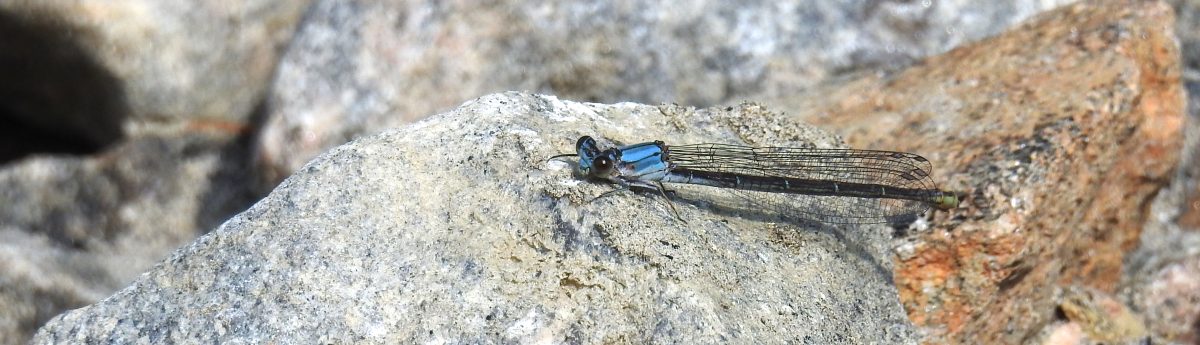
As we progressed along the peninsula we encountered more Azure Bluets. Both males and females are distinctive black-type bluets and can be identified without the aid of a magnifying lens; however, I only saw the males.

Chris was wondering where the other bluets were, and not long after that we found a different species. After netting and examining it we determined that it was a Northern Bluet (Vernal Bluets, which have identical claspers, usually only fly until mid-July).

While we were searching for odes, we weren’t unaware of other flying creatures in the vicinity. Cedar Waxwings were swooping through the air like swallows, and then five Barn Swallows appeared briefly above the water to hunt for insects and grab a quick drink before they disappeared. A Greater Yellowlegs joined us briefly, searching for food along the water’s edge before flying off with a few strident, well-chosen call notes. We heard a couple of Red-breasted Nuthatches chattering in the trees, a Great Crested Flycatcher and an Eastern Wood-pewee calling from somewhere out of a view, and a noisy Northern Flicker which eventually flew out to the top of a dead tree. Chris saw a Ruby-throated Hummingbird fly by but I missed it.
The day was warming up quickly, and we began seeing Saffron-winged Meadowhawks flying by. They are larger than the other meadowhawks, and do not have a row of black triangles along the sides of the abdomen as the more common meadowhawks do. I saw a couple of males land on perches close to the water, but they didn’t stay long enough for me to get close enough for a photo. Then I spotted a very red insect fly by and land in the vegetation. I still had meadowhawks on the brain and was confused as to what it was until I located it and identified it as a Calico Pennant. These candy-apple red dragonflies are always a treat to see; this was only my second one of the year.

I noticed some colourful flowers growing close to the water and pointed them out to Chris. They appear to be a type of coneflower, though I have never seen one with multi-coloured petals in the wild before.

On the other side of the peninsula we found more dragonflies, including a Common Green Darner zooming over the water, and a pair of White-faced Meadowhawks in a mating wheel.

I also spotted a beautiful female Saffron-winged Meadowhawk hanging from some flowers almost the same shade of yellow as her body. Female meadowhawks can often be tough to identify, but the yellow stigmas, the golden stripe along the leading edge of the wings, the lack of distinct black triangles along the abdomen, and the leg colour (half yellow and half black) distinguish her from the other meadowhawks. This was the first female Saffron-winged Meadowhawk I’ve photographed, and I found her so photogenic that I took a dozen photos of her!

We encountered more males as we headed further away from the trails of the Bill Mason Center. I spent some time photographing them on various perches, as this species is not as widespread as other meadowhawk species and I only see them if I make a special trip to the Bill Mason Center in the latter half of the summer. They seem to prefer shallow bodies of water, especially those that are poorly vegetated and have a sandy or gravelly bottom. An uncommon and local species in our area, they do not seem to be present in the same high numbers as most other meadowhawks.

Because the males do not have prominent black markings down the sides of their abdomen, they are sometimes confused with Autumn Meadowhawks. However, their larger size, the eponymous golden edges of their wings (which fade with age and are not a reliable field mark for older individuals), and the leg colour (mostly black, with some brown or yellow on them) help to distinguish this species. They are also quite difficult to approach, unlike the Autumn Meadowhawks which often land on me or my net!

Although I found it difficult to get close to the male Saffron-winged Meadowhawks, I was fortunate to find a few perching on vegetation well within the range of my camera.

I was also happy to find a pair in a mating wheel.

After reaching the end of the pond we stopped to check the vacant space full of wildflowers for insects. We found a couple of darners hunting on the wing, but I missed the one I tried to net. We saw several sulphurs in the area, as well as an Eastern Tailed Blue and a Common Wood-Nymph. We turned around and walked back through the sand pit, though we didn’t add any new ode species to our list.
Chris and I enjoyed our outing at the Bill Mason Center, despite the heat and the humidity. It’s such an excellent spot for odes that even late in the season there are always some interesting bugs around.

 OdoNotations