
The end of September is a good time to see a variety of hover flies (also known as flower flies, syrphid flies, or syrphids). It is also the end of dragonfly season. Most odonates are already done for the season – only a handful of species will continue flying into October, with the last species, Autumn Meadowhawk, flying into November if the weather cooperates.
As the last week of September was still quite warm, I was able to find and photograph a few different species of both insects – even in my own backyard! I finally added Autumn Meadowhawk to my official yard list on September 19th. I’ve seen a few meadowhawks in my yard over the years, but have only identified White-faced Meadowhawk and Band-winged Meadowhawk so far. I found it on the asters at the back of the yard, although it flew up onto the fence when I tried to get closer for a photo. Given how abundant and widespread it is, the Autumn Meadowhawk was the most likely species to be added to my yard list. Now that it has shown up in my yard, I’m not sure what the next likeliest species is – Common Green Darner? Twelve-spotted Skimmer?
On September 20th I started my day at Trail 10 on Carling Avenue. It was foggy when I arrived, but by the time I got to the back of the trail near the river the sky cleared and I started seeing some great birds, including a Blue-headed Vireo, a Swainson’s Thrush, and my last Brown Thrasher of the year. I came across a large flock of warblers flitting about the shrubs that marked the edge of the woods, but most had disappeared into the woods by the time I got close enough to identify them. I did see a Northern Parula, a Magnolia Warbler, a pair of Blackburnian Warblers, and a pair of Black-throated Green Warblers. As I walked through the small field adjacent to the woods to get closer, I flushed a few dragonflies sitting in the vegetation, including this White-faced Meadowhawk.

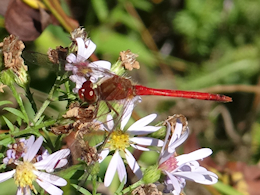
From there I headed over to Trail 26 off West Hunt Club. I added several new species to the hotspot there, including Canada Goose (a flock flying over), Blue-headed Vireo, both kinglets, a Swainson’s Thrush, a Magnolia Warbler, and a Northern Parula. There weren’t as many warblers around as I was hoping, so when I noticed the insect activity in a field full of asters I decided to spend some time photographing them instead. Quite a few of the meadowhawks were Autumn Meadowhawks, of course.

There was at least one White-faced Meadowhawk present, too. These guys usually fly until late September, and now that the nights are getting colder their season is probably just about done.
The following weekend I finally added Shadow Darner to my year list when I found one in an open area at Jack Pine Trail. I spotted it flying around a clearing, and when it landed I approached it in order to identify it. Unfortunately it landed too high in the tree to get a good look at the thoracic stripes or a decent photo. The small abdominal spots and the shape of the claspers confirmed its identity, which I expected to be a Lance-tipped or Canada Darner – I wasn’t expecting to find a Shadow Darner in a dry field at Jack Pine Trail, as I normally see them along the river (Shirley’s Bay, Andrew Haydon Park, Mud Lake). It was great to get another dragonfly for my year list so late in the season.

I didn’t realize this at the time, but these were my last real insect outings of the year. The mornings have been cold lately, with overnight lows only a few degrees above zero. It’s hard to believe that it’s time to put the net away until the baskettails start flying again.

 OdoNotations