
On April 16th my fiancé Doran and I took our first trip outside of Canada and the U.S., spending the week in Cozumel, Mexico. We chose it because when we had originally been looking at going on a cruise, it was one of the destinations we particularly wanted to see because of the Mayan ruins close by, and a one-day stop didn’t seem like enough time to see the region. I was also interested in the wildlife there, though that would have been true of any destination!
We flew from Montreal to Atlanta at the ridiculous hour of 5:45am, having driven from Ottawa the night before and staying at the Marriott in the terminal. It was after 11:00pm by the time we went to bed, and I didn’t sleep a wink – we had to get up at 3:00am for the flight. From Atlanta we flew to Cozumel, arriving at 1:30pm. It was very hot and humid, and I was completely overdressed in my jeans and long-sleeved sweater. We passed through customs and security without any problems despite the long line and arrived at our hotel (the El Cozumeleno Beach Resort in the northern hotel zone) by 2:00.
While the birding in Mexico was spectacular, dragonflies, unfortunately, were few and far between. I only managed to photograph my first species on a trip to Coba with a bird guide on April 18th. We had stopped to eat lunch at a picnic area next to Laguna Coba, and after I was done eating I started scanning the vegetation next to the marsh to look for odes.

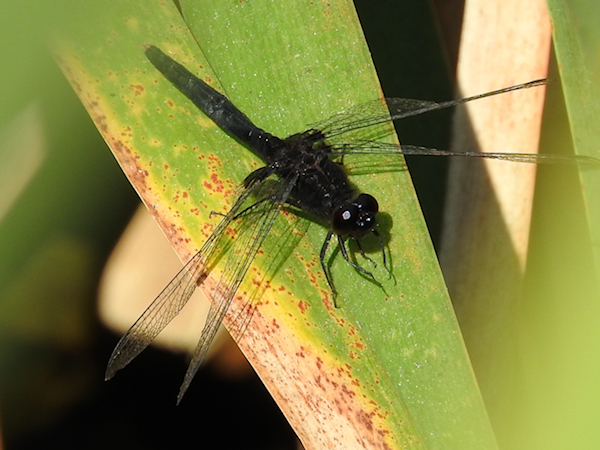
I saw several dragonflies buzzing around the area, and took a few photos when they landed. They all appeared to be skimmers, and with the black patches on the hindwings they looked fairly distinctive. The terminal appendages appear to be yellow; when I got home I tentatively identified it as a Black Pondhawk based on a couple of quick searches of the photo galleries of Greg Lasley and Tom Murray.

About five years later I added it to iNaturalist where this identification was confirmed. The Black Pondhawk is found in Central America, North America, South America, and the islands of the Caribbean; in North America it barely reaches southern Texas. In the tropics they have a year-round flight season and inhabit densely vegetated ponds and swamps where they sally out for their prey like flycatchers; like the Eastern Pondhawks back home, they often feed on dragonflies their own size.
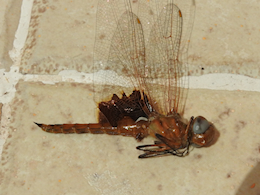
My second dragonfly was found dead on my balcony on the afternoon of April 21st- a victim of a window collision, perhaps. It was the first opportunity I’d had to study one up close so I took a few photos. It was a saddlebags – that much I was able to determine. As I hadn’t been able to find a list of the odonata species of Cozumel after my trip, I wasn’t able to narrow down the possibilities further.

However, once I started uploading all of my dragonfly sightings to iNaturalist, I finally received confirmation that this was a Red Saddlebags, a lifer for me. (Or, since it was not alive at the time, should I call it a “deader”?)
iNaturalist shows six Tramea species – the saddlebags gliders – in Quintana Roo. Based on the number of observations, the four red species – Red Saddlebags, Striped Saddlebags, Antillean Saddlebags and Vermilion Saddlebags) are much more common than the two dark species – Sooty Saddlebags and Black Saddlebags. However, the saddlebags dragonflies don’t like to perch very often, so it’s possible that the number of observations on iNaturalist don’t truly reflect how common or numerous they are.
The four southern species that I’m most unfamiliar with – Striped, Antillean, Vermilion, and Sooty – all have hindwing patches that form a narrow band, lacking the jagged edges of a Black or Red Saddlebags (or a Carolina Saddlebags for that matter). This left Red Saddlebags based on the species found in the region. I also considered Carolina Saddlebags as it’s the only red saddlebags I’ve seen before. However, Carolina Saddlebags has a larger hindwing patch and a much smaller clear area adjacent to the abdomen.

While I was thrilled to get such good looks at this dragonfly, I was sad that it had died on our balcony. It looked perfectly fresh, suggesting that it had not been on the wing for very long.
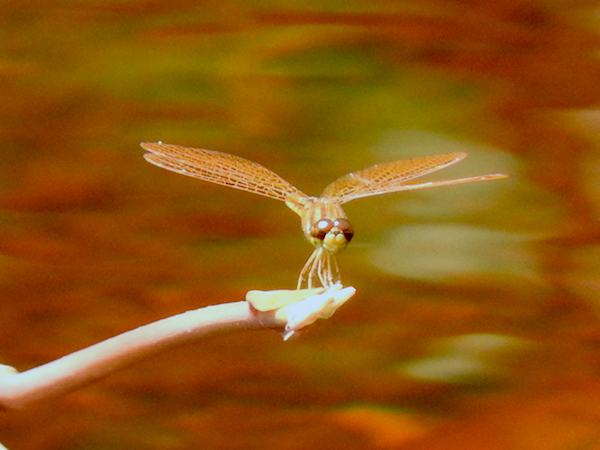
The last new dragonfly was seen at the north end of Cozumel on the same day. Doran and I had rented a scooter to revisit one of the areas where we’d gone birding with a different guide. There in a small lagoon I noticed a few odes flying over the water, including one that looked like an amberwing and another that looked like a saddlebags. A few small damselflies that looked like bluets were lurking in the mangroves at the far side of the lagoon. I wasn’t able to get photos of any of damselflies as they were too far away for my camera, but I did get some shots of a perching amberwing. It, too, remained unidentified until I uploaded my photos to iNaturalist. Although I was hoping for an exotic southern species, it turned out to be the same amberwing I see in Ottawa – an Eastern Amberwing!
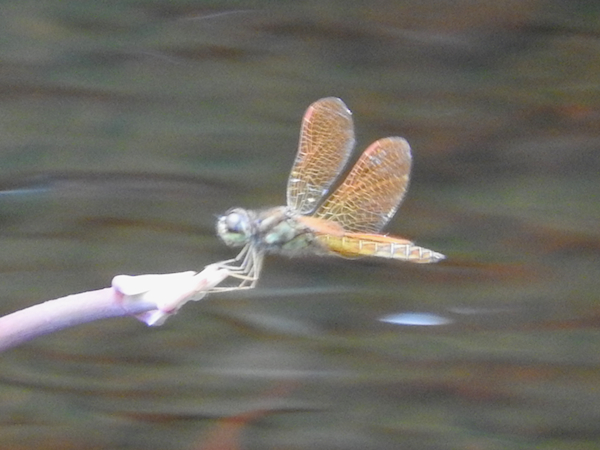
According to iNaturalist there are three amberwing species in Quintana Roo: Eastern, Slough, and Mexican. Although these three species look similar from a distance, particularly the males with their orange wings, the Slough Amberwing has dark legs and a thorax with three dark lateral stripes and three slightly larger yellow stripes; the Mexican Amberwing has pale legs and a yellow abdomen with no dark markings. The Eastern Amberwing has two wide yellow areas separated by a darker area on the lateral thorax and pale legs. The side view leaves no dispute that this is an Eastern Amberwing – the only one recorded on Cozumel as of the date of this update (December 31, 2025).
These three skimmers were the only dragonflies I photographed in Mexico. A bit disappointing, given that there are 86 ode species recorded in the state of Quintana Roo (as of 2025), but perhaps not surprising as I didn’t spend much time in any fresh-water sites.

 OdoNotations