
On Victoria Day I returned to Mud Lake to look for migrants and dragonflies. I arrived early – before 7:00am – in order to beat the crowds, but even at that time there were a few people wandering around. I started at the ridge and worked my way around the conservation area in a clockwise direction; I hoped that by exploring the quieter side trails I would come up with a decent list for the morning. Well, I did finish my outing with a good number of bird species – 43 total – but most of them were found along the northern and western sides, which is where I usually bird anyway, especially when I am short on time.
On the ridge I found the usual breeding birds: Warbling Vireos, Yellow Warblers, American Redstarts, Song Sparrows, and Red-winged Blackbirds. Yellow Warblers seemed particularly abundant; I observed at least 30 of them on my walk all the way around the lake.
As I squeezed my way along the fence on the eastern side of the filtration plant I heard the distinctive call of a Common Raven coming from somewhere nearby. Ravens like to perch on the roof of the filtration plant, and sure enough, when I reached the southeastern corner of the property, I looked up and found two juveniles walking along the edge of the roof. They were noisier than the adults, and I was close enough to see the fleshy gape at the corner of their mouths.
After leaving the ravens I checked the marshy area near the northeastern corner of the lake for dragonflies. Although I didn’t see any, three Black-crowned Night Herons were visible in the bay across the water, and I later saw two more flying over. I also saw a Green Heron fly up into a tree about 20 feet above the man-made storm water pond at the southeastern section of the conservation area. It was in this area that I found my first dragonfly of the day, a Spiny Baskettail perching on a stem in a sunny clearing.
The bridge was still under construction, so I had to backtrack to find my way out of the conservation area to the bike path, and then bypass the bridge and find my way back in.

The birds got more interesting as I worked my way around to the southwestern corner and the open sumac field on the western side. I heard a couple of Pine Warblers singing in the pines, and also found a couple of Blackpoll Warblers, two Black-throated Green Warblers, a Black-and-white Warbler, at least 7 Tennessee Warblers, a Magnolia Warbler, an Eastern Phoebe, and a pair of Gray Catbirds that appeared to be gathering nesting material.
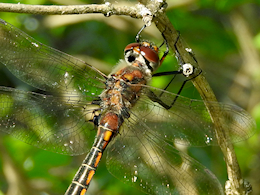
I noticed a few dragonflies flying about, but once I reached the open area near the Rowatt Street entrance I found a huge swarm of them. There were probably about 100 in the area, although most were perching in the vegetation near the edge of the meadow. The more I looked, the more dragonflies I noticed hanging from the branches of various shrubs at about eye level. I didn’t have my net with me, but I was able to view the appendages of the males, and all appeared to have the upward-curving claspers of Spiny Baskettails – I did not see any that had the downward-angled claspers of the Beaverpond Baskettail.

Many females were present, and I ended up with more photos of them than the males. The terminal appendages of the females are slightly longer in Spiny Baskettails than in Beaverpond Baskettails; this can be tricky to determine in the field without both species present, which is why I prefer to catch them and look at the shape of the genital plates on the underside of the abdomen when confirming an identification.

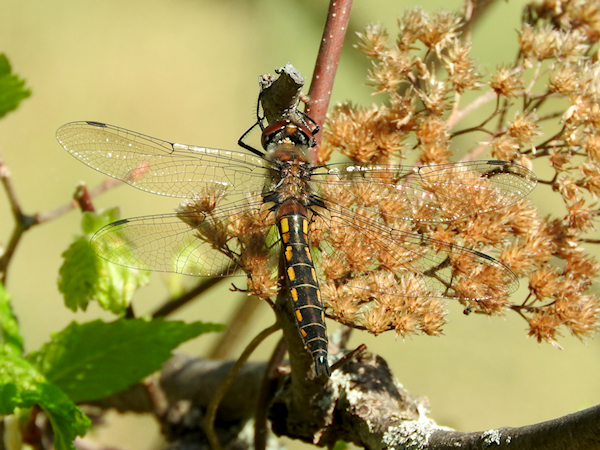
Although these dragonflies were not tenerals (they lacked the shiny saran-wrap wings found in freshly emerged odonates), they obviously hadn’t emerged too long ago as none of them had the blue eyes of older baskettails. Instead, their eyes were reddish-brown above and gray below, which is characteristic of young adult baskettails of all three species (Common, Beaverpond and Spiny).

Some of the shrubs were so laden with perching baskettails that it looked almost as though they were growing on the shrubs. I even saw a few baskettails fly in to land on a branch, and then land on another dragonfly because there was simply no room for one more dragonfly! Of course the ones being landed on didn’t appreciate the intrusion, and quickly flew off.

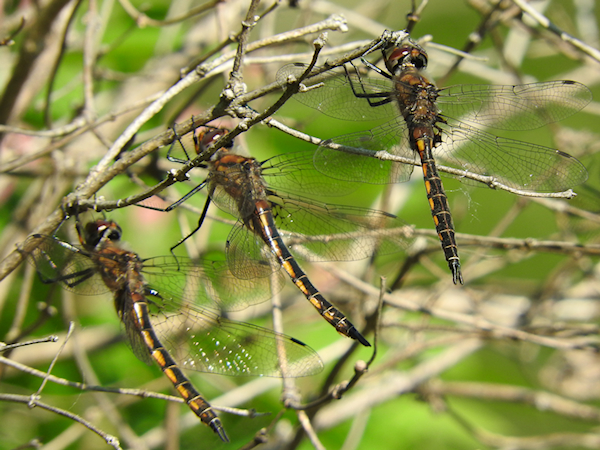
Here is another female Spiny Baskettail with some blossoms in the background:

I was surprised that I only found the one dragonfly species there; there were no American Emeralds or Beaverpond Baskettails, both of which I’ve seen here in the past. There weren’t even any damselflies around, though with the nice weather, they should be emerging shortly, too.

 OdoNotations