
After leaving Sarsaparilla Trail I drove over to the NCC parking lot on Corkstown Road and followed the bike path beneath the Queensway to the place where Chris Traynor had seen the Eastern Red Damsels earlier in the week. The spot isn’t hard to find; just keep following the path parallel to the Queensway as it passes over a small bridge and skirts the northern edge of a farmer’s field. Eventually the path reaches a small woodlot and abruptly turns south; before you get to the small stand of trees, watch for an NCC sign on the left about the crops of the Greenbelt. Chris had found the damselflies in the grass behind the sign.
I saw an Eastern Kingbird and a Common Raven along the way, and spotted a couple of large dragonflies flying over the trail before they disappeared over the farmer’s field. One passed close enough for me to ID it as a Prince Baskettail, my first of the season. A few butterflies were flying, too, and I found a couple of Common Ringlets and an Arctic Skipper in the grass beside the bike path.
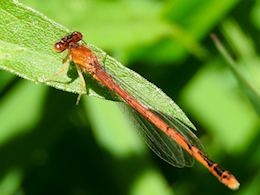
When I reached the sign I began wading through the waist-high grass down the slope. It wasn’t long before I spotted a female Eastern Red Damsel; her bright red body was unmistakable.

Although this species is widespread across the east, it is extremely localized, inhabiting well-vegetated spring-fed seeps, streams and ditches. In Ottawa they are considered rare, and this particular colony was only discovered last year at about this time (June 7, 2015). This trail is not heavily used by birders or other naturalists, and I suspect the colony would remain undiscovered if Brian Mortimer, a local naturalist, hadn’t happened to notice them, and knew not only what they were, but also that they are rare in the Ottawa area. This makes me wonder if there are other colonies in the area that haven’t been discovered because they are in areas with no trails, or along roadside ditches that have no qualities that would attract any naturalists.

I saw about four females after spending about 15 minutes in the area; although I hoped to find a male, there weren’t any in the small area I checked. The slope was quite steep, which made it hard to navigate the waist-high grass. Still, I was happy I had discovered the damselflies so easily as it’s been a long time since I’ve seen this species in Ottawa.
Once I had finished my search, I followed the train tracks beneath the Queensway, and immediately noticed two baskettails patrolling the open area between the Queensway and Corkstown Road. I was sure that the larger one was a Prince; I hoped it would come close enough for me to catch. It didn’t, but the other one flew within swinging distance so I caught it. It turned out to be a Common Baskettail, a species I wasn’t expecting as I see so few of them each season. According to the Ottawa checklist, the Common Baskettail is, unsurprisingly, considered “common”, as are Beaverpond Baskettail and Prince Baskettail; Spiny Baskettail is considered “uncommon”. However, the Common Baskettail is the species I usually see least often, and can remember only finding it in two other locations: Jack Pine Trail (once) and Shirley’s Bay (once). After examining it I placed it on the stem of a plant where it stayed long enough for me to photograph. The large dark patches at the base of the hindwings alone are enough to separate it from the other small baskettail species, though I did examine the appendages, too.

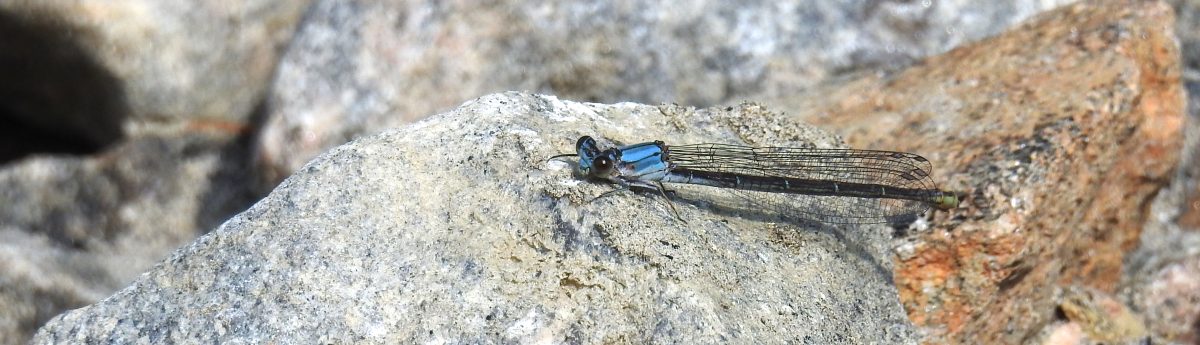
After a brief break for lunch I headed over to Jack Pine Trail to look for emeralds and Arrowhead Spiketails. There were a few Taiga Bluets perching in sunny edges along the trail, and after photographing a couple of these I found one that was different – a Fragile Forktail! I find these damselflies quite striking with their black and green colours, and although they are considered uncommon and local in our area, I tend to see them in all sorts of places. However, they are typically found in such low numbers that I don’t always see them, even when I’m looking for them in places where I know they breed. Jack Pine Trail, Beaver Trail, and Mud Lake are repeat locations for this species, though I even found one in my backyard once!

From there I headed to the open area at the back of third loop. There I found a single female baskettail patrolling the area with a few Racket-tailed Emeralds; she circled me a few times, snapping up bugs, and when she landed I took a couple of photos and then caught her. I felt a bit bad about this after she was so helpful in ridding me of some of the annoying mosquitoes.
Her appendages were quite long, which is indicative of Spiny Baskettail, and this was confirmed when I turned her over to view the shape of her subgenital plates. They curve inward, which is diagnostic of this species.

Spiny Baskettails breed in beaver ponds, slow-moving streams, and marshy lakes. They can often be found in sunny clearings and meadows nearby where they may forage in large groups; my experience with this species at Mud Lake a few weeks ago is an example of this.

I checked the creek briefly, but didn’t see any Arrowhead Spiketails perching in the nearby clearings or flying up and down the stream. I was hoping to find more emeralds flying in the marsh at the back of the third loop, and although the Racket-tailed Emeralds were quite abundant, the only other emerald species I saw was a single Prince Baskettail in the alvar-like clearing. A single Common Green Darner was also patrolling in this area, and both of them were flying high in the sky with no intentions of landing.
My last stop of the day was the Beaver Trail where I still hoped to find Frosted and Belted Whitefaces. I checked the meadow first as it is a great place for bugs in the warmer months; I found a Hobomok Skipper, a couple of Dot-tailed Whitefaces, and a Four-spotted Skimmer.


Unfortunately I didn’t see any other whiteface species along the boardwalks even though I’ve seen both Frosted and Belted Whitefaces perching in the vegetation there before. I did see another Fragile Forktail, and added only one other ode species to my day list: a female Eastern Forktail.

By the time I was finished at the Beaver Trail it was close to 4:00 and I had to end my Dragon Blitz. I ended up with 17 species, which isn’t bad for such a small area in west-end Ottawa within a few kilometers of home:
1. Eastern Red Damsel (Transcanada Trail)
2. Taiga Bluet (multiple locations)
3. Eastern Forktail (Beaver Trail)
4. Fragile Forktail (multiple locations)
5. Sedge Sprite (multiple locations)
6. Common Green Darner (Jack Pine Trail)
7. Racket-tailed Emerald (multiple locations)
8. Spiny Baskettail (Jack Pine Trail)
9. Common Baskettail (Corkstown Road)
10. Prince Baskettail (multiple locations)
11. Lilypad Clubtail (Sarsaparilla Trail)
12. Dot-tailed Whiteface (multiple locations)
13. Twelve-spotted Skimmer (Sarsaparilla Trail)
14. Common Whitetail (Jack Pine Trail)
15. Widow Skimmer (Sarsaparilla Trail)
16. Chalk-fronted Corporal (Sarsaparilla Trail)
17. Four-spotted Skimmer (multiple locations)
I think I may make this Dragon Blitz an annual event, and visit a couple of other locations next year in order to increase the number of species found – the creek near Nortel has produced River Jewelwing before, which would make it worthwhile as a quick stop; Roger’s Pond should have a couple of different clubtails present, as well as Ebony Jewelwing at the stream at the back and the missing whiteface species. Mud Lake is also good for a variety of odes – Hagen’s Bluets, Marsh Bluets, Powdered Dancers, Stream Cruisers, and Horned Clubtails should be on the wing in mid-June. As most of the species seen yesterday are pretty widespread, the only ones I would re-visit for sure are the Transcanada Trail and Jack Pine for those emeralds and Arrowhead Spiketails.
The first annual Dragon Blitz 2016 was quite a success; I’m already looking forward to topping that number next year!

 OdoNotations