
On the first day of June I brought my camera to work with me and headed over to Hurdman at lunch, hoping to find some interesting butterflies and odes to photograph. Hurdman can be a very “buggy” place, so I was sure to find something interesting; at that time I still hadn’t seen my first damselflies of the year, and Hurdman is a great spot to find Eastern Forktails, Elegant Spreadwings, Powdered Dancers, Stream Bluets and Rainbow Bluets during the month of June. However, with the closure of the transitway between Hurdman and Laurier stations, as well as the detours and increased traffic on Nicholas Street resulting from the sinkhole on Rideau Street, it now takes much longer to get there so I am no longer able to spend as much time there on my lunch hour as I would like. Getting around downtown has become and adventure, and timely bus schedules have become the first casualty of all the construction.
Still, I haven’t been there in a few weeks, and I was eager to see what changes the summer has brought. All the migrants were gone; the only birds I found were breeding birds, although I doubt that the three Turkey Vultures I saw soaring over the large hill actually nest nearby. I also found several Warbling Vireos, Red-eyed Vireos, Gray Catbirds, American Redstarts, and Yellow Warblers, as well as singles of each of Great Crested Flycatcher, Red-winged Blackbird, Brown-headed Cowbird, and Baltimore Oriole.
I spent my time scanning the vegetation between the transitway bridge (also closed) and the little lookout onto the river. I was happy to find a couple of Eastern Forktails in the vegetation along the trail and managed to photograph all three forms:


Eastern Forktails are one of the most common and abundant damselflies in our region, breeding in practically every type of wetland from rivers to large lakes to roadside ditches where there are plenty of sedges and grasses. Males are black and green with a few blue segments at the end of the abdomen; immature females are black and orange, while mature females develop a grayish-purple pruinosity. Females can also have the same colouration as the males (which are known as the “homeochromatic” morph), though I haven’t noticed any myself – they are such small bugs, that perhaps I mistook any homeochromatic females for males.
The only other ode species I saw on the first day of June was a Racket-tailed Emerald. I watched it zipping around a small open area before landing; unfortunately I wasn’t able to track it down.
As Hurdman is the only place I know of where Rainbow Bluets can be reliably found every year, I decided to return later in the month to look for them. They start flying in mid-June, and although I was thinking about trying for them late last week, the weather these past few days has been terrible for dragon-hunting: cold and gray, it has felt more like November than June. The sun finally came out today, so I returned to the grassy vegetation near the transitway bridge. Almost right away I found a female Rainbow Bluet in the vegetation just east of the bridge.

This spot has hosted some great odes in the past – Rainbow Bluets, an Elegant Spreadwing, and my first Racket-tailed Emerald and Lancet Clubtail at Hurdman were all found in this same spot. Unfortunately the LRT construction crew are using the muddy spot beneath the bridge to park their equipment, and even though the area is not completely blocked off, they didn’t want me to enter the area and asked me to leave before I could get too far.
Although I was disappointed that one of the most productive areas for dragonflies was now closed to the public, I continued making my way east. I saw a dragonfly fly in and land on a leaf, and to my delight I identified it as a Racket-tailed Emerald. I think I have seen more here this year than I have in previous years, though this was only my second visit since dragonfly season began!

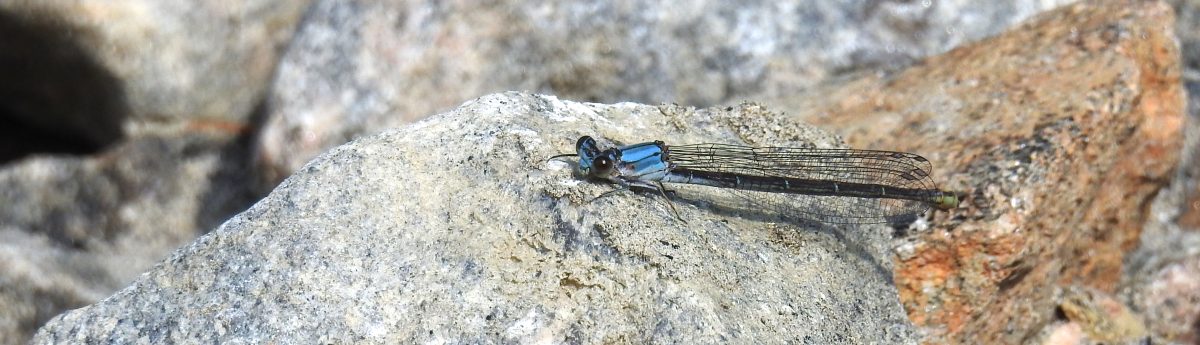
Stream Bluets were also flying. These handsome black and blue damselflies can be identified by their mostly black abdomens with blue rings, the shape of the blue markings on the eighth and ninth segments, and the blue eyespots joined by a thin blue bar. As with the Rainbow Bluets, Hurdman is a good place to find these damselflies in good numbers.

Eastern Forktails were around, as usual, and this one posed nicely for me on a leaf.

Powdered Dancers have emerged; like the Eastern Forktail, they come in different colours. Young Powdered Dancers (like this one) are pale brown; while the males develop an extensive whitish pruinosity on the thorax and the tip of the abdomen which gives them their “powdered” appearance, mature females become powder blue. The thick ovipositor at the tip of the abdomen indicates that this individual is a female.

Hurdman Park is a great spot along the Rideau River to see all sorts of bugs, and my search for damselflies there was highly successful. I was happy to see that all the usual species – except for the Elegant Spreadwing – were flying, and to find a few other colourful and interesting insects as well. The Nessus Sphinx month was a particular favourite of mine, one that I hope to find again in the future.

 OdoNotations