
On July 17th, Chris Lewis and a few other friends and I went dragon-hunting at Petrie Island. Although the morning started out cool, it quickly warmed up, and as a result we saw lots of great bugs. We started our outing by searching the vegetation between the parking lot and the first small bay, usually a productive area for some of the smaller dragonflies and damselflies. This is the only spot at Petrie Island where I’ve seen Vesper Bluet and Orange Bluet, and we spent a good half hour examining the shrubs for these small damselflies. Although both species are considered common in the Northeast, Petrie Island is the only place where I’ve seen them. However, both species are more active later in the day, and since I usually do my birding and ode-hunting in the morning and early afternoon, it is possible I’ve missed them in other places.
We didn’t have any luck with any Orange Bluets, but we did find a couple of Vesper Bluets sitting on various leaves. These blue-tipped, black and yellow damselflies are quite striking. They prefer lakes, ponds, and slow rivers with floating vegetation, although they don’t often emerge to perch on lilypads until late afternoon. It seems to me that they should be present in other places around Ottawa with suitable habitat, such as Mud Lake, Roger’s Pond, Morris Island, Bruce Pit, and the Richmond Lagoons. Or perhaps they are present, and I’m not checking these areas late enough in the afternoon. Perhaps this is a project for next year!

A few Skimming Bluets were also perching in the vegetation. This is one of our easier bluets to identify, with its almost completely black abdomen, the completely blue 8th and 9th segments, and the wavy blue marking on the side of the second segment.

After coming up empty in our search for Orange Bluets, we headed over to the Muskrat Trail next. There we found a couple of Blue Dashers, a Swamp Spreadwing, and a colourful Banded Longhorn beetle. There didn’t seem to be much else of interest along the Muskrat Trail so we headed over to the Bill Holland Trail next. We found lots of Slaty Skimmers and Blue Dashers in the vegetation next to the water, most of them males fighting for the best perching spots. I was happy when I found a few dragonflies perching on the tops of the Pickerelweed stalks and spent quite a bit of time photographing them. The sun was not in the optimal position, but I am happy enough with the resulting photos!


This male Blue Dasher was perched in a better position. Unfortunately he didn’t stay long as he darted out after another Blue Dasher flying by.

In the vegetation along the quiet waters of the Beaver loop at the end of the Bill Holland Trail we found our first Widow Skimmers and Twelve-spotted Skimmers of the day.

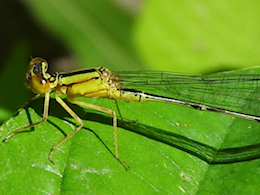
We didn’t see any Hackberry Emperors or Lilypad Clubtails at the end of the trail, but a female Eastern Pondhawk posed briefly for us on a leaf of the same colour.

Another Slaty Skimmer perching on the Pickerelweed was too pretty to ignore.

On our way back we saw a large Prince Baskettail flying above the sandy area. It’s been a while since I’ve seen one of these up close, so I determined to catch it – and did! I took some photos of the dragonfly in my hand before showing the group, and then Chris held it between her fingers so I could get a nice dorsal image of it. Unlike the other baskettails in our area the Prince Baskettail has dark spots in the center and outer edges of its wings. It also has pale horizontal marks across the abdomen instead of yellow rectangles along the outer (lateral) sides of each abdominal segment. And unlike the Spiny and Beaverpond Baskettails, I rarely see Prince Baskettails perching.

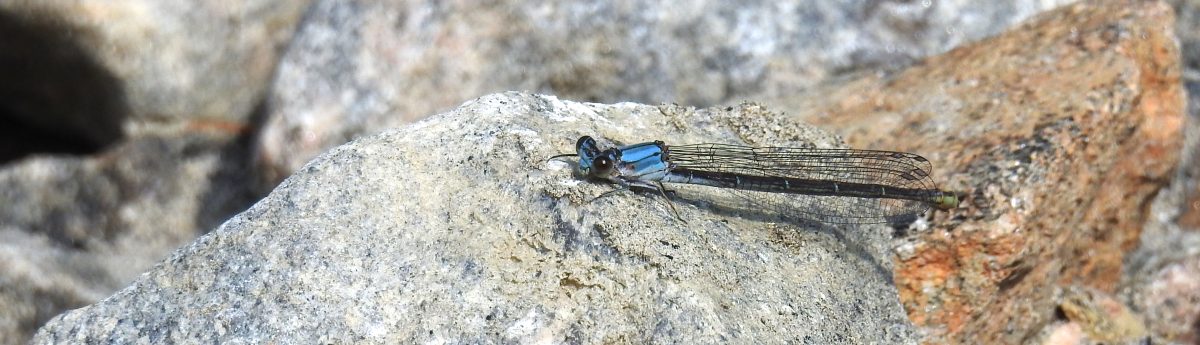
Other odes seen but not photographed include Marsh Bluet, Tule Bluet, Eastern Forktail, Common Green Darner, and Dot-tailed Whiteface. This Fragile Forktail was the the 14th and final species of our walk. This is the first one I’ve photographed that is blue on the thorax instead of green, making it an immature male. The pale exclamation points on the thorax and the lack of any blue markings at the tip of the abdomen are diagnostic.

We saw and heard the usual birds of Petrie Island on our walk, including a Marsh Wren, Solitary Sandpiper, two Green Herons and two Virginia Rails along the causeway, and Wood Duck, Great Blue Herons, Osprey, four species of flycatcher, House Wren, Common Yellowthroats, American Redstarts, and Yellow Warblers elsewhere.
We didn’t do very well in the butterfly department at all – we saw no hairstreaks, anglewings (such as Mourning Cloaks or Eastern Commas), Monarchs, Hackberry Emperors, or Bronze Coppers. Although Petrie Island isn’t a top butterfly destination, I usually see at least one or two of these species on any given visit during the summer. Instead all we saw were Cabbage Whites.
Still, it was a highly enjoyable outing for odes, even if we didn’t see any Lilypad Clubtails or Orange Bluets. The abundance of odes alone makes it worth visiting, as it is always a delight to watch the numerous skimmers battling for territory, chasing females, and hunting bugs along the shores of the shallow bays.

 OdoNotations