

On August 7th I met up with Chris Lewis at Shirley’s Bay for a morning of birding and dragon-hunting. The morning got off to a great start when I saw a group of Wild Turkeys along Rifle Road even before I met Chris at the parking lot; there were two adults and a couple of baby turkeys. At Shirley’s Bay Chris and I tallied 44 species altogether, including a juvenile Osprey which landed in the Osprey nest down the road, five Common Terns and 11 Caspian Terns flying about, a Pectoral Sandpiper, a Semipalmated Sandpiper, a Solitary Sandpiper, and a single American Wigeon in the bay with the usual dabbling ducks, and a flock of migrating songbirds in the woods. The flock included a Yellow Warbler, a Chestnut-sided Warbler, a Black-and-white Warbler, and a couple of Gray Catbirds, and a Rose-breasted Grosbeak.
From there we drove over to the Bill Mason Center, parking in the subdivision rather than at the school. We headed directly for the sandy pond, but before we had even gotten out of view of the car we saw a Saffron-winged Meadowhawk perching on a flower next to the trail.

At the pond, we found a good selection of odes. We checked the weedy spit where we had seen the Leonard’s Skipper last year but came up empty; however, a single male Calico Pennant and several Saffron-winged Meadowhawks were busy skimming along the water’s edge or hunting from exposed perches. The dark red male Saffron-winged Meadowhawks in particular preferred to hunt on the wing, rarely perching for more than a moment before darting out after a small fly or another meadowhawk. The females seemed much more inclined to rest for a while, such as this one.

Another pennant fluttered by, and when it landed we identified it as a Halloween Pennant – a species I have never seen here before. There were at least two in the area, and given their appearance here and at Andrew Haydon Park, it seems they’ve had a good year, turning up in good numbers in a lot of different places. I wonder if that means we will see lots of these guys next year?

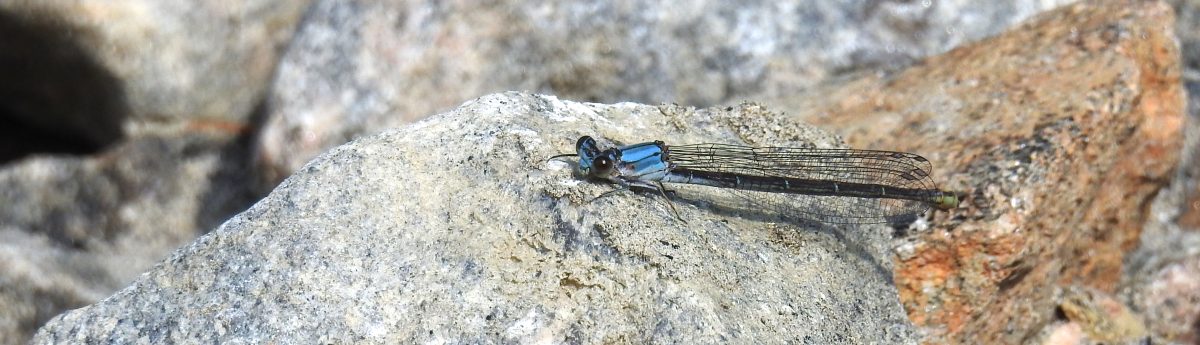
We saw a few Eastern Forktails and a couple of Azure Bluets on the spit, and then this fellow caught my attention. The amount of blue on the abdomen ruled out Azure Bluet, so after photographing it I caught it and gave it to Chris. She identified it as a Northern Bluet, a species that is typically associated with fishless ponds.

We made our way along the edge of the spit, seeing more and more Azure Bluets as we went. The huge blue eyespots were particularly noticeable:

As I scrambled along a particularly steep section, I startled a Bullfrog sitting at the edge of the water. It jumped into the pond where it lazily floated with its head above the water and its legs dangling down.
We made our way around the pond where we saw a Common Green Darner zip by, a Widow Skimmer, an Eastern Pondhawk, and a surprise Slaty Skimmer. I’d never seen this species at the Bill Mason Center before either, and wasn’t able to photograph it before it flew. Chris also saw a Black-shouldered Spinyleg, another new species for the pond, but I missed it. This Calico Pennant was much more cooperative; it is always a treat to see these colourful dragonflies!

We walked along the shore to the north end of the pond where the blackberry brambles grow so thickly, helping ourselves to a couple of juicy blackberries along the way. I reached out my hand to grab an especially plump-looking berry and suddenly found myself staring at this alien creature resting on a branch.

There were quite a few meadowhawks in the area, including a red male with a reddish face which we caught and identified as a Cherry-faced Meadowhawk. We also saw a few White-faced Meadowhawks….

…and lots more Saffron-winged Meadowhawks.


An Azure Bluet with a bent wing caught my attention. Many odonates are able to adapt when one wing gets damaged, or is even missing; this one had no problems flying off when I got a little too close with my camera.

It wasn’t until after I got home and looked at my photos that I realized that it had a worse problem than a bent wing – it had mites on its eyes. Water mites attach themselves to dragonflies and damselflies in their final larval stage under water just before they emerge. When the ode climbs up onto a rock or a stem, it bursts out of its exuvia, and the mites quickly attach themselves to the teneral, piercing its soft body in order to obtain nourishment. The mites feed on the ode until it returns to water to reproduce. They then detach, re-enter the water, and set about completing their own life cycle. The odonate not only becomes a source of food for the mites, but also a form of transportation as the mites use them to travel to new water bodies in which they can reproduce. They are thus known as phoretic parasites.

The Bill Mason Center continues to be a great place to see a variety of odes, even into the beginning of August. For such a small pond it attracts a number of interesting species, with new species still turning up. It will be interesting to see if the numbers of Blue Dashers and Halloween Pennants increase next year – and what species will turn up there next!

 OdoNotations