
On Sunday of the Labour Day weekend Chris Lewis and I spent the morning and early afternoon looking for birds and bugs. We met at Mud Lake at 7:00 am to check out the warbler action, then headed over to Trail 10 once the day warmed up and the trails started becoming busy. Once we were finished there, we returned to Mud Lake to look for odes. It was a good morning with a lot of walking, and we saw a lot of different things.
Our first visit to Mud Lake lasted just over an hour. We started out at the ridge, where the sun was just hitting the highest branches of the trees. The warmth of the sun stirs the insects into activity, which then attracts all sorts of insectivores looking for food. We did see a good number of birds in the tree tops, including a couple of Nashville and Cape May Warblers, several Tennessee and Yellow-rumped Warblers, and at least three Eastern Phoebes. Warbling Vireos were still singing, and a couple of Red-eyed Vireos were foraging low enough in the trees to identify them without hearing their familiar song.
In the meadow I spotted a dew-covered Bumble Bee clinging to a stalk of purple flowers and took a few photos. I’ve always wanted to photograph a dew-covered dragonfly, but in their absence this would have to suffice!

It was warming up by then, so we headed over to Trail 10. Chris had expressed an interest in visiting it as it’s a favourite spot of Jon Ruddy, who has turned up some great birds here in the past couple of weeks, particularly warblers and flycatchers. There’s a nice spot along the shoreline of the river that looked like it might be good for odes, too, so we parked at the Hastings Street entrance and walked west toward Shirley’s Bay. The warbler action was much quieter here than at Mud Lake, and most of the ones we did see were around Shirley’s Bay, including two Nashville Warblers, two American Redstarts, and a Magnolia Warbler.
We spent a good portion of our walk ambling along the river. There was nobody else around; it was foggy out on the river, with the mist obscuring Shirley’s Bay dyke. This made for a pleasing background, so I photographed a Great Black-backed Gull resting on a rock just as it flew off.

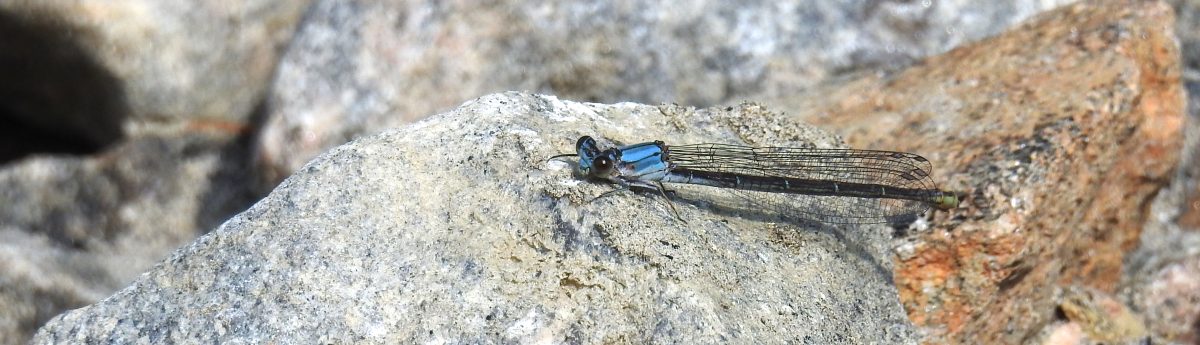
We saw a couple of bluets along the shore, and when we caught one we identified it as a Tule Bluet. I was surprised by how few damselflies there were – with all the sparse vegetation growing between the rocks it seemed like there should have been more bluets and a few Eastern Forktails around.
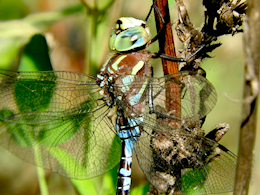
We visited a large opening on the way back to Hastings Street and started walking through the sparse, knee-high grass hoping to scare up a few dragonflies. We got lucky and found a Lance-tipped Darner, and fortunately we were able to see where it landed. I was hoping to find a Shadow Darner, as this was the only regularly-occurring darner species I haven’t yet seen this year, but as I’ve photographed few darners in Ottawa so far this year I was glad to get a few shots.

As the variety of dragonflies was not as good as we were hoping, we returned to Mud Lake chiefly to check out the eastern part of the conservation area where I had had such excellent luck on Friday.
We didn’t see any bluets on the shoreline east of the filtration plant, but a Black-bellied Plover and a large turtle (possibly a Map Turtle) on the rocky spit in the bay were great to see. The only darners we saw at Mud Lake were Common Green Darners, one of which landed in the vegetation in front of us; I will have to wait another day to see my first Shadow Darner of the season.

We went to the eastern edge of the lake that had proved so productive on Friday, and I found another Fragile Forktail in the same area, though it didn’t stay long enough for a photo. The usual White-faced Meadowhawks were present as well.

From there we walked to the small storm water pond but didn’t see much of interest other than a few Eastern Forktails and Slender Spreadwings.
The season is definitely winding down, with very few ode species around. Altogether we tallied the following species in our time at Mud Lake and Trail 10:
- Slender Spreadwing
- Eastern Forktail
- Fragile Forktail
- Tule Bluet
- Common Green Darner
- Lance-tipped Darner
- White-faced Meadowhawk
I don’t even recall seeing any Autumn Meadowhawks, a species that should be abundant right now.
This would probably be my last ode outing of the year, particularly now that migration is fully under way and there are way more bird species to be seen than ode species. It’s been a great season, however, and while putting away the net for the season makes me a bit sad, fall migration and the early winter season can be so dynamic that there will be more than enough to keep me occupied in the coming months.

 OdoNotations