

The Equinox fell on Thursday, and by then the winds were blowing down from the north, putting an abrupt end to summer. Although I quite love the crisp, cool days of fall, I hate the cold early mornings which require hats and gloves to stay warm. This morning I headed out to Jack Pine Trail, leaving at 8:15 – the sun is visibly lower in the sky now – and I wished I had brought gloves as my hands were so cold. A Blue Jay and some chickadees were feeding on seeds left on the ground in the parking lot, and it seemed strange not to hear any Red-eyed Vireos or Eastern Wood-pewees singing.
I decided to take the outermost (fourth) loop of the trail, and was happy to see that the stream at the back was flowing with water again – the drought is over, but I suspect many species were affected when the stream dried up earlier this year.
There weren’t too many insects flying; I found a White-faced Meadowhawk, an Autumn Meadowhawk, and a single darner. The darner zoomed past me and landed in a shrub, and I was happy to identify it as a Shadow Darner – my first of the year. I’ve been looking for this species for a while now, particularly at Mud Lake, Shirley’s Bay, and Andrew Haydon Park as I nearly always find them close to the river. It was a bit of a surprise to find one here at Jack Pine Trail!

I finished my walk with only one warbler on my list, the Ovenbird; this was strange to me as there are lots of good edge habitats which should have been dominated by Yellow-rumps, if nothing else.
By the time I left it was 11:00 am and the parking lot was full – I thought that was strange for such a cold morning, but it seems the trails are busier in September and October than the summer. It was warming up, but the wind was still cold, and as I wasn’t ready to go home yet I headed over to the Richmond Lagoons where I was disappointed once again to see no water in any of the cells. Sparrows were very much in evidence as I walked toward the Jock River at the back of the conservation area – I found migrating White-crowned and White-throated Sparrows as well as the resident Song and Swamp Sparrows. In the woods I was surprised to hear a Brown Creeper singing; this is not a species that I usually hear singing in the fall, unlike the Ruby-crowned Kinglets and White-throated and Song Sparrows.
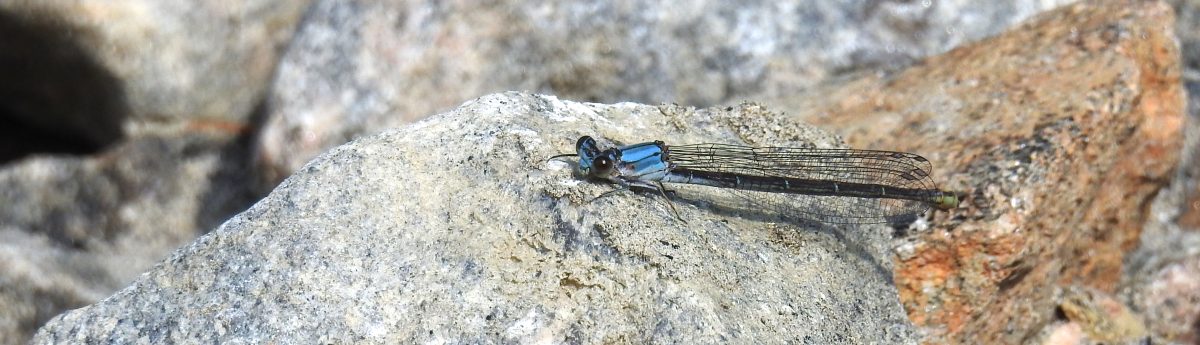
A few odes were still flying, including a White-faced Meadowhawk and this Spotted Spreadwing. The Spotted Spreadwing is one of our latest flying damselflies, and can sometimes be found flying in October.

I was hoping to spot some more darners in the vegetation around the ponds but didn’t see any. Still, I was happy to find a few odes still flying despite the overnight drop in temperature and low water levels in the lagoons and streams; hopefully we will receive more rain next year and our waterways will once again support an abundance of odes!

 OdoNotations