
Doran and I spent a week in Costa Rica from May 27 to June 3rd. We’d been planning this trip since February, and it was a thrill when we finally landed in Costa Rica after a 4:00am start that took us first to Toronto, then to Liberia after a five-hour flight down through Florida and across the Caribbean Sea. When we left Ottawa it had been cool and rainy, but the moment we stepped outside of the airport we were engulfed by the heat and humidity of the tropics. Although the humidity of the 30°C days seemed unbearable at first, we grew used to it by the end of the week – although any sort of exertion (such as hiking up the slopes of the volcanoes in the rainforest) was uncomfortably sticky. Still, we were thankful for the air-conditioning of the van that drove us to our resort, the Occidental Papagayo located on the Gulf of Papagayo in Guanacaste, about a 25-minute drive from the airport.
The resort was beautiful…it was built onto a long, sloping hill and contained large expanses of lawn, clumps of palm trees, mango trees, and other tropical trees, and a beach composed of sand and rocks. As the rainy season had started about a month ago, everything was lush and green, with flowers blooming on trees and shrubs.


I was immediately distracted by all the insects flying about, mostly dragonflies zipping through the air and butterflies flying from flower to flower – I had never seen so many insects on the wing before, reminding me once again that I was far from the cold Canadian north. I wanted to rush out and look at everything, though first we enjoyed a drink as we waited to check in.
Once we deposited our belongings in our room and spent some time getting to know the resort I was impressed by all the lush vegetation and green space between buildings. While the lawns and shrubs around the buildings and pool were all clipped and manicured, the areas around the fringes – particularly around the cliff and the area near the beach entrance – were allowed to grow more naturally, although I suspect this may change in the future as the resort was busily building another pool near a large grove of trees. Still, there were lots of trees and shrubs to attract a variety of birds, and even the blossoms of the hedges attracted a good number of butterflies. This was quite different from the resort we stayed at in Mexico, which was much smaller, and had a higher concrete-to-grass ratio.


Even though our room was at the bottom of the hill, far from the front desk and the dining room in the main building at the top of the hill, we were surrounded by nature – exactly what we had wanted!

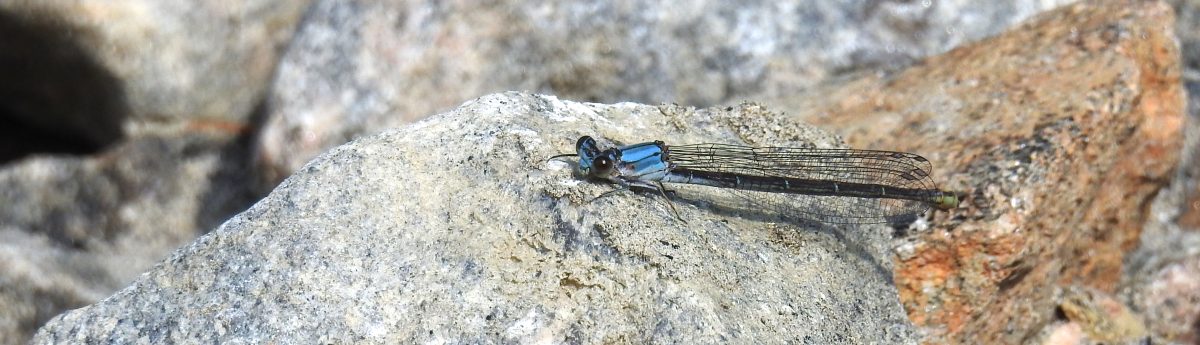
I saw a variety of birds on the resort during the course of the week, and enjoyed the huge iguanas on the walkways and the family of howler monkeys that lived in the trees. Butterflies were numerous, but after our initial arrival dragonflies were not. I found only a couple of dragonflies perching on our first day. I saw one land in the small hedge just outside our room and went to take a look. It was relatively plain, though the orange colour near the tip of the abdomen made me wonder if it had originally been more colourful in its teneral stage, or if it would change into something more colourful as it aged.

Unfortunately the wildlife guide I had bought – The Wildlife of Costa Rica: A Field Guide by Reid et al., published by Cornell University Press – only has one odonate in it, the spectacular long-winged Helicopter Damselfly. I didn’t have any other field guides, so after I got home I set about some online sleuthing in order to identify the handful of dragonflies I ended up photographing. First I found a reasonably comprehensive online list of Costa Rican dragonflies, then I checked each one by doing Google image searches to search for likely candidates. Fortunately I was able to narrow them all down to the skimmer family, which reduced the number of species I had to check. I managed to identify all of the five species I photographed this way – it’s a tedious way to ID a dragonfly when you don’t have a field guide for the appropriate area, but sometimes persistence pays off!
Though I initially believed this one to be a female Reddish Dragonlet based on the faint yellowish tint at the base of the hindwings and the long yellow stripe running all the way up the thorax and into the back of the head, I was informed by Dennis Paulson on iNaturalist that that species does not occur in Costa Rica…so much for identifying species through the internet! Instead, it is a Black-winged Dragonlet, which I would not have guessed as it appears to lack the eponymous black wings.

I only photographed one other dragonfly on the resort. This individual with mostly black wings was perching on the cliff on the other side of the safety fence. It was easier to identify given the wide black wing patches – the only other similar dragonfly, the Band-winged Dragonlet, has a much narrower black band which does not reach the base of the wings. Other identifying features include the black face and eyes, dark abdomen, and tan appendages. I am not sure why some individuals have clear wings and others have black wings; according to the photos on the Arizona Dragonflies site (where a small colony showed up suddenly one year), immature males and females (which have yellow bodies with black markings) sometimes have clear wings and sometimes have dark wings. Perhaps its a regional difference, or perhaps they are just variable!

The only other dragonflies I saw was the day I hired a bird guide for a tour in the Palo Verde area. Olivier (pronounced Olive-YAIR, not O-liv-ee-ay) Esquivel of Natural Discovery was recommended to me by another tour guide who was unavailable for any one-day birding tours during our week, and has excellent reviews on several internet sites including Trip Advisor and Birdforum.net. Ollie, as we were told to call him, met us at the resort gate at 6:00 am, which isn’t as bad as it sounds since we were still operating on Eastern Daylight Time, which is two hours ahead. I liked him right away, as he managed to project both experienced professionalism and keen enthusiasm during our initial meeting, and his knowledge quickly became apparent during our time together.
The half-day tour included a boat ride on the Tempisque River followed by some walking and driving. We dropped in at Filadelphia to buy some breakfast, then continued on our way south to the boat dock on the Tempisque River, picking up some cool birds along the way. When we reached the boat dock at 7:30 my attention was drawn to the large green and black dragonflies buzzing around. Unlike the dragonflies on the resort, these ones seemed to have no aversion to perching on the ground, and when one landed I immediately took the opportunity to grab a few photos. It looked like a longer, thinner version of our Eastern Pondhawk, and eventually I confirmed its identity as a Great Pondhawk by checking the skimmer family on the online list of Costa Rican dragonflies. It was a striking dragonfly with its deep green and black colouration.


We saw a number of birds on the boat ride, though I was hoping for dragonflies as well. The only one that came close was a Great Pondhawk flew in and out of our boat – only the top was covered – and eventually landed on the side of the boat. I wished that all of the dragonflies in Costa Rica were so accommodating.

After the boat tour we did some birding down a dirt road which was initially lined with trees on both sides before opening up onto a large field on the right-hand side. The mosquitoes in the treed area were terrible, and even though we sprayed up with Deep Woods Off! both Doran and I got bit – the nasty little creatures even bit me right through my clothes in several places.
It was a relief to enter the sunlight again where we found quite a few dragonflies buzzing about, but none were as friendly as the Racket-tailed Emeralds in Ottawa that snap up the flesh-eating mosquitoes and deer flies that swarm people. There were quite a few colourful reddish dragonflies, and I managed a slightly blurry shot of one that was a brilliant shade of rose pink. It looked similar to the Roseate Skimmer which I hoped to see on my Florida trip, except the face and eyes were bright red. As the eyes and face of the Roseate Skimmer are usually darker than the body – either a deep purple or dark red – I identified this as a Carmine Skimmer, which was split from the Roseate Skimmer some ten or fifteen years ago. This species ranges from Central Texas and Arizona south into Central America, preferring ponds and still water with abundant shade. While the male Roseate Skimmer has a pink abdomen and violet-coloured thorax, the abdomen and thorax of the Carmine Skimmer appear to be the same colour.

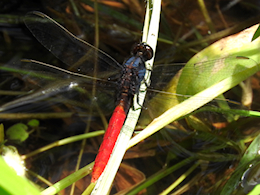
This dragonfly is a Flame-tailed Pondhawk, and was found resting near the bottom of the wet ditch running next to the road. I identified it by doing Google image searches on every skimmer on this list of Costa Rican dragonflies linked above. It helped that I recognized it as a skimmer rather than, say, a darner or clubtail; the thick body and the fact that it was sitting still ruled out the other dragonfly families, though I wouldn’t have guessed it was a pondhawk!

Although Costa Rica was everything I had hoped it would be, from the tropical heat to the abundance of insects and Central American birds, from the wild mammals on the resort to the beautiful Gulf of Papagayo sparkling just outside our door, I was really hoping to find more odes. Though I only saw these four species, it was a nice (though brief) introduction to the skimmers that live in Costa Rica, and I especially loved the colours of the pondhawks and Carmine Skimmer!
Species Observed:
- Black-winged Dragonlet (Erythrodiplax funerea)
- Great Pondhawk (Erythemis vesiculosa)
- Carmine Skimmer (Orthemis discolor)
- Flame-tailed Pondhawk (Erythemis peruviana)

 OdoNotations