
When I got back from Costa Rica I didn’t much feel like doing any birding back here in Ottawa. I’d been spoiled by all the colourful, tropical birds and exotic species that I’d seen – Costa Rica was a dream come true for me, and it was hard to return to reality. As soon as I got back I started thinking about a return trip there, wanting to spend more time in the rainforest so I could see birds such as Cotingas, Jacamars and Bellbirds. And oh, the hummingbirds and tanagers there!
It was difficult to get excited about birding in Ottawa, and the weather didn’t help. It was cold and rainy when we left and still cold (only 16°C) when I returned. The thought of going dragon-hunting stirred my interest somewhat, and when the weather warmed up the weekend after we got back, I decided it was time to take my net out of hibernation.
Sunny skies and temperatures already climbing into the double-digits greeted me this morning as I headed out to the Bill Mason Center. When I arrived I saw a couple of Barn Swallows flying over the parking lot and the lawns closest to the school; I didn’t hear any meadowlarks in the field next door, which was unusual. I also didn’t hear any rails in the marsh, which was a bit disappointing. And, for the first time, I heard more Willow Flycatchers than Alder Flycatchers – two compared to zero. At least the Willow Flycatcher was another bird for my year list!
I proceeded to the sandy pond where I hoped to have better luck with the dragonflies. I was delighted to see lots of them flying about, scared up from the vegetation as I walked by only to land a short distance away. One was a lovely Four-spotted Skimmer:

Another was a teneral Calico Pennant with a faint pattern on its wings. The colours will eventually darken as it ages, and, if it is a male, turn bright red in colour. They are one of my favourite dragonflies, and I was happy to find one so easily.

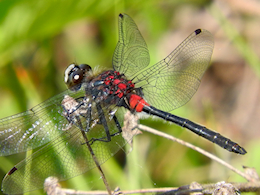
The majority of the dragonflies turned out to be Crimson-ringed Whitefaces. It’s interesting that of all the trails I visit on the Ontario side, the Bill Mason Center is the only place where I see this species in any numbers. They prefer sparsely- to well-vegetated, boggy lakes, ponds, and marshes in forested areas (Dunkle 2000, Nikula et al. 2002, Paulson 2009), so I’m not sure why they don’t turn up at Bruce Pit, Mud Lake or Roger’s Pond. The red markings along the thorax and the bright red first three segments of the abdomen make this a particularly handsome member of the whiteface family.


As I was walking along something large buzzing on the ground caught my attention. It had the shiny wings of a large teneral dragonfly, but it appeared to have difficulty flying.

I wasn’t sure what it was at first, so I put the tip of my finger beneath its front legs and waited for it to climb up my finger and latch on. When it did, I picked it up for a closer look. Then I saw the faint, dark spots on the wings. Those, along with the pattern on the abdomen, identified it as a Prince Baskettail. One of its wings seemed slightly damaged – a little crinkled in the middle, but not torn – and I wondered whether it could fly. That question was answered a moment later as it fluttered its wings a few times, then flew up into the air toward the tree tops.

Not long after my encounter with the Prince Baskettail, a Common Whitetail and a pair of mating Crimson-ringed Whitefaces caught my attention.

After watching the dragonflies for a while I headed back through the woods to the open meadow at the back. The birds here were more interesting – in the woods I heard a Scarlet Tanager, a Winter Wren, an Ovenbird, a Yellow-bellied Sapsucker, and at least four Veeries. In the meadow I heard two White-throated Sparrows, a Rose-breasted Grosbeak and a Nashville Warbler. I also came across a Snowshoe Hare eating the grass next to a bench in an outdoor classroom area. I have seen them in this area a couple of times now; I used to see them in the woods and at the edge of the lawn near the parking lot, but I suspect the trails are so busy now that they’ve retreated to the quieter parts of the property.
A few more Crimson-ringed Whitefaces were sitting in sunny areas along the trail on my way out.

A Northern Waterthrush singing in a wet spot in the woods was the last new year bird of the day. On my way back along the northern boardwalk I saw a medium-sized bird land in a tree on the far side of the marsh. I got my binoculars up in time to realize that it was a cuckoo, but I didn’t get my camera up in time to take a photo. It was probably a Black-billed Cuckoo, a bird I still needed for my year list, but at least one Yellow-billed Cuckoo has been seen regularly on Dunrobin ridge, so there is a slight chance this was another. Yellow-billed Cuckoo would be a lifer for me.
I also saw a small butterfly fluttering along the boardwalk. It would land ahead of me for a moment, and then when I walked too close to it, it would fly further down the boardwalk and land again. We continued on this way until it found a piece of scat it was interested in. Then I was able to get close enough to identify it as an Eastern Pine Elfin, one of the gossamer-winged butterflies. This was my first Eastern Pine Elfin in quite a long time, and I was so thrilled with the sighting that I followed the butterfly around far longer than I should have while taking numerous photos of it. There’s always something unexpected at the Bill Mason Center, and between the gorgeous Crimson-ringed Whitefaces and the Eastern Pine Elfin, I thoroughly enjoyed my time there – despite the cuckoo that got away!

 OdoNotations