

I have never really spent much time looking for odes at the Eagleson storm water ponds, as most of my outings start there first thing in the morning when it isn’t hot enough for many dragonflies to be flying. However, after seeing the unidentified female spreadwing there on Saturday morning, I decided to head over on Sunday after my visit to the Old Quarry Trail. While I’ve seen Common Green Darners, Twelve-spotted Skimmers, Autumn Meadowhawks, Eastern Forktails, Tule Bluets, and Familiar Bluets there since the reconstruction, the arrival of the unidentified spreadwing and even the Delaware Skipper made me wonder whether other species had taken up residence recently. I wasn’t expecting anything too exciting or unusual, but I figured I might at least see some of the common pond skimmers found nearby at places like Bruce Pit and Stony Swamp. Perhaps I should have raised my expectations a bit, for what I found there surprised me!
I headed down to the small, mucky crescent bay next to the small building along the central pond. I thought the vegetated pond edges might turn up something interesting, and I was right: the first dragonfly I saw was a Common Whitetail, one of the common pond skimmers I was hoping to see as I haven’t recorded it here before. It is one of the most frequently seen species around lakes and ponds in our area, and probably the dragonfly I would have ranked at the top of the “expected species” list.

Up on the bank, I caught a flash of movement as another dragonfly landed on a stalk; it was a Twelve-spotted Skimmer, a species I’ve seen here before. It, too, is a member of the skimmer family, a group that it is known for its stout, tapered body shape and patterned wings that are longer than the abdomen. Skimmers are usually the first type of dragonfly that casual observers notice, as they are more abundant than any other type of dragonfly and regularly perch at the edges of ponds and in fields where they are easily detected.

Meadowhawks are also members of the skimmer family, and are commonly seen around fields and grassy areas. There were a couple near the water’s edge, and when I saw the reddish faces I assumed they were Autumn Meadowhawks or Cherry-faced Meadowhawks. Then I realized they weren’t acting like either species – meadowhawks are usually easy to photograph, perching on the same leaf or stick for long periods of time in between sallying out for insects. These two males would only land for a few brief seconds before flying out over the water and hovering near the shore. I usually don’t see White-faced, Autumn, or Cherry-faced Meadowhawks do this…but I have seen the Saffron-winged Meadowhawks at the Bill Mason Center do this! When I got home and looked at my photos I noticed the black legs, the absence of black triangles along the abdomen, and could just make out the yellowish tinge to the leading edge of the forewings thus confirming its identity.

This was an amazing find. Saffron-winged Meadowhawks are considered an uncommon and somewhat local species in Ontario, and while Chris Lewis and I used to see them at the Bruce Pit before the cattails took over the southern edge of the pond, the Bill Mason Center has become the most consistent place to find them. Finding two males here at the Eagleson ponds was an exciting discovery!

Less exciting, though still of interest was a male Eastern Pondhawk perching on the mat of vegetation in the water. This was also the first time I’d seen one here, and I came across a few others on the rocks along the pond’s edge on my walk. I checked each one in case a Blue Dasher was masquerading as a pondhawk, but didn’t see any.


I checked the Crown Vetch area for spreadwings and had no luck. However, I added yet another new species to the list when I saw this immature Widow Skimmer perching close to the shore. This individual is a young one, and probably recently emerged nearby, indicating that this species may now be breeding here too!

I crossed the bridge and continued checking the shoreline of the central pond. A Prince Baskettail was flying over the water, too fast and too far out to consider photographing; this was the only non-skimmer dragonfly of the day. I recalled seeing a smaller baskettail earlier in the season, but it wouldn’t land, and without my net I wasn’t sure whether it was a Spiny or a Beaverpond Baskettail. Both species are finished for the year now, so I will have to wait to next year to see if any of the smaller baskettails return.
A bright orange insect resting on the mat of vegetation close to where the Prince Baskettail was patrolling caught my attention. I was stunned – it was a male Eastern Amberwing, a species that I normally have to go to Petrie Island to see! I made my way down through the vegetation to the water’s edge in order to photograph it. I was thrilled – this discovery was more exciting than that of the Saffron-winged Meadowhawk, for the Eastern Amberwing is a relatively new addition to Ottawa’s list of odes.

I moved along the shoreline, scanning the green mat for more Eastern Amberwings and finding only one other male when I saw a female perching on a tall stalk. I took a few photos before she moved to a different location, eventually flying up into the dense group of pines on the other side of the trail.

Although female Eastern Amberwings lack the bright carnelian orange wings of the males, their wings are just as pretty with intricate brown patterns on a clear background. The colouration of both sexes, as well as their erratic flight style, small size (they are the smallest dragonfly in our region except for the bog-loving Elfin Skimmer), and the way they twitch their wings and abdomens when at rest give them a distinctive wasp-like appearance which may fool predators into finding less dangerous prey.

Eastern Amberwings are quite territorial, particularly when they discover a high-quality breeding spot. The male will protect it during the day, chasing out other male Eastern Amberwings and courting females passing through. Males have even been known to chase large horse flies and small butterflies after mistaking them for other amberwings. At night, they roost in trees, perhaps explaining why I have never seen any here on my early-morning visits.
I continued around the pond, but was unable to find any other Eastern Amberwings or Saffron-winged Meadowhawks. Still, the fact that I found more than one individual of both species was encouraging, making me hope that they were breeding here, and will eventually establish stable populations!
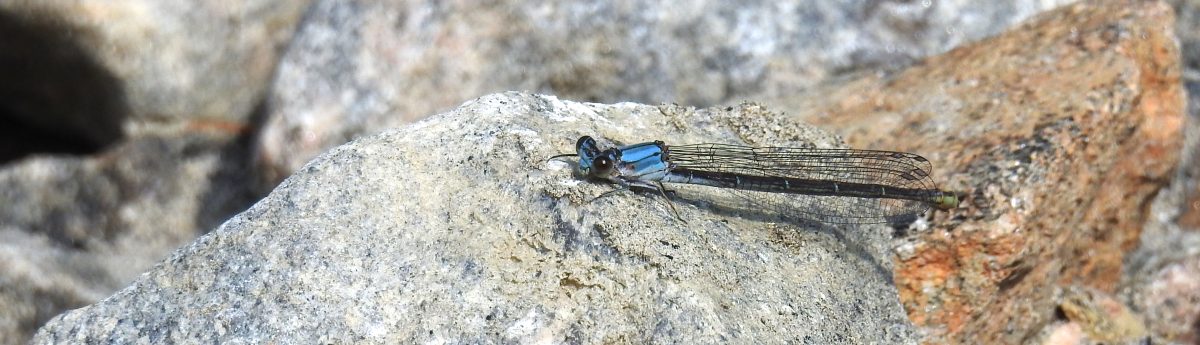
I also saw what looked like a Fragile Forktail in the reeds of the southern-most pond, which was another new species for the ponds. I lost it in the reeds, though, and wasn’t able to photograph it. What really amazed me about all these dragonflies, however, was that only a year ago the ponds were dry and had no water in them – it made me happy to see so many different odonate species recolonizing this spot. I can’t wait to return next season and see whether the Saffron-winged Meadowhawks and Eastern Amberwings were successful in breeding, and if any more new species have appeared!

 OdoNotations