
In late August I took my usual trip to southern Ontario to see my Dad. As usual, we spent a few days at his trailer in the Pinehurst Lake Conservation Area. The birding was fine, although this time there were no flocks of migrants moving through; instead the birds still seemed busy with raising and feeding their young, even this late in the summer. For example, I saw a Red-eyed Vireo feeding a Brown-headed Cowbird, a young Indigo Bunting following its parent around, and a House Wren carrying food. We didn’t see the Broad-winged Hawk family this year either, which was disappointing. However, the insects were fascinating, and I found a lot to photograph.
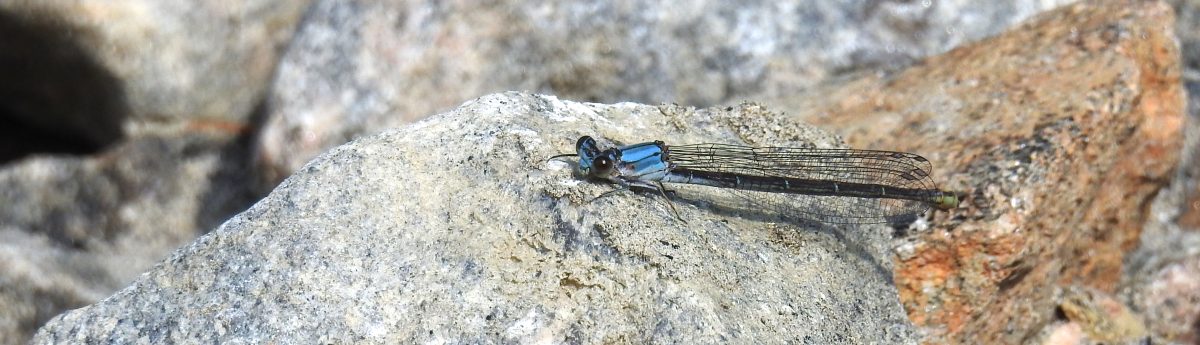
The Conservation Area is a good spot to see odonates in general. Slender Spreadwings are among the most conspicuous damselflies, and I found a couple on my first walk of the trip.

As usual, I spent most of my time on the ridge where the trail climbs above the tree level. This area is open to the sun and has lots of different flowers in bloom which makes it a good spot to find insects and soaring vultures. I was thrilled to find the spectacular Red-spotted Purple butterfly, a subspecies of the White Admiral which has a more southerly range compared to the White Admiral – we don’t have them in Ottawa.
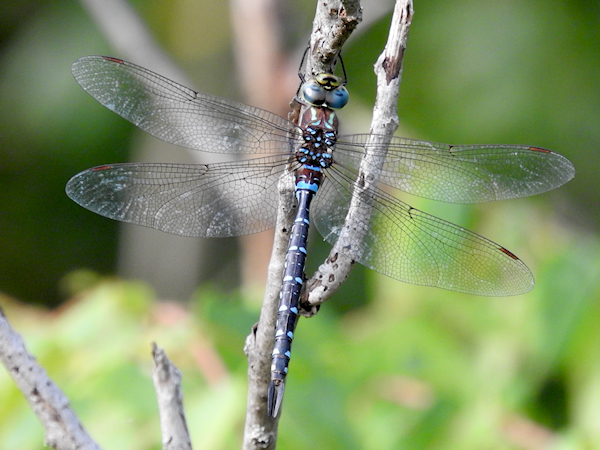
I was hoping to see the soaring darners and gliders that hunt for insects flying high above the ridge; while I didn’t see any gliders this time, a small number of darners were present, all of which were flying beyond the reach of my net. I was disappointed I wasn’t able to catch any, for I’ve seen more darner species here than in Ottawa, and was looking to net something unusual. Finally, I noticed one land, and was happy that it wasn’t just a Canada or a Lance-tipped Darner – it was a Black-tipped Darner! These can be identified by the straight thoracic stripe and the completely black final segment of the abdomen.

The dorsal view shows the entirely black 10th (final) segment of its abdomen for which this species is named:
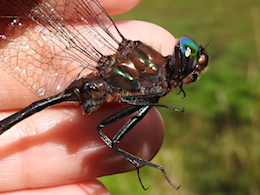
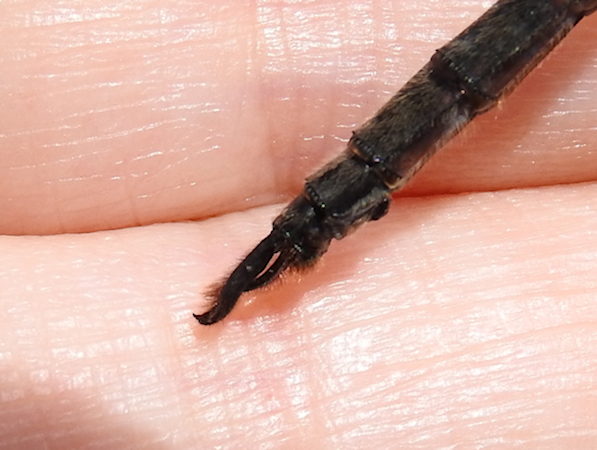
The following day I checked the small swampy area along the main road – it, too, has been great for odonates in the past. I found the Black-tipped Darners and meadowhawks again, but what really caught my attention was a large black dragonfly patrolling the edges of the swamp. I waited a long time on the bank before it flew close enough for me to catch it, and when I did I was happy to identify it as a Williamson’s Emerald! I hadn’t seen one of these in a long time, though I am hoping they emerge in Stony Swamp again next year.

The male Williamson’s Emerald – like the male Brush-tipped Emerald – has hairy claspers but a much longer body.
On our last morning we walked the Morton Trail. My goal was to find some darners to catch in the open field where I caught my lifer Green-striped Darner last year. Unfortunately the morning was cooler and windier than expected, and while I saw a few Monarchs and Common Green Darners, I wasn’t able to catch anything. I was quite disappointed as this field was the best part of my visit last year and I’d been looking forward to going back there ever since I planned my trip.
Southern Ontario is just far enough away that it gets some beautiful species we don’t here in Ottawa, and I am always glad to get away and look for some of these unique butterflies and dragonflies!

 OdoNotations