
The Stony Swamp trail I spend the least time at, other than Lime Kiln, is Trailhead P11 on West Hunt Club. It’s a lovely trail, but it doesn’t have any marshes with boardwalks; the spring flooding requires knee-high rubber boots; and turning left back onto West Hunt Club into the Saturday mid-day traffic can be a nightmare. Still, it’s a great trail system through some prime mixed deciduous and coniferous forest, and I’ve been trying to visit more often to see what kinds of species make their homes here. It’s better for breeding Wood Thrushes than the other Stony Swamp trails, possibly because the forest is denser with fewer open areas, and I’ve had more Broad-winged Hawks here in the summer than anywhere else. I visited one morning in May while on vacation, hoping to find some new species to add to the hotspot list and perhaps to see some butterflies now that the weather has gotten warmer.
The birding turned out to be pretty good, despite the lack of variety in habitats. A Wild Turkey in full courtship display attempted to block my path, but ultimately decided to mosey off into the bush. A single Field Sparrow was singing in the hydro cut, and the usual Swamp Sparrows were at the marsh. Breeding warblers included Black-and-White Warbler, Common Yellowthroat, American Redstart, Pine Warbler, Black-throated Green Warbler, and 12 different Ovenbirds.
The best part of the trail for wildlife turned out to be the wide-open corridor at the back that leads to the Jack Pine loop. Here I observed a gorgeous male Scarlet Tanager singing at the top of a tree in the open near the intersection, an Eastern Kingbird flycatching, and heard both Winter Wren and Veery as well as a Broad-winged Hawk calling from somewhere overhead.
The sunny corridor at the back of the trail was also a terrific spot for insects. I was hoping to see a few butterflies, and was happy when I found my second Northern Spring Azure of the season as well as both Henry’s and Eastern Pine Elfins.
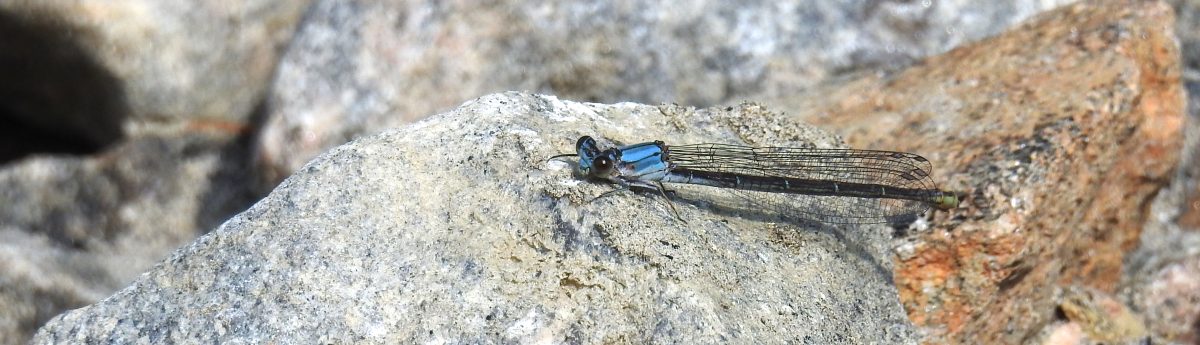
Then something larger zipped by my head, and when I looked up I saw a dragonfly flying off! I followed it for a while, then saw another hunting the vegetation at the edge of the trail. When it landed I was thrilled to see a female baskettail – my first dragonfly of the season! Although female baskettails aren’t as easy to identify as the males, the short cerci (abdominal appendages) indicate that this is a Beaverpond Baskettail, usually my first non-migrating dragonfly species of the year.

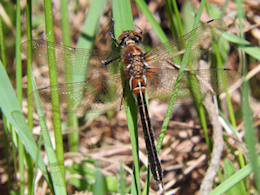
I saw a few more dragonflies flying along the path up ahead, and started walking toward them, flushing a Henry’s Elfin along the way. When I caught up to the dragonflies I realized two different emerald species flying – more baskettails, as well as a couple of American Emeralds. The eyes of both these species develop into various shades of green as the individuals mature; American Emeralds have lovely vivid green eyes, while all four baskettail species have eyes that are more of a turquoise green. The brown eyes of these individuals indicate that they have only recently emerged.

Most emeralds spent more time flying than perching, and often need to be caught with a net in order to identify them. However, I find that early in the season, when they have just emerged, it’s easier to find them perching, particularly the baskettails which spend more time on the wing.

I also saw a couple of small whiteface dragonflies, also freshly emerged as they still had a lot of yellow on their abdomens. Dot-tailed Whitefaces are the most common whiteface species in Stony Swamp, though I’ve seen Belted and Frosted Whitefaces at Sarsaparilla Trail. I was reluctant to leave the sunny open trail and the dragonflies, but it was exciting to know that dragonfly season had officially begun! With so many beautiful insects now taking wing, there’s even more reason to go outside and see what’s around!

 OdoNotations