
During the first week of July my fiancé and I spent some time in Prince Edward County with my dad’s family. We rented a cottage on Loves Lane on Prince Edward Bay, a nice three-bedroom place with 8 acres of land only 20 minutes away from both Sandbanks and Picton. The weather was beautiful, and I spent most of my time getting to know the local residents. On our first full day at the cottage (Monday, July 1st), I went for an afternoon walk on the property to see what I could find. It seemed to be a good spot for odonates; every now and then a couple of Prince and Common Baskettails flew in and started swooping above the deck. There were some other dragonflies present too, so I brought my net out in the hopes of catching one.
The only one I “caught” was this handsome Racket-tailed Emerald which landed on my net voluntarily!

Every now and then a large swallowtail butterfly would fly through the area. Some of these were the Giant Swallowtails I was familiar with in Ottawa, others were smaller yellow ones that were likely Eastern Tiger Swallowtails. To my disappointment, they refused to land.
A closer look around the edges of the property yielded some interesting damselflies. The first was this Sedge Sprite at the edge of the swamp.

An Eastern Forktail flew away too fast for me to photograph, and a Fragile Forktail was very brave landing on the vegetation floating on the water, as the small swamp was full of large tadpoles.
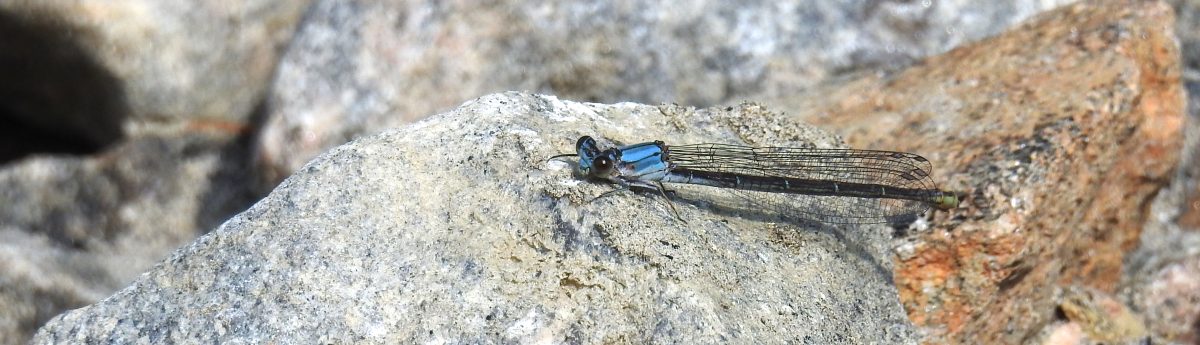
A Taiga Bluet found in the vegetation bordering the parking area surprised me. Normally I stop seeing these guys around the third or fourth week of June, and here was one in July! This is the only “intermediate-type” bluet I can identify without a hand lens, as the large black patch near the tip of its abdomen (segments 5 through 7) is distinctive. Other intermediate types – such as Marsh, Hagen’s, Tule and Familiar Bluets – have the same amount of blue and black which are similarly distributed. Black-type bluets, such as Stream, Azure, and Skimming Bluets, have other identifying features to help distinguish them.

I was excited when I found a spreadwing resting in the vegetation as well. Fortunately it is also one of the easier ones to identify – with the long, thin abdomen and the wings that reach only halfway down the body it could only be a Slender Spreadwing.

I found another spreadwing in the open area of the gravel lane, this one a bright green Emerald Spreadwing. While considered common across North America’s temperate region, with a range extending as far north as Alaska and the Yukon, I hardly ever see this spreadwing in Ottawa any more, even though I used to find them regularly in Stony Swamp. This species has a global range, and can be found across Europe and Asia where it is called the Scarce Emerald Damselfly. They tend to fly early in the season, laying their eggs in temporary pools before they dry up by the end of the summer.
This species is one of our few metallic green spreadwings – the other two, Swamp Spreadwing and Elegant Spreadwing, are both longer and thinner than the Emerald Spreadwing. In addition, I find the two larger species more closely tied to permanent waters, such as the still, well-vegetated bays at Petrie Island or the Mississippi Snye. In contrast, I’ve found Emerald Spreadwings in the grassy vegetation near water-filled ditches and temporary ponds, or along woodland paths in Stony Swamp.

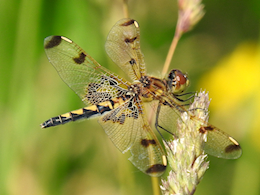
On July 2nd I woke up early, and before anyone else got up, drove 20 minutes to the Macaulay Mountain Conservation Area just outside of Picton. This was the most interesting birding hotspot in our area of Prince Edward County, although only 96 species have been recorded there to date – the 178 hectare (440 acre) property features a large grassy meadow adjacent to a quiet pond, as well as meandering trails through the thick forest leading up to the top of the escarpment. When I got out of the car I was amazed by all the dragonflies I saw skimming through the air – mostly Prince and Common Baskettails – and after I finished birding in the woods, I spent some time around the pond and the meadow to see what I could find. A fresh-looking Calico Pennant was my first good find:

I was surprised to see a clubtail perching on the ground, and when I tracked it down I identified it as a Dusky Clubtail.

I later saw another clubtail land in the tall vegetation that rings the pond. This one was larger, and has bright turquoise eyes – the shape of the claspers (just visible in the image below) identify this as a Horned Clubtail.

The conservation area was a great place to spend some time, so when my family was looking for things to do the next day, I said it would be a pretty place to have a picnic. By the time everyone had finished eating and was ready to go it was past lunch time, so we just went for a walk instead. Because of my Dad’s health we didn’t climb the escarpment but walked around the pond instead. There wasn’t much bird activity, but the dragonflies were quite active; it surprised me how many individuals were present, as they haven’t been particularly abundant in Ottawa this season.
This male Eastern Pondhawk was hanging out at the edge of the water.

I saw a couple of spreadwings in the vegetation emerging from the water, but it wasn’t until I downloaded my photos later at home that I was able to identify this one as an Amber-winged Spreadwing. The wings appear to be tinted gold, and the lower claspers (visible in the image below) are quite short.

We started to walk around the pond but had to backtrack when the trail became significantly narrower and bordered with poison ivy. We returned to the main picnic area, and once again I found two species of clubtail on my walk: a male Dusky Clubtail and a male Horned Clubtail. Once again the Dusky Clubtail was resting on the ground away from the water while the Horned Clubtail was perching on a stick right near the water’s edge.

I find it interesting that these two species were both present here two days in row; it reminds me of how both species are also found at Roger’s Pond in Ottawa together in the early summer. Unlike many clubtail species which prefer the clean, fast-moving water of rivers and streams, these two clubtails inhabit the edges of marshy lakes or ponds, especially those with muddy bottoms. These dragonflies are most commonly encountered perching on the ground, or on dirt roads or trails.

This is the pond where most of these dragonflies likely emerged. Although it’s not really big enough to host flocks of ducks or geese in migration, it’s perfect for odes and indeed seems to host a lot of species.

I was thrilled to find a place with so many active dragonflies. The dense forest was a nice change of scenery from the flat, open fields and pastures of Prince Edward County, reminding me of Stony Swamp back home. Although poison ivy is a concern, I would highly recommend a stop at the Macaulay Mountain Conservation Area in the warmer months.
The last place I was able to go ode-hunting was Sandbanks Provincial Park. My family went there for an afternoon, and when we arrived we stopped by the Visitor Center where I purchased a couple of checklists for odes and butterflies. We also asked the park staff about the best trails for seeing wildlife (including snakes, my dad’s favourite reptile) but unfortunately the best-sounding trail, the Cedar Sands Nature Trail which follows the Outlet River and looks out upon a marsh, was closed. We opted to try the Woodlands Trail, a 3.5 km linear trail that traveled through old agricultural fields and “a mature, deciduous woodland where giant oaks and maples tower overhead”. Although there were supposed to be plenty of opportunities to view wildlife along this trail, we didn’t see much; however, it was terribly hot out, and with the sun burning down from a cloudless blue sky it seemed most of the wildlife was in hiding. I counted only 13 bird species, all of which were common in Ottawa; the best insect I saw was a Prince Baskettail which deigned to land in a tree high above my head.

We didn’t do the whole trail as there wasn’t much to see. We turned around, went back to the car, and drove to the Dunes Beach Day Use Area. This sandy beach was one of three natural sand beaches in the park, and it was crowded. We hadn’t brought our bathing suits, so we sat on a shady bench over-looking the water and took in the view. My eyes were drawn to the damselflies resting on the vegetation a couple of feet out…the usual blue and black bluets were out, and I saw one I recognized, the Stream Bluet. Its abdomen is more black than blue, and the unique pattern of blue on the final segments help to identify it without needing to catch it.

I also noticed a more colourful damselfly flying around. It was a reddish-orange colour in the shadows, and when it finally landed I was thrilled to identify it as an Orange Bluet, a species I normally have to go to Petrie Island to see in Ottawa.

We wrapped up our visit with a stop for ice cream, and then made our way back to the cottage. It wasn’t a long trip, with few species seen due to the late start and the heat. It does seem like a nice park, and I would love to go back again sometime.
The weather was hot and sunny the whole week, which made for some great outings and great photography. Although I wasn’t able to explore the county as much as I would have liked, I did enjoy the parts that I saw and the wildlife that was around. Altogether I tallied 17 ode species, and while none were new, it was great seeing species that can be difficult to find in Ottawa, including the Emerald Spreadwing, Orange Bluet, and Amber-winged Spreadwing. I highly recommend a visit to Prince Edward County, and would love to visit it again someday.

 OdoNotations