
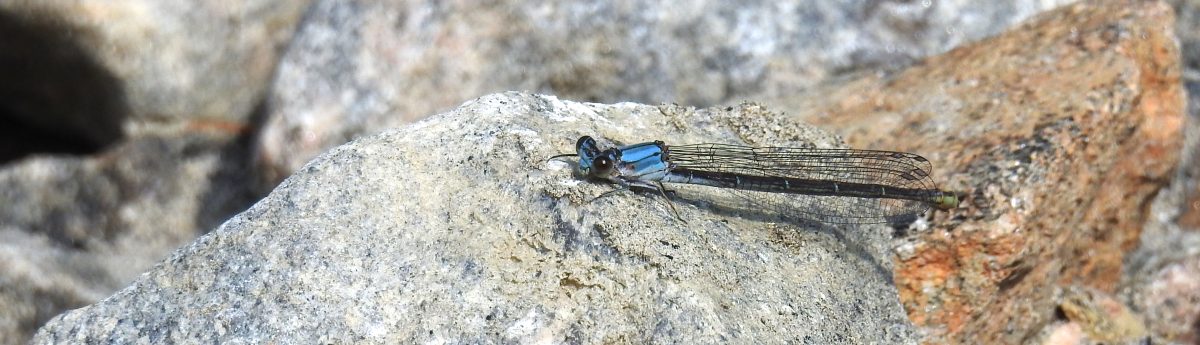

On July 18th I headed over to the Cedar Grove Nature Trail in Marlborough Forest, as a summer visit was long overdue. After a disappointing visit in June, when a lot of odes and butterflies seemed to be late due to the prolonged cold weather, I was hoping to find some of the early species still flying. To be honest, I had no idea whether insect emergence was still late or back on track, or whether I would even see some of the specialties I was hoping for – such as Calico Pennant, Brush-tipped Emerald, Aurora Damsel, Silvery Checkerspot, fritillaries and more. Regardless, I was looking forward to a change of scenery, and would be happy with whatever I saw.
There weren’t many birds of note, although I was surprised to hear both a Blue-headed Vireo and a Black-throated Green Warbler still singing. It was after 1:00 p.m. by the time I arrived, so not only was it late in the season, but also late in the day. A pair of female or immature Hooded Mergansers near the bridge was a surprise; this was the first time I had seen this species on the pond.
The usual odes were present at the pond, including a few Chalk-fronted Corporals still flying, Widow Skimmers, Twelve-spotted Skimmers, Four-spotted Skimmers, Frosted Whitefaces, Racket-tailed Emeralds, and Common Green Darners. I didn’t see any Calico Pennants or clubtails, but a Band-winged Meadowhawk was nice to see – they are not as widespread as other meadowhawk species, and seem to be found in only in various scattered locations with suitable habitat.

Another dragonfly with tinted wings was hunting from a small shrub about knee-high, and at first I thought it was another Band-winged Meadowhawk. A closer look made me realize it was something quite different: a female Eastern Amberwing! I have never had this species here before; indeed, it is fairly new to the Ottawa region with small breeding populations at Petrie Island and a newer one at the Eagleson storm water ponds (established in 2017). I am not sure how long the amberwings have been at the Cedar Grove Nature Trail; I don’t often come this late in the season, so they may have been here for a long time and I never caught them at the right time.

Males have bright orange wings while females have clear wings with amber-coloured patterns. One of the smallest dragonflies in our region, they would be easily overlooked if they weren’t so brightly coloured. Their small size and yellow-striped abdomens make them look more like wasps than dragonflies, and it is believed that this mimicry helps protect them from would-be predators.

I entered the open area surrounding the pond then crossed the bridge to check the solitary cedar trees growing in the open field – in the past I’ve noticed that emerald dragonflies like to swarm these cedars, and once I’d managed to catch a Brush-tipped Emerald among the baskettails and rackettails flying about. Brush-tipped Emeralds are small and distinguishable enough in flight for me to separate them from the other emeralds – all of which are black with varying yellow markings and green or blue eyes. Fortunately I saw only one other emerald species on my walk, the Racket-tailed Emerald, so it was easy enough to pick out a flying dragon that did not have a large club at the tip of its abdomen. When seen perching or in the hand, Brush-tipped Emeralds have a bronze thorax with green and yellow markings, as well as yellow markings along the length of its abdomen.

A whiteface dragonfly posed nicely without me needing to catch it; however, without a clear dorsal view of the area between the wings I am unsure whether this is a Frosted Whiteface or a Belted Whiteface. It was nice to see as I don’t often find these species this late in July; then again, maybe I’m just not in the right habitat at that time.

I headed home feeling quite pleased with the afternoon’s adventures, though I started wondering if the amberwings were flying at the Eagleson ponds yet. I stopped in there to see if any were present, and found a Widow Skimmer, which is uncommon at the ponds, as well as the more common Twelve-spotted Skimmers and Common Whitetails. I also kept an eye out for Saffron-winged Meadowhawks, a species I had discovered at the storm water ponds at the same time as the Eastern Amberwings in 2017; I didn’t see any, although I did find one male amberwing resting on a floating mat of vegetation in the central pond!

It was wonderful to find one here for the third year in a row. They add a nice splash of colour to the pond, tiny as they are, and show that the ponds are healthy enough to support a variety of different insects.

 OdoNotations