

On September 18th I flew to Edmonton to visit my sister for a few days. Alberta is not a new province for me; my family had lived on an acreage outside of Ardrossan, which is east of Edmonton and Sherwood Park, for seven years from 1989 to 1996. As I was just teenager at the time, enduring all the drama and angst of high school, I had had no interest in nature back then – which is really too bad, as we’d lived on a small lot with a forest behind our house and a slough (a vegetated pond) across the road. When my parents and I moved back in 1996 – they to southern Ontario, via Tweed, and me and my fiancé to Ottawa – my sister remained behind, although it wasn’t until 2012 when I returned to attend her wedding.
My sister has since divorced and now lives in the north part of Edmonton, in a brand new development called Crystallina Nera. It is so new that there are no trees or gardens yet, several houses have not yet put down any sod, and houses are still being built nearby. This developments boasts a 4.8 hectare urban forest and a naturalized storm water pond, both of which I spent a lot of time exploring.
September is not the best month to find odonates in most of Canada, but the weather in Edmonton was still warm enough that I saw five dragonfly species and two damselfly species. There were quite a few individuals flying, too, so there was no shortage of insects to photograph whenever I went out. The best spots were the gravel path that runs along the edge of the urban forest and the vegetation around Lake Crystallina.

I was also surprised by the number of odonates still flying, as it hasn’t been a great year for them in Ottawa. I use the online Field Checklist of Dragonflies and Damselflies of Alberta, Montana, and Wyoming by Jim Johnson when I travel to Alberta to determine which species are present there; this checklist states there are 48 dragonfly species and 21 damselfly species present in the province, although a 2019 blog post by the Edmonton & Area Land Trust says there are estimated to be 49 dragonfly and 23 damselfly species. I haven’t yet found a field guide specifically for the Alberta odonata, or a website that shows flight seasons and specific ranges of each Alberta species, which would be very helpful in learning some of these western odes – if I go back anytime soon, it may be time to purchase Dennis Paulson’s Dragonflies and Damselflies of the West.
I only saw one spreadwing, the Spotted Spreadwing. There are only four spreadwing species in Alberta, and they are all found in Ontario so I didn’t need to worry about learning any new western species (the other species are Emerald Spreadwing, Northern Spreadwing, and Lyre-tipped Spreadwing). There were multiple individuals present in multiple places, so it seems to be a common species.

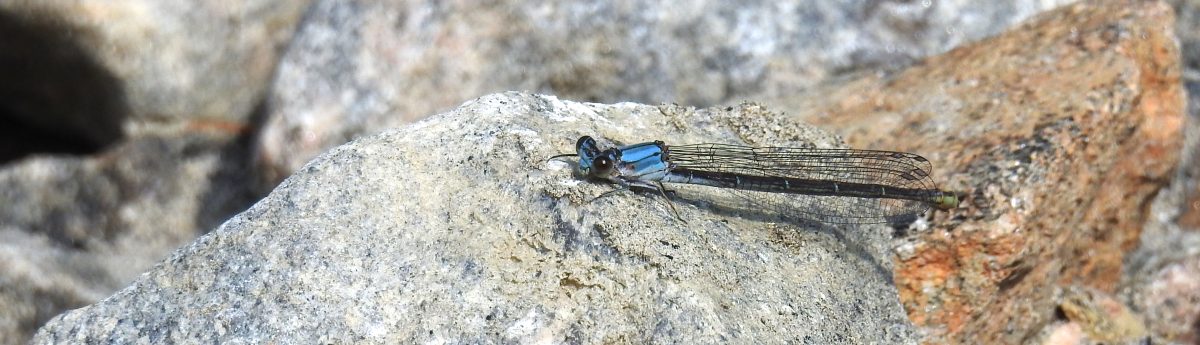
The only other damselfly I saw was a bluet of some sort, but the bluets are more varied with ten species present, and I wasn’t able to get a photo.
There were quite a few darners flying, and although I saw one flying over Lake Crystallina, I had the most luck with them at the John E. Poole wetland and along the gravel path that runs adjacent to the urban forest. The only darner I managed to photograph in the city was the Variable Darner, which seems to be one of the most common and widespread species in this area. I saw this one land on the ground, approached it for a few photos, and was surprised when it landed on my foot!

It flew off when I tried to take a few photos of it, and this time I got a better photo of it resting on the ground. This is the only mosaic darner species I’ve seen which consistently perches horizontally on the ground rather than hanging vertically from the vegetation or on a tree trunk. The Variable Darners of Alberta have thin, straight thoracic stripes rather than the two spots of eastern individuals.

This was the only heteromorphic female that I saw, in the same location although on a different day. Females may have either blue markings like the males (andromorphic) or green markings (heteromorphic); at first the thick body shape made me think I had found a different species altogether. However the thin thoracic stripes are visible through the wings.

I was chasing this male down on my last day in Edmonton, and it flew over someone’s fence and landed on a wooden board. You can see the two thin dashes on the top of the thorax here – these stripes are less developed than those in other mosaic darners, or may even be absent.

The other good spot for darners was the John E. Poole Wetland a short drive from my sister’s house. The wetland is adjacent to Big Lake in St. Albert, a globally recognized Important Bird Area which provides habitat for thousands of waterfowl and shorebirds during both migration and the breeding season. The 350-metre long boardwalk crosses through the marsh, with sections of open water among the dense cattails to provide windows into the wetland. We visited twice, and our second visit was much later in the day (around 2:30 pm) on September 21st. It was a beautiful, warm sunny day and the deep blue of the sky was reflected in the water. The boardwalk zigzagged through the marsh toward Big Lake, and when I wasn’t looking at the ducks I was busy looking for dragonflies and other wildlife. I didn’t see any skimmers in the marsh itself, though I saw several darners flying by; I wondered what species (some emeralds and whitefaces, perhaps?) I could find here at the height of dragonfly season in July.

I was watching a muskrat when a large darner flew in and landed on one of the reeds hanging over the water. It didn’t have the thin stripe of a Variable Darner that I’m used to seeing, so I thought perhaps I’d found something new for list of dragonflies. It turned out to be a male Lance-tipped Darner instead – new for my Alberta list, not new for my life list.

There were a few meadowhawks along the edge of the lake, but when I saw a pair of darners mating I was much more interested in photographing them. They landed twice in the grass at the edge of the path; I was trying to focus my camera on the pair until an unleashed dog ran up to me and scared them off. Fortunately we saw the pair later, and I was able to get close enough to get some good photos and identify them as Variable Darners.

I also saw another darner flying low over the grass. I watched as it settled onto a piece of grass, and moved closer to it. It was another Lance-tipped Darner.

The Lance-tipped Darner allowed me to get so close with my camera that I was tempted to catch it with my bare hands to get a better look. To my surprise I was able to pick it out of the vegetation and show my sister and her boyfriend. The darners are all very stunning up close, especially the males with their bright green, black and blue colouration.

If the darners were the most majestic dragonflies of my visit, the meadowhawks were the most abundant. I saw three different species, though there are six altogether in the Edmonton area. Three species are also found in the east: White-faced Meadowhawk, Cherry-faced Meadowhawk, and Saffron-winged Meadowhawk, while three are purely western species: Variegated Meadowhawk, Black Meadowhawk, and Red-veined Meadowhawk, all of which I’ve seen on previous visits. I was most eager to see another Red-veined Meadowhawk, which has an amber wash of colour on the wings much like a Saffron-winged Meadowhawk and red veins in mature males. However, it also has black legs, and white stripes across the thorax (which fade to pink in mature males), as well as black dashes on the sides of the abdomen (unlike the triangles of the Cherry-faced and White-faced Meadowhawks).
The first meadowhawk I saw was a young Saffron-winged Meadowhawk which landed on someone’s front porch as I was walking to the urban forest. I later found another on the gravel path:

While I was hoping this one might be a male Red-veined Meadowhawk, the brownish legs indicate it’s a Saffron-winged Meadowhawk.

With Ruby Meadowhawk strictly an eastern species, it is easier to sort out the White-faced/Cherry-faced/Ruby Meadowhawk complex that is so perplexing to us easterners. While young and female individuals with yellowish faces are still difficult to distinguish in Alberta, the males are quite easy. This Cherry-faced male was seen along Lake Crystallina.

Black Meadowhawks were everywhere. This made me happy as it is not one that shows up in Ottawa very often, although range maps indicate it is found here. Its name is a bit of misnomer as only mature males are black – young males and females are yellow and black. In fact, only a small percentage of Black Meadowhawks that I saw were entirely black, and I could have mistaken the first one that I saw for a whiteface had I not known that these early-flying skimmers were done for the season.

The Black Meadowhawks were most common along the gravel path at the urban forest and in the area I’d visited at Poplar Lake. There are supposed to be two viewing platforms situated along the western edge of Poplar Lake; while the one I found had a metal viewing scope on the path, it was blocked by the shrubs growing behind the fence and didn’t have enough magnification to identify anything out in the middle of the large pond. When I saw the large number of meadowhawks flying about I spend my time there photographing them instead.

Females have yellow faces, while males have black faces that develop a metallic sheen over time. Both have black legs. Freshly emerged Black Meadowhawks start out with abdomens that are mostly yellow with black stripes along the sides; as the dragonfly ages, each segment gradually darkens until a row of yellow dorsolateral spots are left. The abdomens of the males continue to darken, with the spot on S8 the last to turn black.

This was the yellowest Black Meadowhawk I saw, making me wonder if it was a different species at first. It appears to be a young female.

This female shows her characteristic yellow face and black stripe along the thorax enclosing several yellow spots.

I tried to find an entirely black male to photograph, but most still had spots along their abdomen that had darkened to brown. I only recall seeing the one on my first day that was so dark it could have been mistaken for a whiteface, and it flew off before I could get a photo.

Although the Black Meadowhawk was the only truly western species that I saw, I was glad there were so many dragonflies and damselflies around as I wasn’t sure how much I’d see in the city. They made the trip worthwhile (along with the jackrabbits) – it was amazing how many were around once I learned when and where to look!

 OdoNotations