
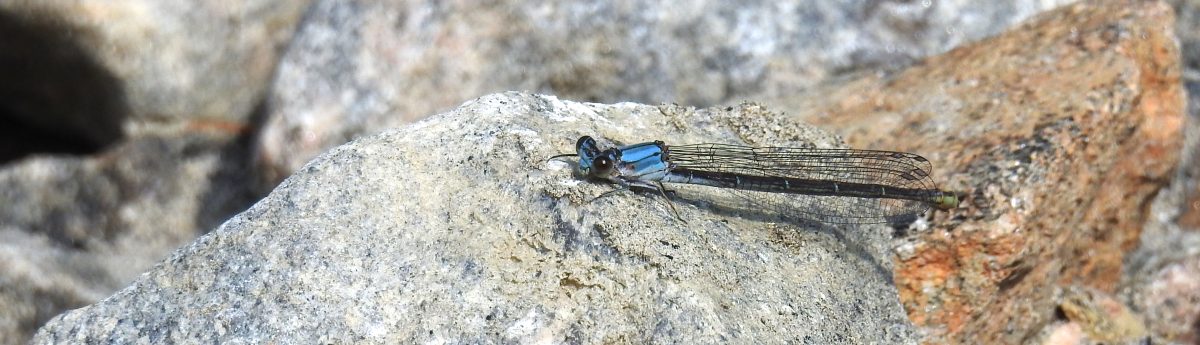
Marlborough Forest has been long known to me as a special place to find some of the more unusual species of the Ottawa area – various trips to the Cedar Grove Nature Trail over the past ten years have turned up Mink Frogs, Eastern Newts and Red Efts, Blue-spotted Salamanders, Bronze Coppers, Silvery Checkerspots, Harvesters, Calico Pennants, Brush-tipped Emeralds, Lake Darners, Twin-Spotted Spiketails, Ebony Jewelwings, and Aurora Damsels. The one “specialty” of Marlborough Forest that I had not yet found, and search for every time I go, is the Smooth Green Snake – it has managed to elude me every single visit.
Still, Marlborough Forest is a big place with many trails, and this year I decided it was time to visit a few new ones. I checked the eBirding hotspots and Google maps, and decided that the trail most likely to produce the widest variety of creatures would be the one heading north from the Flood Road parking lot (no. E4). It leads to a large marsh or pond about a kilometer or so away from the parking lot, and so I hoped it would be good for both dragonflies and butterflies. There was a second trail just west of that, the one at parking lot E6, and it seemed less interesting as it consisted of more forest than marsh. On my first visit on June 19th I ended up driving past the E4 parking lot (it was on the south side of the road and I thought I was looking for one on the north side) so I ended up at E6 which wasn’t even a parking lot but had a narrow spot in front of a gate. It led north, so I parked in front of the gate anyway and headed out to see what might be around. I had a fantastic time there watching the birds and butterflies, however, as expected there was no open water visible at the large sedge marsh 2 km from the parking lot, nor any great dragonfly habitat as far as I could see, and I was disappointed that the only odes I saw were common ones.
A lifer butterfly – the Common Roadside Skipper – gave me the impetus to return to Marlborough Forest two days later. This time, however, I went to the E4 parking lot at Flood Road, parked, and crossed Roger’s Stevens to look for the marsh. Like the trail at E6, it started off with a walk through the woods where I heard Ovenbirds, Northern Waterthrushes, Black-and-white Warblers, Black-throated Green Warblers (one was even walking along the trail like a robin), a Winter Wren, Red-eyed Vireos, Eastern Wood-pewees, etc. Not too far from the road I came to a spot where a small marsh opened to the west, with water draining through a culvert into a small pool on the east side of the road. The pool was surrounded by shrubs and was a good six feet below the surface of the trail with no way to get down to the water; I was intrigued as I found an Ebony Jewelwing perching on a leaf overlooking the water.

A little further along the trail opened up into a huge clearing. As I entered the clearing I was thrilled to hear a Blue-headed Vireo singing – this is a bird I see mainly during migration, as it is an uncommon breeder in the Ottawa area. I have heard them at Roger’s Pond and South March Highlands during the summer in the past, and it was great to hear one on territory here, too. Then, as I walked a little further along I realized I heard a different vireo singing – the slower song of a Yellow-throated Vireo was coming from the grove of trees on my right! I tried to track the bird down but it kept moving further away. I would have loved to have seen it as the only other Yellow-throated Vireo I’d had this year was also heard only and not seen.

The clearing was a great spot for butterflies. There was a large patch of dogbane to the left, and wildflowers blooming sporadically along the edge of the trail all the way along the edge. I found several skippers in the patch of dogbane, though I was only two species seemed to be present: Tawny-edged and Long Dash Skippers. A few Northern Crescents were present, as were Little Wood-Satyrs.
Before I left the clearing I heard another uncommon breeder singing: a Magnolia Warbler. I had thought I’d heard one at Trail E6 two days ago, but wasn’t able to get close enough to be sure. This one was singing in a tree right beside the trail, and I was even able to view the bird long enough to confirm its identity! Further along I heard Nashville Warblers, a Pine Warbler, and several Veeries. I found a Yellow-bellied Sapsucker nest when I heard the continuous begging calls of the young inside a tree cavity and watched to see which adult woodpecker species arrived with food.
After another stretch of wooded trail, I found the large marsh shown on Google maps. It looked like a large field with a dense stand of cattails further back, but I heard Swamp Sparrows singing and saw a few Tree Swallows swooping through the air so I knew water was present. I also heard a few Wilson’s Snipe keening in the vegetation while others winnowed overhead.

I also found a Silvery Blue butterfly resting on the ground, and a couple of skimmers landing on perches close by – mostly Common Whitetails and Chalk-fronted Corporals. I wasn’t able to get to the water at all, so I continued on my way. Fortunately there was a large open pond further ahead, with the road cutting right through it. It looked like a great place to see ducks, but other than a mallard and a Wood Duck flying over I didn’t see any on the water itself.
I didn’t explore much further beyond the T-junction, and turned back at that point – it was another bright, sunny day with the temperature creeping up into the low 30s. Walking back along the hot, dusty road, I paused when I startled a small, dark butterfly off the ground. Fortunately I saw where it landed, and was thrilled when I identified it as a Common Roadside Skipper – the first one I’ve identified on my own in the field.
The Common Roadside Skipper wasn’t my only lifer in Marlborough Forest that week. On my first visit I’d noticed a couple of dark emerald dragonflies zipping around the road; I hadn’t brought my net, and it seemed to me that they were too large for the small Racket-tailed Emeralds flying around. On my second visit I did bring my net, but I didn’t see any emeralds that looked intriguing enough to catch…until I reached the small pool of water near the beginning of the trail. I first spotted it flying over the water before it landed on the stem of a plant on the other side of the pool. As noted above, the small pool was a good six feet below the level of the trail and there was no way to get down to it due to the steep drop-off and thick vegetation. I could see the dark, spindle-shaped abdomen and that was about it until it flew off and landed on a branch closer to me.

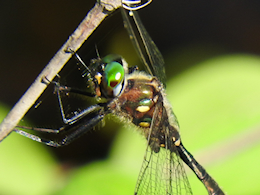
This time I was able to get some photos, and I got a much better look at the thorax when it landed again at a slightly different angle. The shape reminded me of the Brush-tipped Emeralds I’d seen at Roger’s Pond, but the yellow thoracic spots on the thorax did not….Brush-tipped Emeralds have a small, round yellow spot adjacent to an elongated oval-shaped dash, while this dragonfly had two round yellow spots. In addition, the Brush-tipped Emerald also has thin yellow markings along the middle segments of its abdomen, while this dragonfly did not. I would have loved to have caught it to examine the claspers, but it was beyond the reach of my net. Still, the photos I took enabled me to identify it on iNaturalist as an Ocellated Emerald, a species I’ve never seen before!

According the Algonquin field guide, this species prefers shallow forest streams with riffles, without aquatic vegetation. Males patrol along the stream, often hovering over the water, while both males and females may be found foraging along forest edges. They prefer shady locations. This to me sounds a lot like the “Arrowhead stream” at Jack Pine Trail, so perhaps its worth checking there too! In the meantime, who knows what other dragonflies might be found in Marlborough Forest?
I was thoroughly enchanted by the trails in Marlborough Forest and would have liked to have explored further, but the heavy heat had taken its toll on me, as had the continuous swarm of deer flies and mosquitoes that refused to give me a moment’s peace. I also wasn’t a fan of the noisy ATVs that came buzzing along the trails, but fortunately they only became an issue later in the morning as the trails got busier. It was also nice to have people around as I knew bears roamed the forest, and I wasn’t too keen on meeting up with one with no other humans around.
Despite that, I thoroughly enjoyed the change of scenery, and the interesting habitats and wildlife I found there ensured another visit or two in the future!

 OdoNotations