

It’s been a good season for hard-to-find dragonflies at the Eagleson Ponds. Ever since I discovered both Eastern Amberwings and Saffron-winged Meadowhawks here in 2017 I’ve been spending more time here later in the day looking for odes, rather than doing a quick search for birds first thing in the morning before heading elsewhere. The Covid-19 pandemic has made that even easier for me, as I am still working from home and can get out at lunch time for a quick check when the temperature has warmed up enough for many odes to be flying.
Mid-summer seems to be the best time for seeing a variety of odes at the ponds. While I have seen a few early-season species here, such as the Taiga Bluet and Spiny Baskettail, most odes that breed here don’t emerge until later in the summer. I’m not sure if the late start to spring had anything to do with it, but up until the end of June I found very few dragonflies here – skimmers are usually abundant throughout the season, but on June 30th I recorded a single Dot-tailed Whiteface and a single Twelve-spotted Skimmer along with a couple of Common Green Darners and Prince Baskettails that refused to land. Even the Eastern Forktails seemed down in numbers.
By mid-July, however, the activity had picked up. When I visited the ponds at lunchtime on July 15th I was happy to find both Eastern Amberwings and Saffron-winged Meadowhawks flying – this was the first time I’d had both of these species here this season. Both were in the southern-most pond; the Eastern Amberwings were perching on rocks just below the curved metal bridge while the meadowhawks were on the western side of the Hope Side pond where the gravel spit extends into the pond.

I was thrilled when I witnessed both a male and a female Eastern Amberwing on my visit – especially when I saw that the male was hovering over the female while she was ovipositing! This is the first time I’ve seen direct evidence of breeding at the ponds, although obviously they must be breeding here for the population to have been able to sustain itself over the past four years! Hover guarding is a form of protection that occurs after mating while the female is laying eggs directly into the water – the male does not remain attached to the female, but rather hovers in the air above her to prevent another male from mating with her.
A few weeks later I even found a pair mating, but wasn’t able to get a great photo as there were too many reeds between me and the dragonflies:

Most of my Eastern Amberwing sightings are of males. This is because they like to perch on rocks or lily pads in the water where they watch for females and defend their territories from other males. Their bright orange wings make them highly visible despite their small size, even when they fly out to chase other males out over the murky water.

In contrast, females tend to perch well away from the water in wildflower meadows or in trees, searching for small flies and bugs attracted to the flowers. Since I rarely look for dragonflies among the flowers I don’t often see the females; it was only by chance that I found my first Eastern Amberwing at the ponds on July 30, 2017, a female perching along the well-vegetated path above the water. However, both males and females tend to search for food away from the water, so when they aren’t busy keeping a sharp eye on their particular area of the pond, males can be found perching in the vegetation as well.

The Eastern Amberwings remained in the area near the bridge all summer, mostly on the rocks below the bridge on all four banks, as well as the mats of vegetation near the boat launch on the western shore of the central pond. Once I saw a male in the southern pond near the gravel spit where I was looking for Saffron-winged Meadohawks. There was a small triangular rock sticking out of the water, and it looked like the amberwing was going to land on it. Just as the dragonfly veered away, it occurred to me that the “rock” looked suspiciously like the snout of a Snapping Turtle sticking out into the air. Sure enough, the “rock” vanished and I later saw the snout emerge again a little further away. Two days later I managed to photograph the turtle poking its head out right next to the shore. It was good to see that this large turtle was still managing to survive in the pond:

Even though they are larger than the Eastern Amberwings, the Saffron-winged Meadowhawks can be more difficult to find as they don’t have bright orange wings, and don’t tend to perch in conspicuous areas. They like to sit directly on the ground rather than on the large, pale rocks near the shore, or on tall vegetation emerging from the water.

They are most easily separated from other meadowhawks that might be flying by their brownish-red faces, the lack of sharply-angled black triangles running down the sides of the abdomen, the brown and black striped legs, and the reddish or golden-tinged leading edge of the wings. They also tend to hover out over the water more than other meadowhawks, which is the behaviour I first noticed when I first found them here in 2017.

I have seen them in both the central and southern-most ponds this summer; mostly in spots where the gravel spit and the boat launch leads down into the water, but also in the vegetation on the east side of the southern pond. Like the Eastern Amberwings, I mostly see males perching out in the open. However, for the first time I saw a yellowish female perching on top of a stem on the eastern side of the southern pond. She looked quite battered, so it wasn’t just a young teneral male:

Fortunately, they also like perching on flowers, and I found a cooperative individual in the wildflower meadow on the eastern side of the bridge.


Both species were present here for an entire month – my last date for both was August 14th. Saffron-winged Meadowhawks can fly into September here in Ottawa, so I was a bit disappointed not to see any later in the season. It depends on when the individuals actually emerged, as adult dragonflies are not very long-lived.
I had two more uncommon meadowhawk species at the ponds this summer. The first was likely a Cherry-faced Meadowhawk in the ditch near Hope Side Road. Its face was red, but it wasn’t a Saffron-winged Meadowhawk as the legs were entirely black and and it also had a line of black triangles down the abdomen. This species is very similar to the Ruby Meadowhawk, which is not found in Ottawa as far as I know. Even Cherry-faced Meadowhawks seem to be declining – while I normally run across a few red-faced individuals each season, I have seen fewer and fewer candidates these past few years. Chris Lewis and I did go to Hurdman one summer and netted a few there to confirm that they were in fact Cherry-faced Meadowhawks, but I have not been able to get there this year as I haven’t been downtown yet this summer.

The other species of interest I found was the Band-winged Meadowhawk. While it is not as common as the Autumn or White-faced Meadowhawks, it tends to be somewhat restricted to certain breeding areas – though not as locally restricted as the Saffron-winged Meadowhawk. It also turns up in a lot more unexpected places – including a Tim Horton’s parking lot, and even the top of my front tree once! These have been breeding further along the Monaghan Drain at Kristina Kiss park for a few years now, and last August I saw one at the ponds for the first time. I saw my first ones this season at the ponds on August 3rd, with additional individuals seen on August 12th and August 14th.

Other species of note include a Rainbow Bluet seen in the southern pond on July 15th, and this mature Widow Skimmer, a species that I’ve only seen a handful of times here although they are abundant in similar habitats elsewhere (ie Mud Lake). I saw singles here on July 15th, July 23rd and August 15th. The Rainbow Bluet was a bit of a surprise as I hadn’t seen any in this part of the pond. It was a male, and at first I wasn’t sure what it was – I thought it was an Eastern Forktail with something orange on its face until I realized what it was! It’s been a while since I saw one, and I’m hoping there are more around as I wasn’t able to get a photo of it.

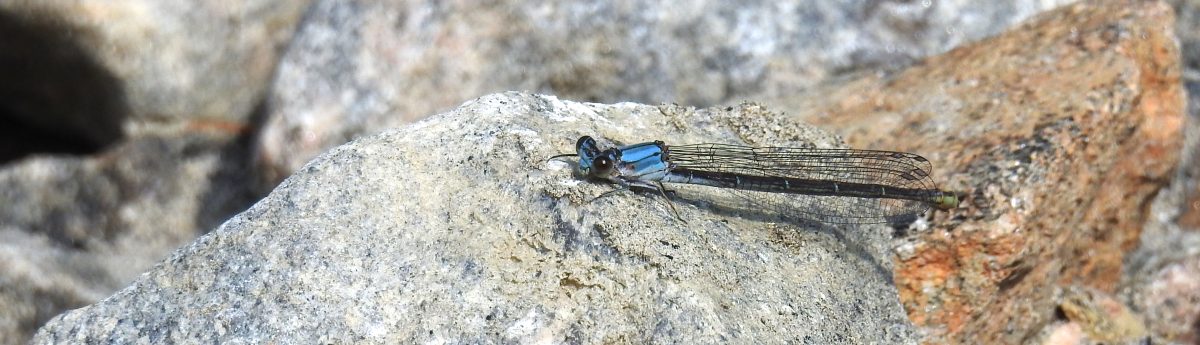
Finally, I added yet another new species to the pond list this summer, and it was one I was not expecting at all: Violet Dancer! Given the gravelly areas surrounding some parts of the shoreline it has surprised me that the much more widespread Powdered Dancer hasn’t turned up here, as it loves such shorelines. The Violet Dancer is a much less common damselfly on the Ottawa side of the river, and although I’ve heard that they can be found at Shirley’s Bay I’ve never seen them there; indeed, the closest iNaturalist sighting is along the Rideau River close to the Vimy Memorial Bridge. This small but bright purple damselfly was resting on the same well-vegetated dirt path above the water where I first encountered the female Eastern Amberwing three years ago. It immediately caught my attention as the damselflies that I usually encounter here (various bluet, forktail and spreadwing species) tend to perch in the vegetation rather than directly on the ground. I have no idea where it came from, but I was happily surprised to see it! Interestingly, it showed up on August 7th, the same day I saw the probable Cherry-faced Meadowhawk and female Saffron-winged Meadowhawk.

Even if the number of individuals has been low over the summer, the diversity of odes and other insects has been excellent this summer. It’s always thrilling to add a new species or two, and it makes me wonder what odes are present when I’m not around, or are breeding at similar storm water ponds in Ottawa. I’m not sure whether anything can top the Violet Dancer this year, though a breeding population establishing itself here would be fantastic. The current list of odonata species recorded at the Eagleson Ponds stands at 22 species on iNaturalist, although this does not include the probable Cherry-face Meadowhawk (a result of being just outside the boundaries of the project), or the Common and Prince Baskettails I’ve seen here (a result of not having photographed any – I will have to start bringing my net and try to catch one of each). It’s fantastic to be able to go dragon hunting practically in my own backyard, especially during the pandemic when I can take a quick walk there on my lunch break or right after work!

 OdoNotations