
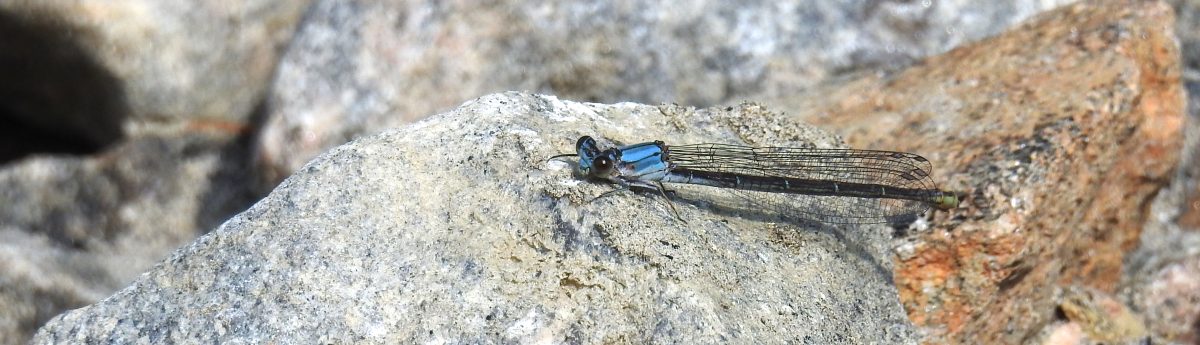
On May 15th I decided to try a new trail in Marlborough Forest. I was mainly looking for butterflies, as dragonflies weren’t all that numerous yet. Dreaming more of elfins and commas than dragons and damsels, I parked on Kettles Road near the Black-billed Cuckoo site from last year. I headed south, and almost immediately found myself in an area with four species flying: Mourning Cloak, Northern Spring Azure, Henry’s Elfin, and Gray Comma. The sunny day was perfect for looking for butterflies, and I ended up finding quite a few, especially in the open cedar woods where they were resting on the trail.
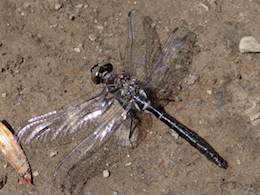
I had a great morning finding and photographing butterflies, and before I was able to get too far into the forest I came to a spot where deep puddle took up the whole width of the trail and had to turn around. By then a few dragonflies were on the wing; I saw several baskettails, but they kept flying by without landing. Eventually a small, dark dragonfly landed on the ground in front of me, and at first I thought it was a whiteface – until I realized the proportions were wrong, and that the abdomen was too long and narrow for a skimmer. When I took a closer look I saw that it had narrow white rings around the first few segments of its abdomen, making it an Ebony Boghaunter – a species I see regularly in Marlborough Forest, though usually once per season. The eyes are brown, not green, and the wings are shiny which means it is a teneral that has only just emerged.

After some discussion with another dragon-hunter in my area we realized that almost all of our photos are of tenerals, rather than mature adults. The only photo of an adult Ebony Boghaunter with green eyes I have is from Mer Bleue back in 2014. It is described as “secretive” in the Algonquin field guide; perhaps this tendency to hide itself away develops once it matures?

This is now the second trail in Marlborough Forest where I’ve seen this species, indicating that they do in fact breed close by. Their breeding habitat consists of woodland acid bogs made up of pools of open water interspersed with mats of sphagnum and other mosses. Males will often perch on the mossy vegetation or sphagnum mat, while females oviposit directly in the open pools of water. Interestingly, pairs in mating wheels are often found well away from the water, though I have never seen more than one individual in any location. Still, their presence in Marlborough Forest means that there must be a sphagnum bog within in its depths somewhere; it would be a major triumph to find out exactly where it is!

 OdoNotations