
On June 20, 2021 I accompanied fellow OFNC members Derek and Erik to the Carp Barrens Trail off of Thomas Dolan Parkway to assist them in a survey of breeding birds and other wildlife. Because of the sensitivity of the ecosystem and number of at-risk species which breed here, this trail is closed to the public during the summer. In order for us to access the site, Derek had acquired a permit to allow us to look for unique breeding birds such as Black-billed Cuckoo, Eastern Towhee, Common Nighthawks and Whippoorwills. Derek and Erik started around dawn to listen for both nightjars, but heard none. I joined them at 6:00 am while they were still walking along Thomas Dolan Parkway, and together we entered the trail system.
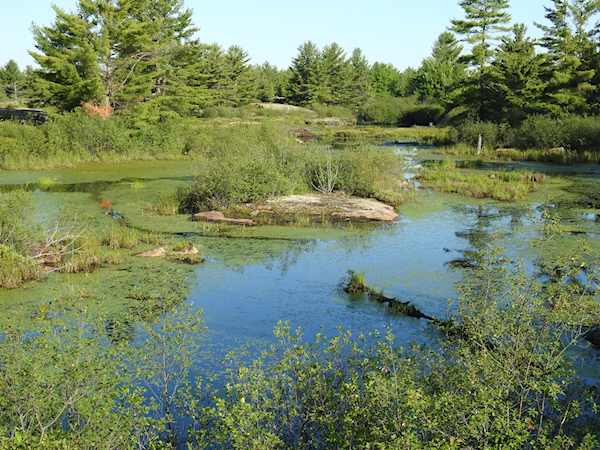
The trail follows a rocky outcrop around a long slough. Many birds were already singing, and we heard the typical open field and woodland edge species: Field Sparrow, White-throated Sparrow, Veery, Scarlet Tanager, Rose-breasted Grosbeak, and many warblers, the best of which (in my humble opinion) included two Pine Warblers, two Yellow-rumped and two Nashville Warblers.
We got lucky and found a perching Black-billed Cuckoo only a few minutes into our walk. It was sitting in a tree, and didn’t make any noise to attract our attention; in my experience, you can either see a cuckoo or you can hear a cuckoo, but you can never see a vocalizing cuckoo!
We followed the trail around the pond, and as it warmed up we started seeing more and more dragonflies, mainly skimmers perching in the sunlight to warm up their flight muscles. This Twelve-spotted Skimmer posed nicely for us:

There were also quite a few whitefaces around, although the only ones I managed to photograph were Belted Whitefaces:

This male Eastern Pondhawk was a lovely sight perching on the white lichen mat:

As we walked deeper into the trail we heard more birds. We came across several Black-and-white Warblers, a few Red-breasted Nuthatches, a Blue Jay carrying food, a family of Yellow-bellied Sapsuckers, and even a male Eastern Towhee singing out in the open! We also heard and saw at least three Hermit Thrushes at the far end of the trail. One of my favourite songsters, it was a delight to hear and I took a brief recording of its song for our eBird checklist.
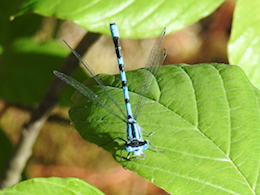
We returned via the loop on the opposite side of the pond and had our first opportunity to get down to the water where I was eager to search for more odes, particularly damselflies. Although the habitat looked great, it was sadly lacking in dragonflies and damselflies. I was a bit baffled to see only a few Frosted Whitefaces and Sedge Sprites in the sparse vegetation around the shoreline and a single Dot-tailed Whiteface perching on a lily pad.
The most bizarre sighting was that of a Blandings Turtle resting with its head below the water. We spent several minutes watching it and waiting for it to move, which it never did. We assumed it was deceased.
In fact, I was surprised by how few lepidoptera (moths and butterflies) we found as well – a Little Wood Satyr and a lovely Great-spangled Fritillary were the only ones I recorded. It was certainly warm enough and late enough in the morning at that point for more insects to be flying.
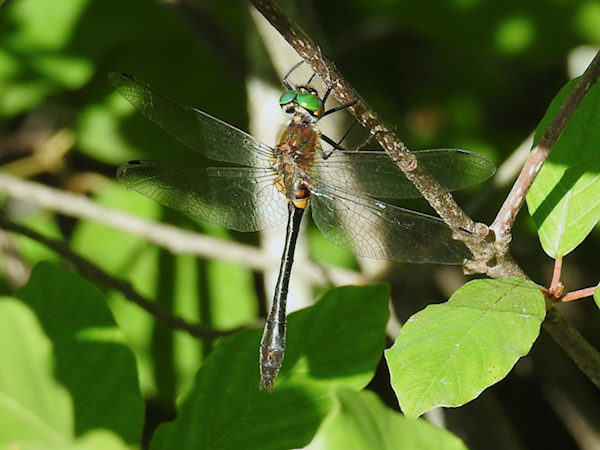
On the way back we saw a spreadwing which I couldn’t get close enough to identify and a Racket-tailed Emerald patrolling a small clearing. I was hoping that it might be some more interesting than this common and widespread species, but when it landed I was able to see the yellow collar at the top of the club-tipped abdomen that make this emerald unique.
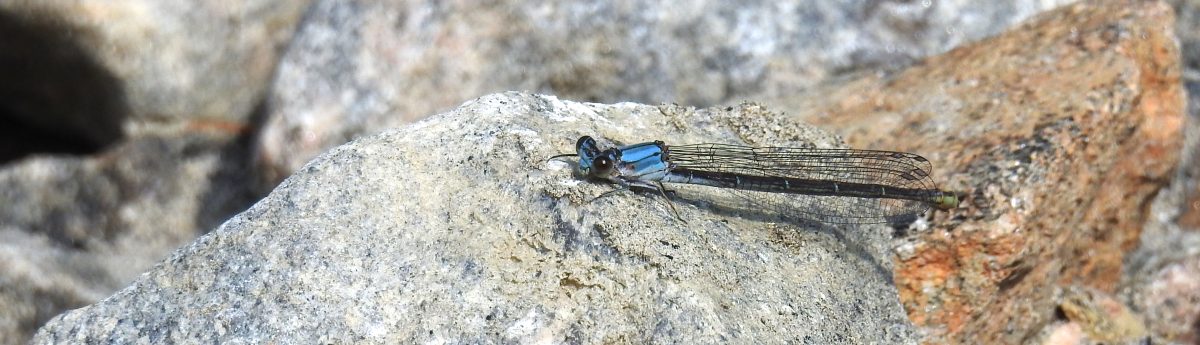
I also saw a single bluet perching in the vegetation along the trail and caught it; it turned out to be a Marsh Bluet. It was hard to believe that it was the only bluet in the area.

The trail wound its way along a second, much larger pond on the opposite side, and I noticed it was full of dragonfly activity. I saw a couple of dragonflies emerging from their larval shells on stems just below a small lookout; many skimmers, including Twelve-spotted Skimmers, were buzzing over the water. It was completely different from the pond we had just circled, and I was curious as to why this one was so full of life. We even saw a few Killdeer and a Wilson’s Snipe in the area!
While I was watching the water a large dragonfly with bright red wings flew in close toward me and spent some time patrolling the shoreline. I was a bit puzzled because the only dragonfly we have in the area with candy apple red patches on the wings is the Calico Pennant, which has a few small red spots and is itself a small dragonfly. It also spends more time perching than flying. It occurred to me that it might be saddlebags, and the more I watched it the more certain I was that it was one! There are two species in Ontario; the Carolina Saddlebags which is common south and west of Kingston, and the Red Saddlebags, which has an even smaller range in the southwest of the province and is much less common. It is more likely to have been the former than the latter, but even so it was an astounding find for our region, and I waited a good half hour with Derek and Erik to see if it would come in close enough for me to take a swing at it with the net. Unfortunately it zipped off over the water to parts unknown, taking all opportunity to catch or photograph it as well.
Saddlebags are skimmers with long, wide wings and are known to venture beyond their typical range – Black Saddlebags has been found in Ottawa before, and the gliders are famous for their long travels. It would have been amazing to have gotten some photographic evidence of this large, beautiful red dragonfly and add it to the region’s list of odonata; unfortunately it may have only been a one-time wonder not likely to be repeated. Still, it was the highlight of my day, and a sight I will not soon forget!

 OdoNotations