
Mud Lake and Andrew Haydon Park are usually excellent places to find different species of dragons and damsels throughout the summer months. In both 2015 and 2019 I had a good number of species at Andrew Haydon Park in late July, and an OFNC dragonfly outing at Mud Lake on July 21, 2013 also netted some fantastic species. I was hoping for some similar luck on an ode-hunting trip on July 24th, but this time I found fewer species and fewer individuals overall. I am not sure why there seem to be so few dragonflies around good pond habitat these past two years (such as the Eagleson ponds), but the trend is concerning.
My first stop was the shoreline at Mud Lake where I hoped to find some large river clubtails perching on the rocks in the channel behind the filtration plant. When I arrived I was happy to find two dragonflies perching on the rocks right away, and managed only to photograph one before a couple of people came along and scared them both – while I’m certain one of them was a clubtail, the one I photographed turned out o be an Eastern Pondhawk. The clubtail did not return, although I saw a couple flying out over the water several times on my visit.
I most often see Eastern Pondhawks along the shore of Britannia Point, though rarely anywhere else at Mud Lake. I also usually only see one or two on a given visit, so it was nice to see this one feeding on a small bug.


I had brought my net to catch some of the notoriously difficult bluets, and caught a few that all had upturned hook-like structures at the tip of the abdomen. As best as I can tell they are Northern or Vernal Bluets, although given the date I suspect these are Northern Bluets (Vernal Bluets don’t fly this late into July according to the Algonquin Field Guide). I did not get any decent photos of the terminal appendages to confirm my identification on iNaturalist.

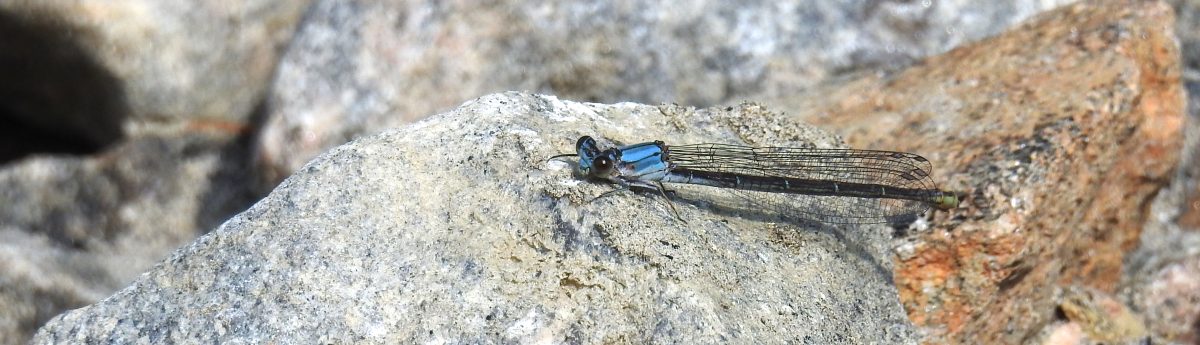
Interestingly, the bay side of the point was home to a different species of damselfly – the Stream Bluet. I am not sure why the Northern and Stream Bluets prefer different sides of the point; Northern Bluets tend to inhabit ponds and fishless bogs, while Stream Bluets live along streams and lakes with emergent vegetation and wave action. The Stream Bluet is easier to identify, as most of the black-type bluets are; note the thin blue rings from segments 3 to 7, the angled blue marking on S8 and the small blue eyespots connected by the narrow blue occipital bar.

The point and most of the northern environs of Mud Lake (including the Ridge) are great places to see Powdered Dancers perching on rocks, vegetation, or even the ground. I found a lovely female brown Powdered Dancer perching on a leaf close to a Stream Bluet.

I saw no clubtails perching in the vegetation and only a few skimmers – usually Lancet Clubtail is regular here. A few Twelve-spotted Skimmers were dancing over the water, while this Dot-tailed Whiteface waited patiently for its next meal.

The large trees growing along the point are great spots to find exuviae of large dragonflies, so I spent some scanning the base of the trunks. I did not find any notable exuviae; however, there were several female LDD moths (formerly known as Gypsy Moths) laying egg masses of varying sizes. Although I’ve seen many caterpillars and a few male moths this year, this was my first time seeing any of the flightless females.
I checked a few spots around the edge of the pond hoping to find a few more species, but found nothing new around the water’s edge. I drove to Andrew Haydon Park next, thinking that I might find some Blue Dashers, Halloween Pennants, Widow Skimmers, Ebony Jewelwings, or Band-winged Meadowhawks but struck out on most of these as well. In fact, there were very few odes present at all, and I wasn’t sure of the reason – my best guess is that there have been no recent mass emergences, and perhaps any dragonflies that did not disperse had fallen prey to one of the many insect-eating blackbirds and flycatchers around. One lonely Twelve-spotted Skimmer flying over the pond was the only large dragon I could identify – I did see a darker dragon zip over but couldn’t ID it, though I thought it might be a Prince Baskettail, a species I’ve often seen patrolling the large ponds. Two Common Green Darners were hugging the river shoreline as well.
There were several bluets around the two ponds, and the only one I caught turned out to be a Marsh Bluet. A spreadwing got away from me before I could photograph or catch it. I headed over to the eastern creek to see if anything was flying near the bridge, and found a single Ebony Jewelwing perching in the vegetation by the creek and an Autumn Meadowhawk next to the bridge.

I spent some time checking the vegetation along the eastern creek where the most interesting ode was this yellowish bluet. I couldn’t tell whether it was a female Vesper or Orange Bluet (a male nearby would have been nice!), but after getting nowhere with iNaturalist, two people on the Northeast Odes Facebook group weighed in and said they were both leaning toward female Vesper Bluet. This is a species I’ve only seen at Petrie Island, so it was great to find it at Andrew Haydon Park! I would love to check this park again for either Orange or Vesper Bluets, but with my trip to Nova Scotia coming up next weekend it doesn’t look likely. I’ll definitely have to return next year!

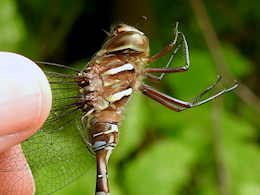
My last great find was a Shadow Darner which I scared up from a low-hanging spot in the shrubs. Fortunately it didn’t fly very far, and I took a few photos of it in the shrub before catching it to verify its identity.

The lack of odes was disappointing, although I was really happy to find the female bluet and the Shadow Darner at Andrew Haydon Park and see the Stream Bluets at Mud Lake. Still, when it comes to nature, every day brings something different, so another visit would confirm whether the low numbers I found today was just a random fluke or a more worrying trend. Hopefully next year will be better!

 OdoNotations