
By the time November arrives, all but the hardiest of insects have vanished, leaving only those few species that are adapted to the cold temperatures of mid-autumn in Canada. The last dragonfly on the wing here in Ottawa is the Autumn Meadowhawk, a small red or brownish dragonfly with very little black along the abdomen and yellow or brown legs. It is these two traits that make them easy to distinguish from other local meadowhawks – the other common species have distinct black markings on the abdomen and black legs. The most similar dragonfly in our area is the Saffron-winged Meadowhawk, which also lacks distinct black abdominal markings. However, the Saffron-winged Meadowhawk is larger, usually has a noticeable amber-coloured tint to the leading edge of its wings, and has black legs with brown stripes. In addition, most of the other meadowhawk species are gone by mid-October.
While the Autumn Meadowhawk starts flying as early as July, it becomes much more common after September – this could be either because more individuals are emerging at that time, or because there are fewer dragonfly species still flying and so naturalists notice them more. It is hardy enough to survive a few light frosts, particularly if the days are still sunny and the day-time temperature is still mild. However, once night-time temperatures remain below 0°C and the day-time temperatures struggle to get much above 0°C – or if bad weather sets in – the Autumn Meadowhawk’s season is over. The latest date for this dragonfly in Ottawa is November 18, which is pretty good for one of the coldest capital cities in the world!
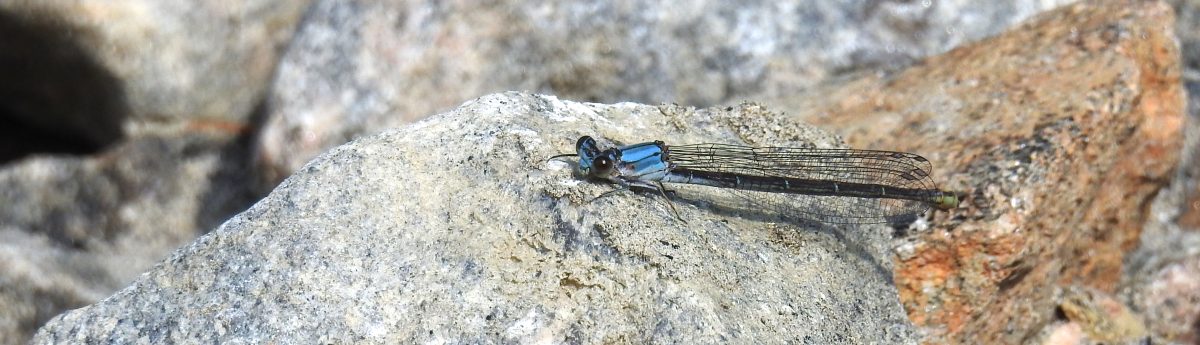
When I went to Bruce Pit on October 29th we had only recently had our first frost of the season – the average date for the first fall frost is October 8th, but this year it didn’t occur until October 22nd. It was cool in the morning, but as it warmed up I startled a few Autumn Meadowhawks perching on the ground. They like to rest on dark leaves on the ground to absorb the heat of the sun more quickly, as this one was doing.

The meadowhawk was probably my best sighting of the day. I didn’t see as many bird migrants as I had hoped, although I did get my first American Tree Sparrows of the fall – a sure sign of the changing season and impending winter.
My last Autumn Meadowhawk of the season was found at Sarsaparilla Trail on November 8th. This was a rare afternoon walk for me, and the daytime temperatures were still warm enough (14°C) to hope for a few odes to be flying despite the recent string of sub-zero temperatures overnight. I was happy when I scared one up from the grass on my way into the woods, and there were at least three perching on the boardwalk railings when I visited the pond.

Day-time temperatures remained warm right up until November 12th, but I wasn’t able to get out again; these were my last odes of the year, and it was great to see them while they were still active. They appeared to be in good shape, which made me wonder just how long ago they emerged – individual dragonflies that manage to evade predators, storms, prolonged cold spells, and accidental drownings typically live only for a month or two, and over time their wings become tattered and torn. It’s fascinating to think that they likely emerged in October, although depressing at the same time – this gives us only six months in our local dragonfly season, which means six whole months until May when the next ode season begins.

 OdoNotations