
After completing cancer treatment last November and recovering from all but a few of the (mostly minor) side effects, I decided to celebrate by returning to Costa Rica in late April. We first visited it 2017 and I loved it so much I made a promise to myself to return. This seemed like a great time as I am finishing up my medical leave and head back to work in May. It is also the beginning of the rainy season when resort prices are a bit lower. I’d been checking flight prices since January, but post-pandemic prices are much higher than my previous trip – unfortunately I couldn’t find any discounts there. We originally planned to stay from Saturday to Saturday, but as it was cheaper to fly out on Friday we decided to do that instead, spending our first night at an eco-tourist lodge on the slope of Rincon de la Vieja volcano. The lodge was great, and I was disappointed we didn’t have time to visit national park it backed onto (Parque Nacional Rincón de la Vieja) before we left. I got a couple of life birds and butterflies, but saw only a couple of odes: a slightly tattered Black-winged Dragonlet and a couple of probable Wandering Gliders flying over the sun-dazzled parked cars in a small parking area.
After leaving the Rinconcito Lodge it took us about 90 minutes to get to the Occidental Papagayo Adults Only Resort on the coast of Guanacaste. We passed the rice fields where Oli Esquivel showed us the magnificent Jabiru on our last trip, and though I looked for these unmistakable birds, I saw none. We would be seeing Oli in three days for the first of two birding outings. I had enjoyed birding with our guide Olivier Esquivel of Natural Discovery birding tours so much on our last trip that I hired him again for two separate birding outings on this trip. Like our previous trip, we planned to do a half day in the Palo Verde area and a full day in the rainforest, though Oli intended to take us to different places from our previous outing six years ago.
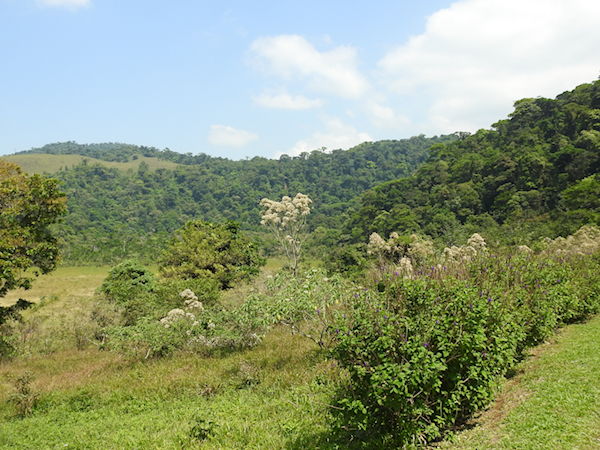
We did the same boat ride as our previous outing, but for the second half we visited the Hacienda El Viejo reserve in order to look for ducks and other water birds attracted to the crucial water sources there during the dry season. I also hoped to photograph a few dragonflies; I figured this outing would be my best chance at seeing a good variety of species given the different habitats we visited (first the river, then the marshy ponds and open fields at the wetland). On the reserve I had noticed a fair number of dragonflies flying over the fields and road, some of which appeared to be gliders and a few of which appeared to be darners. Perching dragonflies were harder to find, but I did see one Great Pondhawk at the entrance near the gate, though it flew off before I could focus my camera. This is the same species that landed on our boat on our 2017 ride up the Rio Tempisque! I was disappointed that the dragonflies were not cooperative, but happy at least to get a few photos of a new butterfly species.
I had better luck with odonates on my second trip with Oli, a full-day trip to the rainforest in Bijagua on the Caribbean slope of Costa Rica. Bijagua is a small village located in a valley between Miravalles and Tenorio Volcanos in the Guanacaste mountain range. I was excited not only because crossing over to the Caribbean slope meant birding in a whole new province, Alajuela, it also meant seeing a large number of different species not found in the dry forest of Guanacaste. This outing was sure to push my life list – which stood at 561 species after my previous outing with Oli – close to, if not over, 600 species of birds! I had asked him to let me know which eBird hotspots we’d be visiting ahead of time, and spent two months studying the birds most likely to be seen at the Tapir Valley Nature Reserve around the end of April. There were lots of hummingbirds and flycatchers on the list, and enough tropical species such as toucans and tanagers and motmots and honeycreepers to make my imagination soar with all the possibilities.
I had been afraid it would rain the day of our tour of the rainforest, but thankfully the day was warm and sunny – I couldn’t ask for better weather for insect hunting. We saw many fantastic butterflies, but it was the odonates that interested me the most, and as soon as I saw the water-filled channel in a sunny spot at the base of the southwestern slope I had to investigate. There were some emergent reeds at the water’s edge and a few sticks overhanging the bank, creating plenty of perches for a hungry dragonfly.

I spotted two types of dragonflies and one damselfly in the vegetation, and was able to photograph all three. I thought at first that identifying them would be easier than the lepidoptera; the odonata of the country appear to be much better studied than the lepidoptera, thanks to the efforts of Dennis Paulson, author of the well-known and much-consulted North American field guide “Dragonflies and Damselflies of the East“. I had no problems finding an online checklist of the Odonata of Costa Rica1 that he co-authored, his online library of neotropical specimens captured from Mexico through South America, or this slideshow for the Canopy Tower Family in Panama, which includes a checklist of the Panama odonata and 222 photos of 171 species. Although not specific to Costa Rica, this slideshow is worth viewing because of the large number of photographs of species found in both countries, and the valuable background it gives on some of the families that are unfamiliar to those of us who live in the Great White North, such as the threadtails and twigtails. What I did have trouble finding was a guide on how to distinguish one dragonfly species from another, or one that pointed out a species’ distinctive field marks.
Little did I know that Dennis Paulson has written a printed field guide for the country, aptly called “Dragonflies and Damselflies of Costa Rica“, which I found out when I saw it for sale in the resort gift store the day after this outing. I would have loved to spend some time browsing through it, but it was wrapped in plastic so I couldn’t open it. I debated whether it was worth buying, but given the meager number of species photographed on my trip (6), and given that there is no certainty of a return trip to Costa Rica in the future, particularly one focused on odes, I decided to pass it up for the time being. Instead, I decided to identify them on my own the hard way: look at iNaturalist’s suggested IDs, review the online checklist and see how many similar-looking species there were, and try to narrow it down from there. Before I had time to delve much into my dragonfly IDs, however, Dennis Paulson himself came along and identified the photos I posted on iNaturalist! Identification on iNaturalist certainly doesn’t get much easier than that!
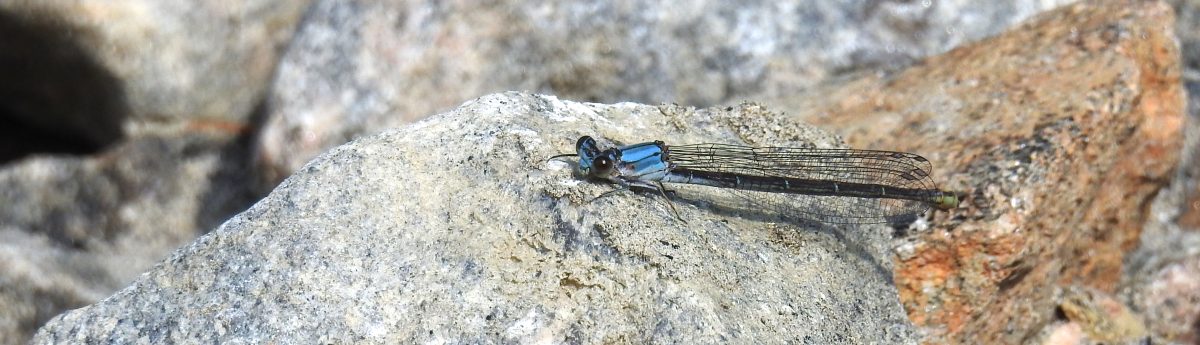
The damselfly that I found in the vegetation above the water looked similar to a male Eastern Forktail, except the abdomen was narrower and the blue patch at the tip was longer. The top two suggestions in iNaturalist were for species in two different genera: the forktails and another one called wedgetails. There are three forktail species and three wedgetail species in Costa Rica according to the online checklist, and the observations posted on iNaturalist agree with those numbers, though there is an additional observation of one other species, Mexican Wedgetail, which was found south of San Jose and vetted by Dennis Paulson. Fortunately, I could rule out the forktails since the blue at the tip of the abdomen completely encircles the segments; in the forktails, normally some black is visible on the sides, restricting the blue to the top. The appendages on the final segment appear triangular in shape, which definitely made it a wedgetail, but which one?

Dennis Paulson identified this as a Pacific Wedgetail, though I am not able to determine what makes this male a Pacific Wedgetail rather than a Costa Rican Wedgetail, Narrow-tipped Wedgetail or Mexican Wedgetail. I was not able to get close enough for a more detailed macro shot or a profile view, so unless I get a copy of his field guide I will just have to take the author’s word for it!
The dragonflies were just about as easy to narrow down. I photographed two different individuals that appeared to be the same species. I could tell they were skimmers by the way they perched with their wings held downward and forward, but the front half looked like a meadowhawk while the back half looked like a dasher…both of which hold their wings forward and down the same way while resting.

iNaturalist only gave me one possibility for this fellow, so I was fairly certain it was indeed a Red-faced Dragonlet. The males of this dragonfly are entirely red when fresh, and develop a pruinose abdomen as they age, similar to some North American skimmers. They have a red patch at the base of the hindwings, though I do not know if this is diagnostic. This is seen on the second individual, who appears to be in rougher shape.

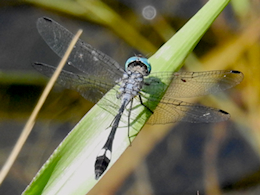
The other dragonfly present was one that looked quite similar to the Spot-tailed Dasher (Micrathyria aequalis) I saw in the Dominican Republic. This gave me a great starting point, until I counted 12 different Micrathyria species in the Ramirez checklist, and 13 species on iNaturalist! Then add a couple of similar-looking sylphs (genus Macrothemis), a dryad (genus Nephepeltia) and some of the clubskimmers (genus Brechmorhoga) onto the list of possibilities, and it’s no wonder I’m relieved that Dennis Paulson was able to dismiss most of the possible matches suggested by iNaturalist and identify it as a Square-spotted Dasher. He does note in the Canopy Tower slideshow that both the sylphs and clubskimmers are commonly found at streams, flying up and down their territories and occasionally hovering, which rules these genera out. The shape of the yellow spots near the end of the abdomen rule out the most common of the beautiful blue-eyed Speckled Dashers, the Spot-tailed Dasher.

Those were the only three types of odes I saw at the drainage ditch, and I was happy enough to see them. I was even happier when a few hours later I spotted a damselfly perching on a sunlit fern next to the shaded creek that wound through the rainforest at the back of the reserve. It looked like some sort of rubyspot, and I had to crouch down to make sure that the red patch at the base of the wings was visible against the green in my photos. There are nine rubyspot species in Costa Rica, and six were suggested by iNaturalist as possible identifications. Dennis Paulson identified it as a Highland Rubyspot, which is the most common rubyspot found in the mountainous regions of Costa Rica based on the number and location of observations in iNaturalist.

I did not observe any other odonates on the reserve until we returned to the drainage channel again on our way back, not even any gliders or darners swarming through the air the way they had at the Hacienda El Viejo Wetlands. I’m guessing this is partly because there are more wetlands (even if they were drier than expected) and a large river in the vicinity of Hacienda El Viejo, and partly because Tapir Valley is 500 meters above sea level while Hacienda El Viejo is at sea level.
The last dragonfly was brilliantly red and held its wings straight out like a Widow Skimmer rather than down like a like a Blue Dasher. It is the only one that was not identified by Dennis Paulson, but as none of the other identifications suggested by iNaturalist quite matched the colours of this one, I was pretty sure it was indeed a Brilliant Redskimmer (got to love those tropical dragonfly names!).

While I was watching the dragonflies, Oli pointed out a frog floating in the water, which turned out to be the only amphibian of the trip. It belongs to the family of American Water Frogs, meaning it is closely related to the bullfrog, Wood Frog, and Green Frog I see at home.

I found one more dragonfly on this trip, a Black-winged Dragonlet just outside the Occidental Resort the following day. The interesting thing about this trip is that all of the odonata species I photographed were entirely new, except for the Black-winged Dragonlet seen near the resort on both trips.
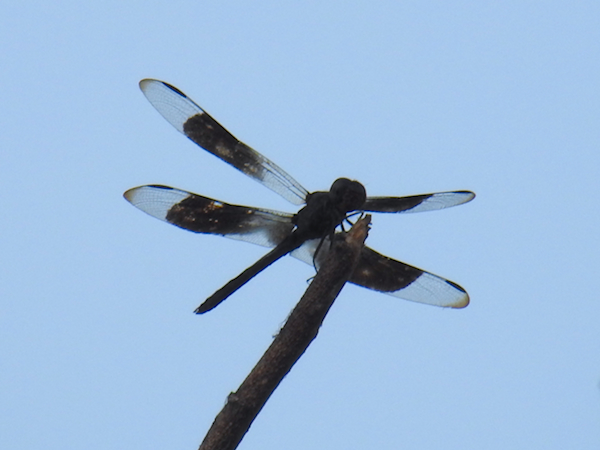
In 2017 I found a Great Pondhawk, Carmine Skimmer and Flame-tailed Pondhawk in the Palo Verde area close to where we took the boat tour. This means that on my two outings with Oli I’ve photographed six skimmers, one pond damselfly, and one broad-winged (or jewel-winged) damselfly! Although I would have loved some more diversity, the skimmers (family Libellulidae), and pond damselflies (family Coenagrionidae) make up the majority of species in Costa Rica, followed by the clubtails and darners. Overall these four groups make up around 75% of the just under 300 odonate species in Costa Rica, which, in addition to habitat, explains why I have run into so many skimmers and no other types of dragonflies. Still, I am happy to see the ones that I did, and add them to my life list!
Odonata seen 2023:
- Highland Rubyspot
- Pacific Wedgetail
- Black-winged Dragonlet
- Red-faced Dragonlet
- Brilliant Redskimmer
- Square-spotted Dasher
- Probable Wandering Glider hovering over cars at Rinconcito
all odonata seen in costa rica:
- Highland Rubyspot
- Pacific Wedgetail
- Great Pondhawk
- Flame-tailed Pondhawk
- Black-winged Dragonlet
- Red-faced Dragonlet
- Brilliant Redskimmer
- Carmine Skimmer
- Square-spotted Dasher
- Probable Wandering Glider
Citations:
- Ramírez, Alonso, Paulson, Dennis R., & Esquivel, Carlos. (2000). Odonata of Costa Rica: Diversity and checklist of species. Revista de Biología Tropical, 48(1), 247-254. Retrieved December 2, 2023, from www.scielo.sa.cr/scielo.php?script=sci_arttext&pid=S0034-77442000000100028&lng=en&tlng=en ↩︎

 OdoNotations