

Last year a particular OFNC outing caught my eye: a bioblitz to be held at the Morris Island Conservation Area on September 10th. Morris Island is a fantastic place for a bioblitz; the woodlands and wetlands of this 47-hectare site are home to a number of fascinating wildlife species, including several ode species not regularly found in my area of the city. I had never gone ode-hunting in September there before, as September is past the peak of ode season, with fewer species flying than in June or July. Still, it was a good chance to observe what was still flying there, and maybe find an unusual darner species or two. I attended with Chris T. and Chris L. and we photographed seven species for inclusion on the Morris Island Bioinventory Project on iNaturalist: Skimming Bluet, Eastern Forktail, Fragile Forktail, Powdered Dancer, Halloween Pennant, Autumn Meadowhawk, and White-faced Meadowhawk. So much for finding any cool darners!
A second bioblitz was held on May 22, 2023 (Victoria Day), and this time Chris T. and I attended together. I had never been there in May before either, so it was a good opportunity to look for early-flying emeralds and whitefaces and maybe an unusual darner species or two.
It was still fairly cool when we arrived, with a clear blue sky and a bright late-spring sun that I hoped would warm things up fairly quickly. We arrived early as it was a holiday, and parking tends to fill up fast; cars were still arriving as we scanned the vegetation and rocks surrounding the parking lot, and it didn’t take long before we found our first dragonfly as it buzzed by us and then landed on the ground. I thought it was an immature Dot-tailed Whiteface, but Chris said it was a Hudsonian Whiteface; the females and immatures of these two species are difficult to identify as both have yellow spots running down the abdomen to the seventh segment. The shape of the last spot helps to differentiate these two dragonflies: in Dot-tailed the spot is square and wider than the spot above it, and often wider than it is long in females, while in Hudsonian the last spot is elongated and pointed. The spots on the Hudsonian Whiteface also are usually as long as the segment itself, and never less than two-thirds the length of the segment, a helpful field mark if other whitefaces – particularly Belted and Crimson-Ringed – are found within the same region. Wing venation is another key field mark: immature Hudsonian Whitefaces have pale veins within the dark basal patches at the base of each hindwing, while Dot-tailed Whitefaces never have these pale veins. Hudsonian Whitefaces also seem to have larger basal wing patches than Dot-tailed Whitefaces.

Another individual – this one much thicker-bodied, which indicates a female – showed the pale veins within the basal hindwing patches much more clearly:

A close-up of the veins:

It was a good beginning to the bioblitz. Although I was hoping for some other whitefaces, the only other species we saw was Dot-tailed Whiteface, finding one or two immature and mature individuals. We also saw some baskettails fly by, out of reach of our nets. We would have to wait for one to land before we could identify it: the first was a male Beaverpond Baskettail, which we identified by the angular shape of its upper clasper with the small dorsal tooth projecting outward.

The Spiny Baskettail came later, with one male perching nicely in front of us, giving us the definitive side view:

The only other emerald we saw was an American Emerald…no rare Somatochlora, and no amazing aggregation of emeralds such as the one found by Colin Jones & Peter Burke on the afternoon of May 25, 2001 which included Racket-tailed Emerald, Common Baskettail, Kennedy’s Emerald, Forcipate Emerald, and Uhler’s Sundragon among the common species we’d seen today.

When we reached the causeway we were shocked to see that there was very little water in the bay on either side. I’ve never seen the bay without any water, and it was weird to see all the stumps sticking out of the muck.

There was more water further out:

We wended our way through the woods and checked out every rocky opening onto the river that we could find, hoping for the early clubtails to be out. The only ones I managed to identify were Dusky Clubtails. Usually the small clubtails I see at Morris Island in the summer are chiefly Lancet Clubtails, which has yellow extending down all of the abdominal segments. The Dusky Clubtail has an earlier flight season in Ottawa, running from early May to mid-July, while the Lancet Clubtail flies from early June to mid-September.

It was too early for any big river dragons to be cruising along the Ottawa River, with only the Dragonhunter a possibility as it emerges in late May. Still, we were hopeful that something unusual would turn up on our search.

After checking the river side of the conservation area we crossed the causeway and tried the woods. Chris has had luck with Stream Cruisers flying up and down the path here, but again, it was too early in the season for them to be flying. They emerge in late May as well, and should be emerging at any time as long as it stays warm. We added to our odonate list with Eastern Forktail, Four-spotted Skimmer and Chalk-fronted Corporal, all typical species for the Victoria Day long weekend.

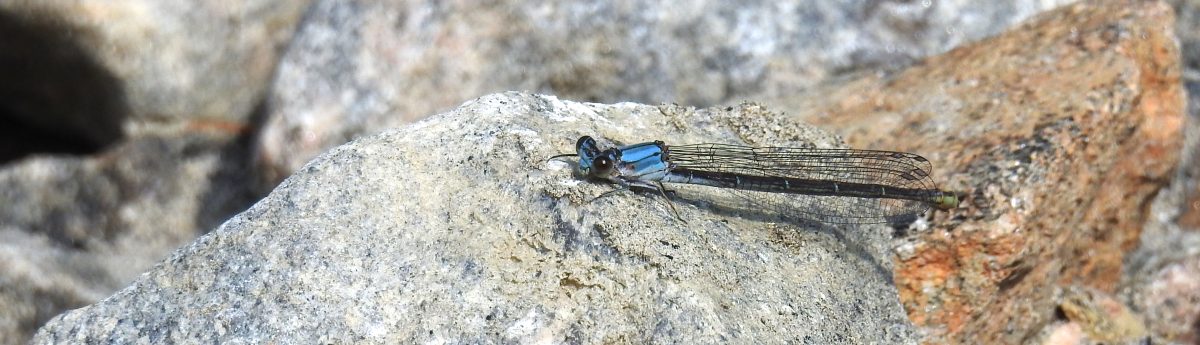
Toward the end of the causeway we were rewarded with our second identifiable damselfly species, the Aurora Damsel. There were a few of them perching in the leaves, mostly young individuals that had not attained their blue colouration yet. Some females are yellowish-brown instead of blue, and I didn’t see any of those either.

When we got to the end of the trail we spent some time looking for dragonflies around the water. The trail dips down to the channel that breaks the causeway in half, and on the other side there is a fence blocking the way. This is where would see all sorts of Slaty Skimmers and Widow Skimmers and whitefaces in the summer; none were present this early. Chris had jumped across the channel and was taking photos when I saw a large clubtail fly in and land on the ground behind him. I could not find it in my binoculars and told him to turn around slowly; however, it flew off before he saw it and departed to parts unknown. It was likely a Horned Clubtail, or maybe even a Dragonhunter, but without a photo or a good look we will never know.
We were still in the same area near the end of the trail when something large and dark with a bit of a pattern flew in and landed on a stick a couple of inches above the ground. I stared at and just could not process what it was (Stream Cruiser? No, the pattern was too busy) when Chris exclaimed that it was a Springtime Darner! This piqued my interest as I haven’t seen a Springtime Darner in years. I looked at the thorax and saw the straight yellow stripes bordered in black and confirmed his identification.

The Springtime Darner flies between mid-May and early July and is considered “local and uncommon” in Ottawa. Its preferred habitats include woodland streams and larger rivers with a current; lakes with rocky shorelines; beaver ponds; and shaded forested environments. While males can be seen flying up and down streams or along the shoreline of larger rivers at about knee-height, both sexes can be found feeding in clearings close to the ground. They are active at the water throughout from the early morning to dusk, and are considered one of the dusk-flying species. This may explain why I see very few of them!
Despite its appearance, its is not considered one of the “mosaic darner” species. Not only does it fly in an entirely different season and largely different habitat, the Springtime Darner is considered a more primitive species as determined by wing venation.

So in the end we found our cool and unusual darner and photographed 11 odonate species (excluding the bluets we were unable to catch) for the bioblitz. That brought us to 17 species altogether as only one species, the Eastern Forktail, was repeated on both the September and May counts. It was fun going outside of prime dragonfly season and looking around to what was there; while there were no surprises on the fall bioblitz day, seeing the Hudsonian Whitefaces and Springtime Darner in late May were definitely unexpected, and make Morris Island worth visiting again in the spring!

 OdoNotations