

Sunny skies, a predicted high of 20°C, and a day off from work on the last Friday in May meant plans to visit Marlborough Forest for the first time this season with my mentor, Chris L. I had convinced her to come with me to trail E4 north of Roger Stevens Drive, home of the Ocellated Emerald, Ashy Clubtail, and Twin-spotted Spiketail – though it was too early for any of those to be flying yet. No less exciting were the possibilities for the early spring dragons that should be on the wing by now: Harlequin Darner, American Emerald, Ebony Boghaunter, and maybe a Springtime Darner or Stream Cruiser. We were sure to see plenty of whitefaces and other skimmers, some baskettails and a Dusky Clubtail or two, and some gossamer-winged butterflies to keep things interesting…the great thing about Marlborough Forest is that it is home to an amazing number of species not easily found in the city, so anything is possible!
We met at the parking lot at 9:00. It was still a little cool, but once we started walking we quickly warmed up. There were practically no biting bugs; the deer flies had not emerged yet, and only the occasional mosquito bothered us. This was the first time I had visited Marlborough Forest without a swarm of bloodthirsty insects harassing me, and it was bliss! There were no odonates at first either, and we spent most of the first hour listening to the birds.
I showed Chris the pool of water formed by the stream where it meets the culvert under the road, but nothing was perching in the vegetation or flying over the water: it was too early for the Ebony Jewelwings as well. Once we got close to the large marsh where we heard a snipe keening and Marsh Wren singing we started seeing a few skimmers flush from the trail and perching in the vegetation. We saw a Four-spotted Skimmer, a Common Whitetail, a few teneral whitefaces (though I could only identify Frosted and Dot-tailed), and Chalk-fronted Corporals. Then an emerald flew by and landed on a leaf. I didn’t think it was anything particularly rare or uncommon, but I swung my net and caught it anyway…it’s always nice to see one of these up close. It was an American Emerald, one of the earliest members of Family Corduliidae to take flight each year. I handed it to Chris then took a few photos for iNaturalist. Its eyes were mostly green, a sign that it has been on the wing for a few days already.

With a flight season beginning in early May, only the Beaverpond Baskettail has an earlier flight season, starting in late April. Of course, this is dependent on the weather and how long it takes the various ponds and marshes to warm up. Seeing the emerald made me realize that there were no baskettails flying up and down the trail at all…I usually see both Spiny and Beaverpond Baskettails on the wing at the same time I see my first American Emeralds.
The American Emerald is one of the easier emeralds to identify, even without catching it. The hairy thorax combines metallic shades of both green and bronze, and lacks the yellow spots and stripes of the striped emeralds (Genus Somatochlora). When viewed from above, the abdomen is entirely dark except for a thin yellowish-white ring between the second and third segments near the top. The abdomen may flare out into a slight club. The only dragonfly that resembles the American Emerald is the Racket-tailed Emerald, which is smaller, flies later in the season, and has two small yellowish triangles on segment 3 that make me think of the points of a collar as well as a much wider club. Given its propensity for perching (unlike many other emeralds), a clear photograph is enough to identify the American Emerald.

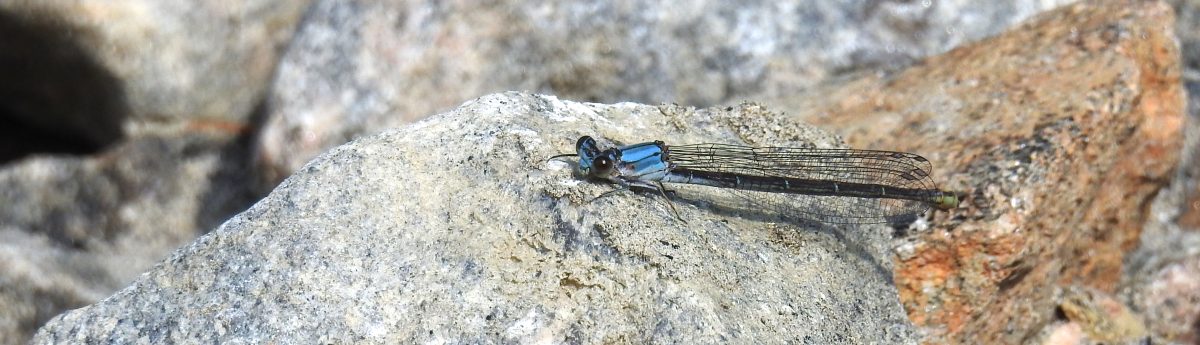
We reached the large wetland at the T-intersection at the back of the trail, then turned around as Chris had to be somewhere by noon. We found a Common Roadside Skipper and Henry’s Elfin on our way back, two of the early-flying butterflies, as well as a couple of bluets which, when caught and examined using our hand lens, turned out to be Boreal Bluets, a species I don’t see very often as it is considered uncommon and local in Ottawa. When viewed from the side, the upper clasper appears “bulbous”; other field marks to look for to help distinguish the Boreal Bluet from all other bluets except the Northern Bluet are very large eyespots, and a black mushroom-shaped mark on the top of segment 2. We scared up a couple of clubtails that looked like Dusky Clubtails; this is the common species here, flying earlier than the other clubtails in our region.
An immature Chalk-fronted Corporal landed on a twig as we passed by, and I thought that the reflections of sunlight glancing off its teneral wings looked pretty.

All too soon we finished the walk and Chris hurried off to her appointment. I was still in the mood for more dragon-hunting, eager to put the long, dreary, cold dragonless months firmly in the past. I drove down the road to the Cedar Grove Nature Trail, knowing that there were sure to be plenty of dragonflies around the edges of Roger’s Pond.
There were a few damselflies in the vegetation at the start of the trail, mostly Aurora Damsels and a couple of tenerals too colourless to identify. The Aurora Damsels didn’t have much colour either, but at least their thoracic pattern is distinctive enough to identify them: they have one solid black patch in the center of the thorax with wavy edges. This male, which has yet to turn blue, has the small black spots on segments 8 and 9 that also help distinguish him from other damselflies.

I still didn’t see any baskettails, so I took a chance and headed down the short trail that leads to the open clearing we refer to as “the dump” due to all the large waste items that have been abandoned there. I was lucky; an emerald was patrolling the narrow trail, and it landed in the shadowy branches of a cedar close enough for me to photograph. Finally, something different: a male Brush-tipped Emerald! It was fairly fresh-looking, with sparkling new wings like so many of the dragonflies that day, so I let him be. Seeing him made me happy, as the current Checklist of the Odonates of Ottawa shows this species’ flight season as beginning in mid-June.
After I got home I checked all of my personal iNaturalist records, as well as all of the Brush-tipped Emerald observations for Ottawa, and discovered this was the only record for late May. I then looked at Odonata Central, which had no records for May for all of Ontario. It occurred to me that this might be the earliest date on record for this species in Ottawa, though these online records were hardly conclusive given that there are only 19 observations in iNaturalist – most of which are from after 2014, and over half of which are mine! My sporadic spreadsheets show my previous early date as June 1, 2014 at Roger’s Pond, so I asked Chris what her earliest date was. She told me hers was June 12! The question now becomes whether this May 26 date truly is earlier than usual, or whether the Brush-tipped Emerald has always emerged toward the end of May and never was observed before given its rather restricted habitat of slow streams flowing through various wetlands, and the very small number of dragonfly observers who just can’t be everywhere at once!

While I was reluctant to catch the emerald, I did, however, net a blue-type bluet flying close to the ground. It was another Boreal Bluet, but I wasn’t able to get any clear photos of the tip of the abdomen. Once I finished examining him I placed him on a stick on the ground to photograph him from the top. You can see the large eyespots and a bit of the “black mushroom” on the top of the second segment.

At Roger’s Pond there were a few tenerals flying around, mostly skimmers. The best bug at the pond turned out to be butterfly rather than a dragonfly; it was small and orange, and my first thought as I saw it dancing around a cluster of yellow flowers was that it was a Meadow Fritillary. Only when I got home and started going through my photos did I realize that it was not a Meadow Fritillary but something just as cool: a Silver-bordered Fritillary, a species I haven’t seen in a long, long time. One of the lesser fritillaries, it was formerly known as Boloria selene until 2022 when genomic sequencing concluded that it was not conspecific with the Eurasian species and should be considered a full species on its own. It is distinguished from other fritillaries by the thick black margin on the upper side of each wing containing a row of small orange spots.

I didn’t feel like walking to the creek at the back, but I did want to explore the woods on the east side of Roger’s Pond. I’d seen Eastern Commas there in the past and had heard reports of other commas in the area, so I thought it would be worth a look. I found some Taiga Bluets and a White-striped Black Moth, but other than those I mostly saw the same species I’d seen earlier on my walk. The gaywings (Fringed Polygala) were in bloom, and their bold shade of pink was delightful to see.

I found another American Emerald in a sunny opening in the woods, along with several mature Chalk-fronted Corporals. The mature Chalkie is quite different in appearance from the teneral I photographed earlier; it has turned black and developed a coating of minute white dust on the top of the thorax and abdomen. This coating, called pruinosity, is common in many odonate species, including the whitefaces, some of the king skimmers, and the Powdered Dancer.

When I reached the clearing with the log shelter I noticed a small patterned dragonfly zipping merrily back and forth over the sunlit trail. I thought, Oh! So here is a baskettail at last! and began watching it to see if I could discern a particular flight path that I would be able to intercept with my net. Then it began flying toward me, so I just swung the net and caught it! Some dragonflies take a while to settle into a predictable patrol pattern, but this one made it really easy by heading right toward me in a straight line. When I reached into the net I saw that it wasn’t a baskettail at all: it was a Harlequin Darner. And I realized that if I had just waited a few minutes more it probably would have landed on my khakis.

The Harlequin Darner is the only member of the “pygmy darners” (Genus Gomphaeschna) found in eastern Ontario. The only other pygmy darner in the world, the Taper-tailed Darner (Gomphaeschna antilope), is a close relative found in coastal states from southern Maine to Louisiana, with additional records in eastern Texas, New York and Michigan. These similar-looking darners are smaller than the mosaic darners of Genus Aeshna but have similar intricate patterns on the brown-coloured body in shades of amber, gray and in the case of the Harlequin Darner, laurel green. The pairs of triangles running down the top of the abdomen look like dancing flames.

The Harlequin Darner is unique among dragonflies in that females, like the one shown here, have a club-tipped abdomen, while males do not. Clubtails belonging to Family Gomphidae and emeralds such as the Racket-tailed Emerald are the opposite: males have a stronger club than females. The male is also unique among darners in that the lower clasper (the epiproct) is forked. The eyes of the female usually remain grayish-brown, while males develop stunning green eyes, placing it in the ranks of other attractive green-eyed dragonflies such as the Dragonhunter, the Swift River Cruiser, the emerald family (Family Corduliidae), and the spiketails of Family Cordulegastridae.
Harlequin Darners are well known for their habit of landing on people, especially those wearing light-coloured pants. This was not the first time one approached me with exactly those intentions in mind, and I suspect this lady initially started flying toward me because she saw me as a potential resting spot. Once I finished examining and photographing her I placed her on my leg to see what she would do. Harlequin Darners prefer to rest vertically on tree trunks where they blend in with the bark, and this one stayed on my leg for a few minutes even though there wasn’t much camouflage to be had.

Harlequin Darners breed in conifer swamps, sphagnum bogs, and fens with standing trees, but often forage over open fields, trails, and woodland edges away from the water. Marlborough Forest must have a thriving population of Harlequins, as I have seen them on and off at the Cedar Grove Nature Trail (aka Roger’s Pond, or Trail E3) since 2014. I’ve also seen them at Mud Lake, Mer Bleue, Gatineau Park, and the Bill Mason Center.
I spent some time trying to photograph the darner on my leg, and to my amusement I soon noticed that she was slowly climbing up my leg! In the photo below she had made it up to the bottom of my pocket over a period of four minutes. While dragonflies have amazingly long and sturdy legs, they are not used for walking; rather they are used for perching on or clinging to vegetation (or human bodies!) and for catching and holding prey. You will notice that the hindlegs are the longest and the front legs are the shortest; bringing them close together in flight helps them to create a “basket” in which they catch smaller insects. Each leg is covered in tiny spines to prevent prey from escaping.

Perhaps I startled her while taking her picture; perhaps she realized there was something a little off about her “tree”; or maybe it was simply time to hunt again, but she left shortly after that, leaving me feeling grateful to have shared this one unique moment in time with her. This was by far the best dragonfly encounter of the day, and I was glad I chose to walk a different route to the log shelter. Had I taken my usual route to the bridge over the creek I might never have seen her at all. With dragon-hunting, luck is all about being in the right place at the right time.

 OdoNotations