
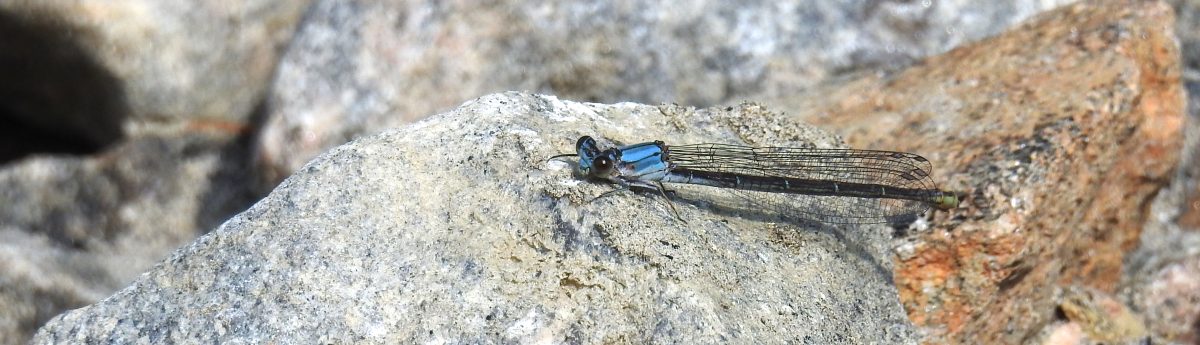

Family Corduliidae (the emeralds) is one of my favourite dragonfly families. My love for these green-eyed beauties grew when I started seeing a large number of Williamson’s Emeralds (Somatochlora williamsoni) in Stony Swamp in the summer of 2014; one particular day at the end of June stands out in my memory because I found a total of five emerald species at Jack Pine Trail in one visit (Common Baskettail, Prince Baskettail, Racket-tailed Emerald, Brush-tipped Emerald and Williamson’s Emerald). It was around that time that I realized that I didn’t have to wander too far from home to see such a fantastic variety of wildlife – Stony Swamp in particular is amazing, with the Eagleson storm water ponds close behind. I saw two Williamson’s Emeralds in Stony Swamp in 2018, then none in any subsequent years. The Brush-tipped Emerald population was still present as of last year, with one iNaturalist record (not mine) from Old Quarry Trail on July 1, 2022.
During the pandemic I discovered that Marlborough Forest, too, was an excellent place to see emeralds. I had known that Roger’s Pond was a good place to see Brush-tipped Emeralds and the occasional Ebony Boghaunter, but when I found my lifer Ocellated Emerald there in June 2020 and Kennedy’s Emerald in June 2021 on the trails north of Roger Stevens Drive it made me wonder what other emeralds might be hiding within its fens and marshes. The first Sunday of June was forecast to be sunny and warm, with a high above 20°C so I made plans for a mid-morning visit to Trail E4 to see if I could find another Ocellated Emerald – or something else just as rare.

The weather was just as beautiful as the weatherman predicted, so I had high hopes of seeing many different butterfly and odonate species, perhaps even finding something completely new. I started my day with a Four-spotted Skimmer and a couple of Frosted Whitefaces in the parking lot vegetation, followed by an Arctic Skipper in the first few meters of the trail itself.
I stopped at the culvert where I saw the Ocellated Emerald three years ago. Nothing much was flying at the stream where it pooled next to the trail other than the usual Ebony Jewelwings. In the vegetation I saw a few Sedge Sprites and Aurora Damsels, while a few small orange butterflies – Hobomok Skippers and Northern/Pearl Crescents – fluttered along. There were no emeralds or skimmers, and I waited a few minutes in case the Twin-spotted Spiketails were flying. To my delight one appeared flying low over the water before it propelled itself up and over the steep bank. I tracked it with my binoculars and was surprised when it hung up in the bare branches of a shrub next to the road! It was great to see this species here again, especially since I didn’t have to push my way into the bush to see where it was landing. This is the second location where I’ve seen Twin-spotted Spiketail in Marlborough Forest, though I haven’t seen any – or attempted to see any during its brief flight season – at the Roger’s Pond location in a long time.

I left the culvert, and it wasn’t long after the trail was swallowed up by trees again that I started seeing the occasional emerald flying along the sun-dappled path. The male Racket-tailed Emeralds were easy to identify in flight with their club-shaped abdomens, but then I spotted another small emerald that looked different. I held out my net, prepared to catch it, but then it flew up into the trees and perched on a branch about five feet above my head. A quick look through the binoculars confirmed it as one of my target species: a male Brush-tipped Emerald. Even from that angle the distinct hairy claspers were distinctive.

I was happy to see it and add it to the day’s checklist of odes but didn’t think too much of the sighting itself. I puttered along the trail, finding a Common Whitetail, a Four-spotted Skimmer, an immature Frosted Whiteface, more Aurora Damsels and Sedge Sprites, and an immature Chalk-fronted Corporal that looked lovely perching on some tiny flowers. It looked almost pink in colour.

While I was photographing the corporal another orange butterfly started fluttering at my feet and eventually settled on the ground. It perched with its wings closed, and the pattern reminded me of a crescent at first. The shape, however, reminded me of an azure or hairstreak. I took a closer look and was thrilled to identify it as a Harvester! This species is a member of Family Lycaenidae, and if it doesn’t look like any of the other gossamer-winged butterflies it’s because it is the only member of its genus (Feniseca). The Harvester is one of the more difficult members of its family to find – although it lives in swampy areas and woodlands near water, it is highly localized and depends on colonies of woolly aphids on which the caterpillars feed. It’s been so long since I’ve seen one that I don’t even have any observations submitted to iNaturalist, which I started using regularly in 2016.

I reached the large clearing with the dirt-bike tracks, and decided to spend some time here looking for bugs. The large pond of snowmelt looked promising for odes, and I found a few skimmers flying over the water and perching on the ground, mostly Common Whitetails and Chalk-fronted Corporals. However, there were several emeralds buzzing around the small stand of cedar trees growing next to the water and while most looked like Racket-tailed Emeralds, a few did not. I spent a long time trying to catch one of these and finally was successful, netting a male Brush-tipped Emeralds!

These small emeralds have a distinctive shape that makes them stand out from the Racket-tailed Emeralds that fly in good numbers at the same time: they have a big head attached to a robust thorax, and a narrow upper abdomen that gets wider toward the end. Compare this to the shape of the Racket-tailed Emerald I caught a little later (in all fairness I should be comparing the male Brush-tip to a male Racket-tail; but since the male Racket-tail has such a distinctive wasp-like shape, I tend to focus on catching the dragonflies I can’t identify in flight):

The female Racket-tailed Emerald has a more balanced look while the Brush-tipped Emerald looks “front heavy” with a proportionally short abdomen compared to the span of its wings. The difference is noticeable enough for me to distinguish them – but not readily identify them – in flight. For that you need a good look at the terminal appendages. The male Brush-tipped Emerald is aptly named with his brushy claspers, the pelt of hair obscuring the outer third of his cerci (the two upper appendages on a male dragonfly).

Females, like males, have two cerci at the end of the final segment of the abdomen, though they are blade-like in appearance. On the underside of the body, a subgenital plate protects the opening of the reproductive tract between segments 8 and 9. These dragonflies are large enough to see the differences between perching males and females with binoculars or a good zoom camera. I got lucky and managed to net a female patrolling with a small group of emeralds further down the trail.

The shape of the subgenital plate can be useful in narrowing down the ID of a female Somatochlora emerald. While many female dragonflies need to be flipped over to look at the underside of the abdomen, quite a few female emeralds can be identified with a side view alone. Some have triangular or thorn-shaped subgenital plates pointing straight down from the ninth segment; others have scoop-shaped subgenital plates extending backward at an angle, varying in shape and size; and still others are notched below and need to be examined upside-down. The Brush-tipped Emerald is alone in being described as have a “sub-perpendicular” subgenital plate in the Algonquin field guide, projecting backward at a 45° angle with a length greater than segment 9. This is visible in the below photo:

Fortunately Brush-tipped Emeralds do not need to be identified by their “naughty bits” alone. In addition to their small size, the most useful distinguishing feature is the unequal shape of the yellow spots on the side of the thorax: there is one small stripe or dash followed by a smaller round spot. These are more prominent in individuals that have recently emerged, as they become obscured with age. Another field mark to look for is the yellow spots running down the sides of the abdomen to segment 7. Finally, these dragonflies often have an amber wash on the wings, though many other emerald species have tinted wings, too. The amber colouration is quite prominent in the second female that I caught:

It turned out to be an excellent day for Brush-tipped Emeralds. I found a total of three perching individuals (I watched them land) and caught four altogether, two females and two males. All of them looked fresh, indicating that there must have been a mass emergence within the past few days. I have never seen this many Brush-tipped Emeralds in the same area before, nor caught so many on the same day!

I made it beyond the T-junction beyond the large marsh but didn’t go much further, as the walk had taken more time than I had planned and I wasn’t finding any emeralds on this section of the traiI. I found some other interesting odes along the way, including this mature Hudsonian Whiteface. I think this is the first time I’ve seen this species in Marlborough Forest:

Another interesting, if macabre, sight was this Dot-tailed Whiteface eating a bluet headfirst. It’s always sad seeing an ode eating another ode, especially when there are so many mosquitoes and deer flies out there….

This mature male Racket-tailed Emerald was perching nicely for the camera. You can really see how thin the middle portion of the abdomen is compared to the club-shaped tip. This shape gives it a resemblance to some of the thread-waisted wasps, and makes it easy to identify in flight. Note the brilliant green eyes on this fellow!

I saw some more butterflies on my way back to the car, including this cooperative Indian Skipper on the ground. This is only my second time time seeing one of these early-flying skippers; they live in open meadows, brushy fields, pastures, forest clearings, and along roadsides. The orange underside of the hindwing contains a faint crescent of square yellowish spots which barely contrasts with the background; while this pattern is very similar to that of the Long Dash Skipper, the spots on the Long Dash are longer, resembling an uneven stack of books. The Long Dash flies later in the season, too, usually emerging in mid-June whereas the Indian Skipper emerges in late May. So far Marlborough Forest is the only place I’ve seen this species, both times on the trails north of Roger Stevens Drive.

Although I didn’t see any unusual dragonflies, I thoroughly enjoyed this outing and catching all the Brush-tipped Emeralds. The Hudsonian Whiteface, Indian Skipper, and Harvester were good finds, too. It seems like every time I visit Marlborough I find something different, and this is why I’m drawn back to it time and time again.

 OdoNotations