

Spiketails are large, brightly coloured dragonflies that inhabit small or mid-sized streams, usually with a good current in forested areas. There are three species present in eastern Ontario, all with dark brown or black bodies, green eyes, and bold yellow patterns along the abdomen that may cause them to be confused with clubtails in flight. Each species has a dark thorax with two vivid yellow stripes on the side and two smaller yellow dashes on the top. It is the pattern on the top of the abdomen that distinguishes them: the Arrowhead Spiketail has a single line of yellow arrows pointing toward two round spots at the tip; the Twin-spotted Spiketail has two lines of yellow spots with straight tops and rounded bottoms running down the abdomen, set close together; and the Delta-spotted Spiketail has two lines of widely-separated spots running down the abdomen, each pointed and distinctly triangular in shape. Because of their habitat requirements, they are considered local and uncommon, and in Ottawa the Arrowhead Spiketail is considered the rarest of the three.
While I have seen Arrowhead Spiketails in Gatineau Park and Larose Forest, Jack Pine Trail is the only place I regularly visit where I have found them to be reliable, seeing them there on and off since 2014. I usually make it a point of visiting the stream at the back of the trail system each season to see if they are still there, and while it was a bit early on my first visit there on June 3rd, I had hopes of seeing some other interesting odes to add to my Stony Swamp project on iNaturalist. Unlike my Eagleson storm water ponds project, this one is solely devoted to odonates, and I was looking forward to adding more observations.
I didn’t see any odes until I reached the clearing where the bird feeder used to stand. It is completely open to the sun after the derecho brought down a number of trees in the area; and if there is one thing dragonflies like, it is patrolling sunny clearings in the middle of the woods for food. I found a couple of emeralds zipping along the trail, and netted a male Spiny Baskettail. Although a member of the emerald family, baskettails have eyes that are quite blue compared to the Somatochlora and small emeralds. I see Spiny Baskettails more often than Beaverpond Baskettails in Stony Swamp, where they are common at Sarsaparilla and Beaver Trails as well as Jack Pine Trail.

Close by, a Four-spotted Skimmer waited patiently on a stick for something to fly within reach; it occasionally sallied out and returned to the same area. I don’t see as many as these as I see baskettails, possibly because they are perch-and-wait predators that are highly territorial, chasing out competing Four-spotted Skimmers and other dragonflies.

I continued on my way toward the back of the trail, checking the vegetation growing between the marsh and the trail for damselflies. I found a female Taiga Bluet, a male Hagen’s Bluet (which I caught and examined) and some Sedge Sprites. There were no dragonflies here, but at the next intersection – the same one where I’d found the American Three-toed Woodpecker in January – I found one cruising along the small clearing before hanging up in a shrub only a foot above the ground. When I scanned it with my binoculars and realized it was a Stream Cruiser, I was astonished – I had never seen this species in Stony Swamp before.

Stream Cruisers breed in forest rivers or streams with sandy bottoms, or occasionally sandy-bottomed lakes. Although named for its habit of patrolling long sections of streams or lakeshores, I most often see them flying up and down forested trails close to water, looking for food. Their slightly clubbed abdomen differentiates them from darners in flight, and they do often perch, hanging diagonally from the vegetation as this one was doing. I was happy to add it to the list of odes of Stony Swamp, particularly since this wasn’t only my first Stream Cruiser in Stony Swamp, it was the first member of its family – Macromiidae – that I’ve observed here!
As I expected, it was too early to see any spiketails flying along the stream at the back of the trail. Sometimes they can be found actively patrolling the stream as it winds its way through the woods; other times they can be found perching in the vegetation nearby. I most often find them when they fly by, either up and down the watercourse or just as they hang up in a shrub. Nothing of interesting was stirring along the trail behind the new bench, but back at the main trail I found a Racket-tailed Emerald willing to have its photo taken.

Another member of the emerald family was flying along the back of the trail, which is not uncommon; I usually see Racket-tailed Emeralds beyond the second loop and baskettails along all three loops. This one turned out to be a Common Baskettail, a species which I usually see along the third loop with Prince Baskettails. In our region the Common Baskettail is the only baskettail with a large black patch at the base of the hindwings.

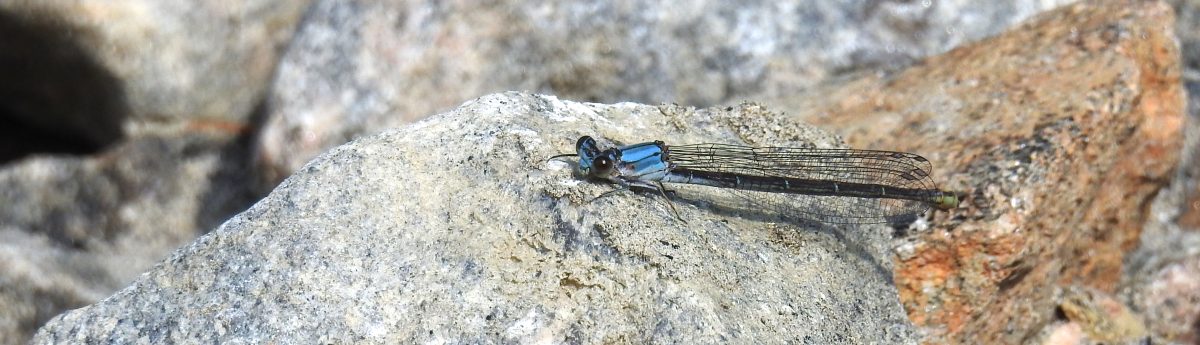
The last noteworthy species of my visit was a Marsh Bluet. I find that blue-type bluets are not all that numerous in Stony Swamp; Taiga Bluets tend to emerge in abundance at all my favourite trails at the beginning of the season, and Marsh Bluets seem to be numerous at Sarsaparilla Trail a little later in the season, but other than that I usually only find the occasional individual bluet here and there, including the Hagen’s Bluet I’d caught earlier. I caught this one to verify its identity – it has the Marsh Bluet’s curved forked upper claspers that look like a sideways “U” (or a backwards “C”) extending from the tip of the abdomen, visible only with a hand lens or a camera with excellent macro capabilities. Once I finished examining it I placed it on a stem in order to take some more natural photos that show the entire bug.

I didn’t see any additional odes on the rest of my walk around the third loop, though I did see some butterflies: Viceroy, Juvenal’s Duskywing, Arctic Skipper, Hobomok Skipper, and Common Ringlet.
When I reached the parking lot I was happy to see another large dragonfly buzzing around the clearing next to the outhouses. I approached it with the intention of catching it, but then it landed and I was startled to see that it was another Stream Cruiser! This was another first for me – two Stream Cruisers on one trail!

I returned the following Saturday (June 10, 2023), still hoping to find Arrowhead Spiketail for my year list. Because it was getting late in the afternoon (I’d already been out visiting the Eagleson ponds and Terry Carisse Park), I didn’t spend too much time looking for damselflies. I did quickly check the boardwalk at the middle loop, where I found both Four-spotted Skimmer and Common Whitetail, then headed directly to the stream. I made my way past the bench leading to the fabled fourth loop, and spent some time watching the stream. The sound of the burbling water was soothing as I scanned the area for other dragonflies or butterflies. I didn’t have to wait too long before a large dragonfly came skimming along the stream’s surface and disappeared up the channel – with the black and yellow pattern it could only be a spiketail! I waited for another couple of minutes, and eventually it came back – and then hung up on a dead reed not too far from where I was standing!

It is always thrilling to see these large dragonflies perching out in the open, even though they seem to spend as much time perching as they do patrolling. Perhaps it is the fact that they are hard to find and so seldom seen that makes them so intriguing – in Dragonflies through Binoculars Dunkle says that spiketails “are not commonly seen except at just the right time and place”! That certainly seems to be the case with this species, as I saw my first Arrowhead Spiketail at the Larose Forest bioblitz in 2010 when I stepped out of the car and saw one perching on some vegetation in the ditch!
This dragonfly showed no signs of moving, and having obtained my goal, I left it to its own devices and headed back to the car. It was reassuring to see that this population still managed to survive here even after droughts in previous years had caused the stream to dry up and floods in other years had caused large volumes of rushing water to overflow the channel. And as it is a handsome bug in its own right, it is worth seeking it out each year just to admire its brilliant green eyes and striking arrowhead pattern.
If I don’t get back to Jack Pine Trail again during its brief flight season, it’s definitely a date next June!

 OdoNotations