
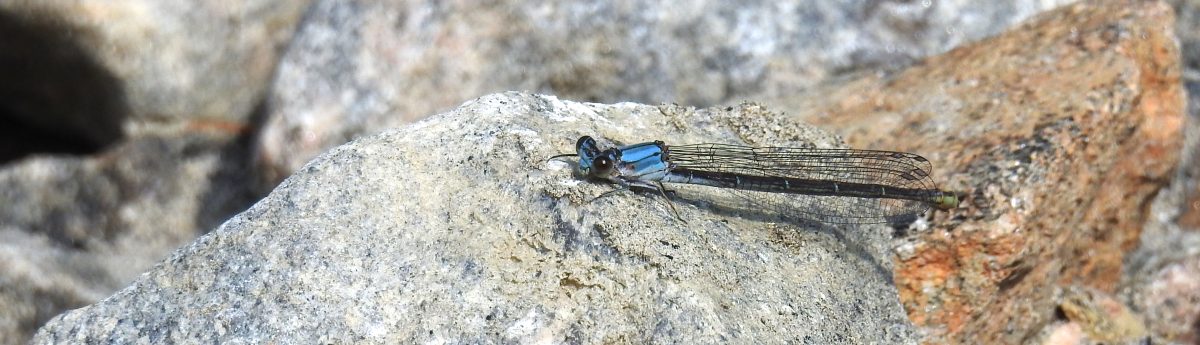

I wasn’t expecting to find a new species for the Eagleson storm water ponds when I went there this morning, let alone two; my main goal was to look for some Rainbow Bluets in the vegetation around the southern-most pond. My walk started normally enough, with the usual odonates perching in the vegetation: Taiga Bluets, Eastern Forktails, Sedge Sprites, and even a Fragile Forktail. I headed out onto the small spit of land where I used to see Saffron-winged Meadowhawks and Eastern Amberwings perching over the water before the sparse planting of cattails became a solid, impenetrable wall of vegetation. There was one dragonfly here, and I caught a glimpse of the black and white colours as it landed on the ground ahead of me. It was Chalk-fronted Corporal, and at first I thought nothing of it as I snapped a few photos for my iNaturalist project. After all, these dragons were not only common, but also abundant where they happened to emerge. It took me a moment to realize that although I see them quite regularly at Sarsaparilla Trail and in Marlborough Forest, I had never seen one here at the ponds before. It was a new species for my project!

I only saw one as I made my way around the southern-most pond, but then I didn’t have time to check any of the others. Would it be a one-time visitor, like the Racket-tailed Emerald of 2022 or the Violet Dancer of 2020? Or would more follow? I’d seen a noticeable decline in skimmer numbers over the last year or two, so new additions were definitely welcome. There are fewer Common Whitetails, Twelve-spotted Skimmers, Widow Skimmers, Eastern Pondhawks and Dot-tailed Whitefaces around the edges of the ponds than there used to be. While none of these had ever been truly abundant, I would usually see a few on most visits in appropriate weather. I suspect the large number of fish – particularly carp, which feed by disturbing the wetland floor and stirring up sediment containing dragonfly larvae – and growing number of frogs and toads are likely responsible for this decline, but have no evidence to support this theory.
I found some Rainbow Bluets in the vegetation right where I expected them – they seem to prefer the western side of the southern pond – and was reassured when I saw a Common Whitetail a little later, flying over the small J-shaped pond next to the rock bridge before landing on a bare patch of ground sloping down to the water. I was making my way around the pond back to my car, looking for pondhawks basking on the rocks when something black fluttered in the vegetation below me. When I identified it as a male River Jewelwing I was astonished, as this was a species I never expected to find here at the ponds.

River Jewelwings live along medium-sized streams and small rivers with a slow to moderate current and plenty of submergent vegetation. They prefer more open waterways with more sunlight than Ebony Jewelwings, though the two species are often found together along wooded streams. The closest places I’ve seen River Jewelwings are the stream at the back of Jack Pine Trail in Stony Swamp (which I call Spiketail Creek), and Stillwater Creek at Corkstown Road just east of Moodie Drive. The former was a one-time visitor, while the latter was seen during an exploratory excursion in 2015 with Chris Traynor after I saw one away from the water across the road in 2011.
There is a small channel of water that runs south from the Eagleson storm water pond system through farmland before reaching the Jock River at Terry Carisse Park. It has enough of a current to keep it open during mild winters, and I suppose it is just as likely that the River Jewelwing flew up the channel as it is that it flew or was blown south from Stillwater Creek. It’s a mystery as to where it came from and where it was going when it found the ponds, and I expect this to be a one-time visit rather than the harbinger of a new population of River Jewelwings at the ponds.
As I was photographing the jewelwing I saw two Common Green Darners fly by in tandem. This species is common at the ponds, and I usually see one or two patrolling the shoreline every visit in the first couple of months of the season. The pair stopped so the female could lay her eggs, inserting the tip of her abdomen into the water while still connected to the male:

It is always fun adding new species to my project, especially if they become permanent residents: the larger the number of residents, the healthier the ecosystem. Dragonflies and damselflies in particular are good bioindicators of water quality and the health of a wetland, as they require clean water in which to grow as larvae and survive to adulthood. Given that the purpose of the storm water ponds is to collect poor-quality runoff from the surface of the city streets, which often contains road salt, vehicle fluids, bacteria, fertilizers, pesticides and other pollutants, I had my doubts whether these ponds could support a vibrant population of dragonflies. However, with recent additions such as the Orange Bluet, Eastern Amberwing and Band-winged Meadowhawks, whose populations seem to be stable, it seems that the water quality is in fact high enough to allow these species to thrive.
My informal list stands at 35 species as of June 2023, which is the same number as the species recorded on the iNaturalist project, though with two differences: I don’t count the single record of Hagen’s Bluet which shows up there, as the photos do not show sufficient detail for me to identify it; and I do count Prince Baskettail which is not in iNaturalist, as I have seen many but have not been able to photograph or catch one. I don’t count the Northern/Sweetflag Spreadwings which I’ve seen but haven’t been able to catch, either, since identification requires a close view of the male’s claspers….all goals for future visits!
So what species will turn up here next? I’m thinking Powdered Dancer or Halloween Pennant are most likely, but with dragons and damsels one just never knows. As my mentor says, odes – just like birds! – have wings and can turn up anywhere!

 OdoNotations