

I’ve been studying the map on iNaturalist over the past few weeks, looking for new parts of Marlborough Forest to explore. In particular, I’ve been looking for ways to access it from the south, where there are very few trails or points of entry….and very few odonate records. Paden Road runs along the southern boundary, while Malakoff Road winds along its eastern boundary. There is one formal trail on Paden Road, and there are other roads that enter the forest and come to dead ends with what look like trails extending beyond them. I found four places that looked intriguing: one such trail extending beyond Mulholland Road at Harnett Road; a place further south on Harnett Road where it cuts through a large wetland; another extension beyond Weedmark Road off of Paden Road; and the Paden Road trail itself. I planned a day outing in June to see if these places were as fantastic for odes as they looked on the map. If I had time, I also wanted to explore Heaphy Road on the western boundary, which runs through another big wetland. I scheduled this project for the second Sunday in June and was looking forward to it; however, when I woke up on June 11th and saw that the forecast called for increasing cloudiness with a low chance of rain later the afternoon I wasn’t sure if I would see many bugs. However, I didn’t want to put it off as it was already almost the middle of June and soon many species would be done for the year.
The sun was still shining when I reached the intersection of Mulholland and Harnett. The shoulders were wide enough to park comfortably, and trees dominated the landscape. Right away I saw the track leading into the forest; it was fairly wide at first, then grew narrow as the vegetation closed in. I stopped to scan the ditches along the road, first; some of my best sightings have been found along the ditches of country roads. Right away I saw a few small dragonflies; both turned out to be whitefaces, one mature Dot-tailed Whiteface and one immature Frosted Whiteface.

A few emeralds were cruising the open clearing just before the track narrowed. I waited for one to land, without avail; when I caught one it turned out to be a Racket-tailed Emerald. Then I turned and entered the tunnel of close-growing vegetation, dodging the occasional puddle. A little further along I encountered my first Sedge Sprites and Taiga Bluets.

The occasional puddles became larger pools of water filling the track, and I only managed to make it 0.2 km before the entire trail became flooded just before it opened onto the wetland I had seen on the maps. Without boots there was no way I could go any further, so I had to turn around. By the time I reached this spot the Sedge Sprites had become numerous, and there were a good number of Taiga Bluets in the vegetation growing along the trail.

It had clouded over by the time I reached the end of the track; I was disappointed the sun had only lasted such a brief time, but I plodded on. I returned to the car, then drove to the wetland on Harnett. Unfortunately that stop proved even less productive than my first stop, as I was engulfed in a swarm of horse flies as soon as I got out of the car. I scanned the vegetation for a few minutes but didn’t see a single ode; I stopped to photograph a horse fly on my car, then hurried over to my next stop.

My next stop, Weedmark Road, was much better for wildlife, including fewer horse flies. When I reached the end of the road I could see a large marsh opening up on the west side of the road, while the track proceeded through an open, overgrown, shrubby area straight ahead. There were tall trees further back on the east side, and these had bordered most of the road on the drive in before it came to a dead end hooking to the right. It sounded great for birds, too, with American Bittern, Virginia Rail, Wilson’s Snipe, Alder Flycatcher, House Wren, Wood Thrush, Gray Catbird, and Yellow Warblers all singing or calling.
Right along the road I saw a couple of Chalk-fronted Corporals perching on the ground and Racket-tailed Emeralds buzzing around. I had to catch the emeralds to make sure they were what I thought they were, and not one of the rarer species I was hoping to find (Ocellated Emerald, Williamson’s Emerald, Kennedy’s Emerald and – dare I hope? – Ski-tipped Emerald).

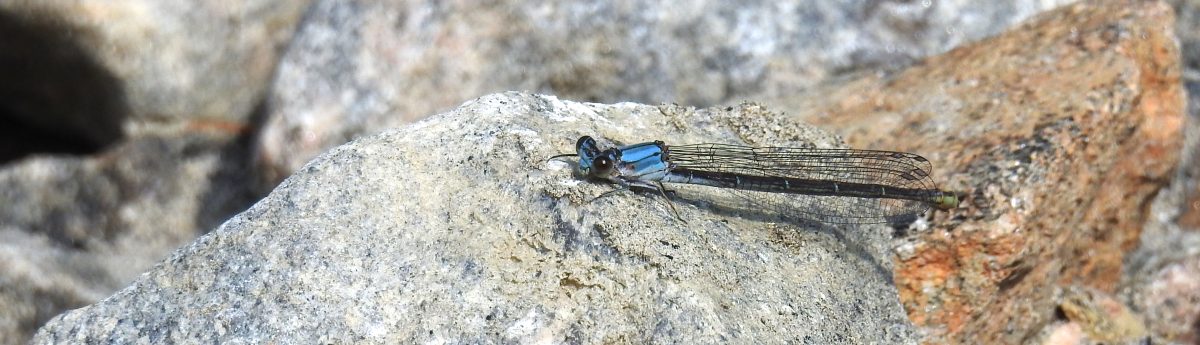
I followed the track through the grassy, knee-high vegetation, once again spying several Taiga Bluets and a large number of Sedge Sprites (at least 70 by my estimate!) flying and perching in the weeds. A few Fragile Forktails were present too, and I caught and identified one Hagen’s Bluet. Although I checked for Eastern Forktails, both pruinose female forktails that I saw had the double exclamation marks of Fragile Forktails so I was not able to add the Eastern Forktail to my day’s list. In addition, the only dragonflies I saw along the track were whitefaces: there were at least two mature Dot-tailed Whitefaces and two mature Frosted Whitefaces, as well as several immatures I couldn’t get close enough to identify. I saw one dragonfly land on the ground with dark red between the wings; this was my only Belted Whiteface of the day.
The trail ended at a steep drop off into the water but continued on the other side of this narrow channel; it was too far to jump, and too steep to climb as the banks emerged directly from the water with no shoreline to stand on. Although I really wanted to see where it went, I had no way of getting across and so I contented myself with exploring the 500-meter section I could access. I spent some time scanning an open section of water below the bank, and found a Mink Frog sitting with only its head showing above the water.
The sun showed no signs of emerging from the thickening bank of clouds, but I continued on to the Paden Road trail anyway. The parking lot here was small, and when I followed the trail it immediately split into two: one continued straight while the other branched left, following a course that ran parallel to Paden Road. I didn’t know where either of the trails led, so I followed the trail to the left as it looked more open and more promising with a diverse variety of shrubs and trees. It didn’t take long to find all of the usual skimmers: Dot-tailed and Frosted Whitefaces, Four-spotted Skimmer, Chalk-fronted Corporal, and Common Whitetail. I didn’t come close to any water – Google maps showed it heading towards a large wetland, but it was quite a distance away and the presence of increasingly larger puddles in the rutted trail started making the other branch of the trail more appealing.

The butterflies and frogs kept it interesting. I found a couple of Green Frogs in the puddles and a Wood Frog along the trail next to the water (with the Mink Frog and a Northern Leopard Frog earlier, this brought the total number of frog species to four).

I saw a couple of different skipper species, including several Long Dashes and a couple of fresh Tawny-Edged Skippers. A Silvery Blue darted out at me and actually landed on my sleeve before flying off to the vegetation…I think this is the first time a gossamer-winged butterfly has landed on me.
I headed back after the trail became too watery, and was relieved to see nary a puddle in sight as the main path headed through the trees. There weren’t too many insects here, but another side path led to an open area with some more wildflowers. Here I found more butterflies included a few fresh Northern Cloudywings, a Common Ringlet, and more Tawny-edged Skippers. An Indian Skipper was a nice find.

I spent only about 90 minutes there before deciding it was time to head home. The overcast sky looked heavy with rainclouds, and I didn’t want to get caught in the rain. A few Racket-tailed Emeralds swarming the cedars at the start of the trail were the only other dragonfly species I encountered on this trail, leaving me with no damselflies and no other families except the skimmers. Sure enough, not long after I started the drive back home the raindrops started hitting the windshield.
Still, I had seen more than I had expected for such a dreary day, even if I didn’t encounter anything rare or unusual. Altogether I found 11 odonate species during my exploration of the lesser-surveyed areas of Marlborough Forest: Fragile Forktail, Taiga Bluet, Hagen’s Bluet, Sedge Sprite, Racket-tailed Emerald, Frosted Whiteface, Dot-tailed Whiteface, Belted Whiteface, Four-spotted Skimmer, Chalk-fronted Corporal, and Common Whitetail. I think both the trail beyond Weedmark Road and the Paden Road trail system are worth visiting again, especially the large wetland west of the trail entrance where there might be more of a variety of odes and maybe some different darners or clubtails. And as I never did get to Heaphy Road, that area, too, will have to wait for a sunnier day.

 OdoNotations