
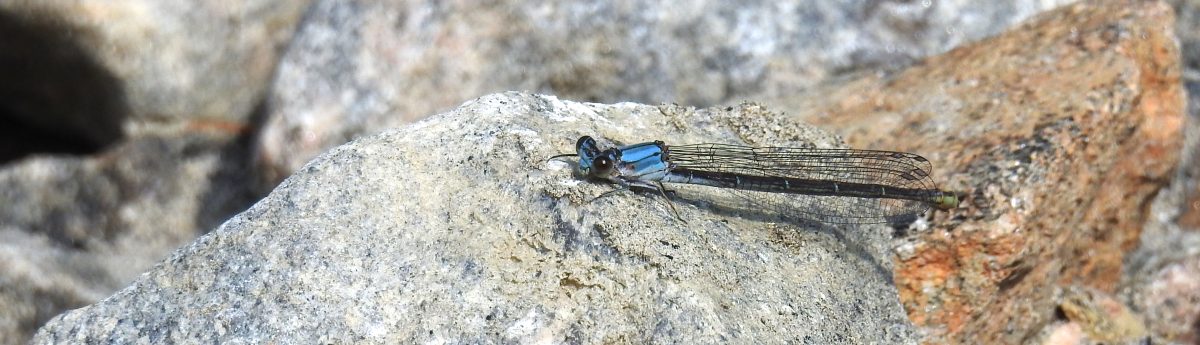
When I went out searching for Rainbow Bluets at the Eagleson Ponds on June 10th I photographed all damselflies that had the characteristically pale thorax, orange eyes, and blue markings at the tip of the abdomen as I expected that many individuals that had recently emerged would not have developed their full colouration yet…when most teneral bluets emerge, they are a colourless pale beige with black markings, and it takes time for their colours to deepen. When I found this particular individual damselfly in the grass along the southern-most pond, I assumed it was Rainbow Bluet still developing, snapped a quick photo…then realized the field marks didn’t add up. For one thing, the green shoulder stripes were too wide, and for another, it lacked the narrow blue bar connecting the two eyespots.

The thorax was pale green, and the legs and parts of the eyes appeared orange, but the tip of the abdomen showed two irregular blue markings on top of segments 8 and 9. It had an ovipositor, so it was a female – but what species? When it flew a short distance to a blade of grass close by, I followed in order to get some photographs from the top. The eyespots looked more like those of a forktail which started to make me think: could this be a rare andromorph female Eastern Forktail?
An andromorph damselfly is a female which looks like a male. Female forktails (genus Ischnura) in the northeast can be quite confusing as they have two more colour forms: most have an immature form and a mature form (which, if different from the male, are both considered heterochromatic), and some have a male-like andromorph, or homeochromatic, form as well.

Of the three forktail species found in Ontario, the Fragile Forktail (Ischnura posita) is the easiest to identify as the female has only an immature and mature form, both of which have the same broken shoulder stripes (resembling double exclamation marks) as the male and the same black abdomen with no blue markings on any of the final segments. Both forms are considered homeochromatic. A little further south, and once upon a Burnt Lands alvar, the female Citrine Forktail (Ischnura hastata) has only an immature and mature form as well, both of which are heterochromatic. Nothing about the three forms suggests they are all the same species: the male is primarily green and yellow with small black markings on top of the first seven abdominal segments, the immature female is primarily orange with black markings on top of segments 6-8, and the mature female is almost entirely black with brownish or olive markings on the thorax.
Similarly, none of the three common forms of the Eastern Forktail (Ischnura verticalis) suggest they are all the same species, either: the male is primarily green and black with blue markings on segments 8 and 9; the immature female is primarily black and orange; and the mature female is a pruinose grayish purple.

Homeochromatic females are rare and look quite similar to the males, but may also show some variation. The thorax is typically greenish-blue, and the blue spots on top of segments 8 and 9 are variable. Some females may show an orange blush on segments 1-3, with the most orange showing on segment 3. In the photo below showing the profile it looks as though there is a hint of orange on the underside of segments 2 and 3. The thorax is also paler than that of the male, the green colour showing more yellow than blue.

Finding one of these unusual colour morphs is akin to finding a four-leaf clover. This is only the second time I’ve ever seen a homeochromatic, or andromorph female; I saw my first at Hurdman Park many, many moons ago. It, too, had unusual blue markings at the tip of its abdomen. It just goes to show that these damselflies – quite possibly the most common, the most widespread, and most abundant odonate in the northeast due to its ability to colonize just about any still or slow-moving body of water – are worth a second glance as you never know if their own version of the four-leaf clover is lurking among the rest of them.

 OdoNotations