
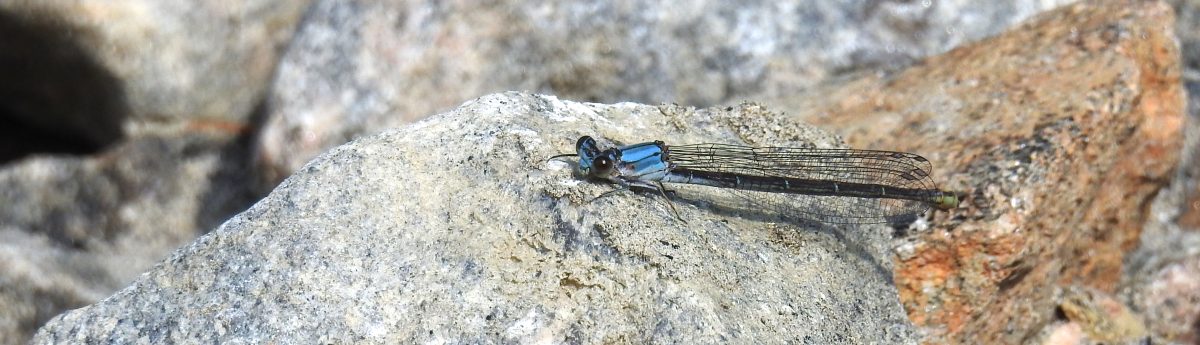

If the first half of June is great for seeing all kinds of pond damsels (Family Coenagrionidae), the latter half is great for seeing all sorts of spreadwings (Family Lestidae). They may not have the bright colours or the variety of hues of the pond damsels, but what the spreadwings lack in colour they make up for with their larger size and the beautiful metallic green colouration of some of the species. Adult male spreadwings are generally one of three colours: metallic green, black, or brown, each developing various amounts of bluish-gray pruinosity on the thorax and tip of the abdomen. They can be easily identified in the hand or in a photograph that clearly shows the tip of the abdomen viewed from above, as each species has paraprocts that are distinctly different in size and/or shape. On the other hand, females and tenerals are generally duller, browner, or sometimes even bronze or orange in colour. Much like female bluets, these spreadwings are difficult to identify in the field; though some can be examined and identified in the hand, others require a microscope. As such, I have never really delved into the difficulties of identifying female spreadwings.
Spreadwings live along the vegetated shores of marshes, ponds (both temporary and permanent), sheltered lakes, bogs, fens and the quiet bays of slow-moving streams or rivers. Some only thrive in wetlands that are free of fish and other damselfly-loving predators, such as temporary vernal pools that dry out in the summers, while others are able to survive in permanent ponds or streams with fish. Different species emerge at different times in the season depending on their overwintering strategy and the type of wetland they use for breeding. The Swamp Spreadwing, Elegant Spreadwing and Amber-winged Spreadwing spend the winter in the larval state in permanent water bodies, with only the first two species breeding in ponds or rivers that contain fish. All three may spend as many as nine months as nymphs, with as many as 17 developmental stages – called instars – between moults. All three emerge in June. The remaining local spreadwing species overwinter as eggs, which is rare among the odonata…both the broad-winged damselflies and pond damsels in our region, as well as the vast majority of the dragonflies, overwinter as larvae in permanent ponds or water bodies. The eggs are laid in stems of cattails or other vegetation above the water, and do not hatch until the spring when higher temperatures and rising water levels trigger development. These species only have about 10 instars and develop quickly, spending only about two or three months in the larval state. The Emerald Spreadwing develops and emerges quickly, as it generally lives in temporary ponds that often dry up over the summer. It is one of the first spreadwing species on the wing in our area. The remaining species take their time emerging, with one species, the Spotted Spreadwing emerging only in late July.
The Richmond Conservation Area (formerly the Richmond sewage lagoons) is a great place to see a variety of spreadwings. I visited on a day late in June when the wildfire smoke from up north was so bad I actually wore a mask to avoid inhaling any noxious chemicals. The sky was overcast, but it was warm so I spent some time walking around the lagoon cells photographing insects. The paths (if you could call them that) were clearly unmaintained – the vegetation was waist high, and encroached on the path almost completely. I felt as though I were struggling along a rarely-used game trail rather than a city-maintained conservation area. The only good thing about the unkempt, overgrown state of the trail is that it made looking for damselflies easy. There were lots of Sedge Sprites and Eastern Forktails, and it didn’t take long before I found my first spreadwing, a small, dark Lyre-tipped Spreadwing.

This small spreadwing has a dark bronze-coloured thorax with green stripes and a dark abdomen that shines dark metallic green in the sunlight when fresh. The male develops bluish-gray pruinosity on the thorax and the final three segments of the abdomen as it ages, though segments 8 and 10 lack this waxy substance in distinct V-shaped areas that leave dark triangles pointing to segment 9. The male’s paraprocts curve outwardly, resembling a medieval lyre. This species breeds in small, open sunny ponds that may dry out in some years.

A little further along I found a pair of spreadwings resting on blades of grass quite close together. One was the bronzy-green of an young spreadwing, while the other was bright metallic green with bluish-gray pruinosity on segments 9 and 10. I was so thrilled to find my first Emerald Spreadwing of the year that at first I didn’t realize it was feeding on another damselfly.

A closer look revealed the damselfly to be a Sedge Sprite, another metallic green damselfly. Although I know that odes must eat, I wish they’d confine themselves to bothersome insects like midges, gnats, mosquitoes, horse flies and deer flies! Fortunately Sedge Sprites are quite numerous and are not likely to suffer any population declines as a result of living alongside so many larger predators.


The Emerald Spreadwings emerges early in the season chiefly because of how rapidly the larvae develop. Like most other spreadwings, the eggs are deposited into the stems of emergent vegetation just above the water, where they remain over the winter. The eggs containing the late-stage embryos are hardy, able to withstand temperatures falling below -20°C (or -4°F). When the spring runoff floods the pond, the moisture triggers the hatching of the eggs and the larvae quickly pass through the 10 instars before emerging as adults in June.
Both the males and females are metallic green; this is one of the easier female spreadwings to identify, especially since she is shorter and thicker-bodied than the Elegant and Swamp Spreadwings and has a larger ovipositor that extends beyond the tip of the abdomen. The female also has pale shoulder stripes. The male has paraprocts that curve inwardly with thickened ends, looking like a pair of Christmas stockings.

I left the Emerald Spreadwing to enjoy its meal in peace and continued on my way. I encountered both Marsh and Hagen’s Bluets along the path, catching both to verify their identity through their own specially shaped claspers. A few Taiga Bluets were still around, too. A little further along I stumbled across another spreadwing in the tall grass, though I had a difficult time telling what it was. It was a male, so I swiftly caught it in my net.

I needed my hand lens to identify it as a Sweetflag Spreadwing, which look almost identical to Northern Spreadwing. It appeared to be young, as it has not developed very much pruinosity yet on the thorax, which was surprisingly colourful. Some older males appear to have an entirely grayish-blue thorax and abdominal tip with a black abdomen in between, but this one still had a lot of lemon-yellow colouration on the side of the thorax. Note the small black spot in the middle of the yellow stripe; this spot is not present in all individuals, and is not diagnostic, but is one of the field marks to consider when identifying one.

The claspers are the only way to tell the male Sweetflat and Northern Spreadwings apart. In this case it is not the shape of the paraprocts that is important, but rather the profile of the two teeth of the cerci. In the Northern Spreadwing, the two teeth appear large and close together, whereas in the Sweetflag Spreadwing, the distal tooth (the one furthest from the body) is small and well-separated from the basal tooth. In this photo you can see the two teeth pointing downward; they are spaced quite far apart and the distal tooth is quite small.

The last spreadwing I found was a teneral that I didn’t want to net because its body is still quite fragile at this stage. It was still completely orange-bronze, but even without the wide aqua stripes on the thorax of an adult I could still easily identify it just by the length of its abdomen: it is twice as long as the wings are wide. Only the male Slender Spreadwing has such a long, distinct abdomen, which is also the only spreadwing that develops no pruinosity at the tip of the abdomen at maturity. Identification is further confirmed by the white veins at the rounded outer edges of the wingtips, another field mark that is more pronounced in males. Females have shorter abdomens and can sometimes be confused with female Northern, Lyre-tipped and Sweetflag Spreadwings; however the length of segment 7 is often twice as long as segment 8 or 9, instead of beings only 1.5 times as long as in the other species.

The Slender Spreadwing has a marked preference for shady areas, typically the forested edges of slow streams and medium-sized rivers, shallow ponds, or marshes. It has a long flight season, with adults on the wing from late June until September. I usually find adults in open vegetated areas close to water where groves of trees provide shade, or along forested trails with marshes or ponds close by. They are quite common, and I usually see a couple in several different places over the course of the season.
I hoped to find a Northern Spreadwing to bring my spreadwing count up to five species, but only netted another Sweetflag Spreadwing. Another Slender Spreadwing a little further along brought the count for that species up to two, and I found two more Emerald Spreadwings which was thrilling as I hadn’t expected to find this species here at all…this is a species which I might only see once per season. As usual, the Lyre-tipped Spreadwing was the most numerous, and I counted at least seven in one area. This will change later in the season when the Spotted Spreadwing becomes the most abundant spreadwing species; it does not emerge until July as it overwinters in a much earlier embryonic stage than other species, hatches in the late spring, and then takes about 50 days for the larvae to develop.
I was happy to find that the Richmond Conservation Area was still a great place to find a rich variety of spreadwings, the densely overgrown trails making it easy to find them in the vegetation. Although it would be nice to return on a sunnier day, I am not sure I will return later in the summer once the Wild Parsnip blossoms and takes over the paths, making it all but impossible to navigate the trails without coming into contact with this toxic plant. But for now, this spot remains high on my list of places to go ode-hunting both early and late in the season, as it is one of the easiest places to find good numbers of different spreadwing species.

 OdoNotations