

Doran and I visited Nova Scotia again in mid-July, now one of my favourite times to visit after seeing so many dragonfly species on our last trip. This time we rented an Airbnb in Middleton – the basement suite of a house right on the Annapolis River. Although the vegetation along the river was much too thick to get close to the water, there were a few well-trampled trails leading down to the water’s edge. In addition, our location was close to both Bridge Street (Highway 10), with Riverside Park on the opposite bank, and the South Shore Annapolis Trail which has its own bridge across the water and runs behind Riverside Park and the Middleton sewage lagoons. We got settled into the apartment, and the following day that Doran and I went exploring. My fiancé had recently become interested in searching out local waterfalls, and as a number of clubtail species can be found on fast-flowing rocky rivers, I was more than keen to accompany him.
Our first search took us to Nictaux Falls just south of Middleton. There was no real parking lot here, but we found a wide spot on Highway 10 just south of the intersection with Nictaux Falls Road. The South Shore Annapolis Trail – which could be seen as the Nova Scotia equivalent of the Rideau Trail in eastern Ontario – runs parallel to the Nictaux River, and meets a smaller side trail that follows the edge of the water. I saw my first ode of the trip not by the water, but in the vegetation next to the side of the road where we’d parked our car! It was a big, blue Slaty Skimmer, one of my favourite skimmers and a great start to the trip.

We made our way to the trail, which runs through mixed deciduous and coniferous forest. We heard some birdsong near the beginning of the trail – Black-throated Green Warbler, Ovenbird, Blue-headed Vireo, and Scarlet Tanager – but most of our walk was quiet. We discovered that there were very few places to get close to the water, and when we stopped at a couple of lookouts to check out the view, the water was running much too high and too fast to expose many dry rocks or perches for a hungry clubtail to rest on. Still, we found a few Powdered Dancers and Ebony Jewelwings, common species along shaded, rocky rivers.

The falls weren’t as spectacular as we had hoped, and as the sun was directly behind them I didn’t get any photos worth posting. Here is what the river looked like quite a distance away from the base of the falls:

We only walked about half a kilometer before the trail met another road; we turned back, and headed back to the apartment. After getting some lunch, I spent a nice half-hour walking along the ponds around the corner from our Airbnb, looking for typical marsh odes. Both Eastern and Fragile Forktails were present in the vegetation next to the road, and I spotted a Blue Dasher sallying out from a perch looking out over the water. A Dot-tailed Whiteface in the vegetation next to the road was also nice to see; it was the only one of the trip. Again it was difficult to get down to the water, or even to see it due to the thick line of trees and shrubs between the road and the steep bank leading down to the water.

The next day I spent some time exploring the park on the other side of the river as well as the rail trail that runs behind it. The aptly named Riverside Park is small, 7-acre park with a walking trail, a small garden, and a dock providing access onto the river for canoes or kayaks. It was also an eBird hotspot with 66 species observed within its environs. Just as I arrived water started dripping down from the overcast sky; I didn’t mind birding in the rain, as long as it was a soft and gentle rain, but it wouldn’t be great for finding or photographing insects. I made my way down to the shore next to the dock and found a female River Jewelwing along with some Stream Bluets in an opening in the cattails; and then the rain started in earnest. Reluctantly I left the water’s edge and climbed higher onto the bank to shelter beneath one of the larger trees. While I was waiting for the rain to stop, I saw an Eastern Phoebe and one Eastern Kingbird flycatching for insects out over the water. I am not sure where the phoebe was nesting – possibly under the bridge – but the Eastern Kingbird flew across the river and delivered whatever it had caught to two vocal fledglings in the shrubs opposite the dock. I just hoped whatever it had caught wasn’t one of the river clubtails I’d been hoping to find!
Eventually the rain eased up enough to continue my walk. I made my way to the back of the park where I found a female American Redstart, a pair of Yellow Warblers, and a couple of Gray Catbirds. The walking trail consisted of an orderly path of neatly-mown grass, however, it hadn’t been mown recently and held enough water that my feet quickly became soaked through the holes in my old hiking shoes. I gave up any idea of completing the full loop and returned to the apartment with plans to buy a pair of new waterproof shoes as soon as we could go into town.
When the sun came out later that afternoon, I decided to return to the park and to complete my walk around the park and find some more odonates. I was beginning to feel discouraged after completing the heart-shaped loop until I reached a small open area between the outhouse and picnic table at the front of the park. There I found a single dragonfly zooming around, zipping part-way up the trail I was leaving, then suddenly reversing course and flying back toward the shrubs behind the outhouse. I watched it for a while, identifying it as an emerald based on its small size, dark body and flight pattern, and I regretted not bringing my net when after more than five minutes it showed little interest in landing. It slowed down close to the shrubs as if thinking about landing, then changed its mind and zoomed off again. Finally it flew up into the branches of a tree and landed, hanging up from a bare branch. I was delighted, especially when I saw the pattern of amber-orange spots down the side of the abdomen. It wasn’t a Racket-tailed Emerald, as I had been assuming, but something else, and I was pretty sure at the time it was a Petite Emerald!

It was too high above my head to get a get a photo from a decent angle, but after clambering up onto the top of the picnic table I was able to get some photos. This was a species I had wanted better photos after my visit to Nova Scotia last year, and I didn’t think it would be so easy to find – especially not in a city park without a bog in sight. However, they are often found in the same habitat as their close relative the Racket-tailed Emerald, breeding in ponds and marshes as well as bogs and streams within cedar swamps. The thick abdomen, shape of the cerci, and amber spots down the sides of the abdomen indicate this is a female, as the male has either no or reduced coloured spots.
The following afternoon I took a walk to the South Shore Annapolis Trail. Accessed from a small path between two of the ponds just around the corner, this part of the trail proceeds through a small wooded area before crossing the river and traveling behind the sewage lagoons toward a more developed area of Middleton. My goal was to take a short walk and look for a way down to the Annapolis River from the base of the bridge, and see whether the sewage lagoons were visible from the trail in case there were migrating shorebirds. It has its own eBird hotspot and I knew several swallow species were being seen, including the difficult-to-find Bank Swallow. The bridge over the water was very picturesque: the first is a picture of the bridge from Riverside Park from the day before, the second is a picture from the trail as it goes over the bridge.


I was disappointed to find that there was a wide, thickly-vegetated ditch between the trail and the sewage lagoon fence, with few gaps in the vegetation to see into the lagoon cells. I didn’t see any shorebirds or waterfowl from the one clear vantage point I found, but I was happy to see both Barn and Bank Swallows flying overhead; a large number of them were swooping over the property, but a few ventured close enough and low enough for me to identify. Two singing Veeries and a singing Hermit Thrush were nice to hear; and while imitating the Veery’s call-note I was amused when a juvenile Yellow Warbler popped out of the shrubs to investigate!
I had a little more luck with my second goal: there was in fact a way down to the water at the base of the bridge. The path was steep, however, and there wasn’t much of a shoreline; a pile of broken boulders provided enough of a ledge two feet above the water to allow close inspection of the damselflies in the emergent vegetation. I was happy to see both River and Ebony Jewelwings perching in the reeds just above the river. I was hoping to see some clubtails either resting on the rocks or zooming up the river, but there were no real rocks to rest on and no dragonflies in the area that I could see.

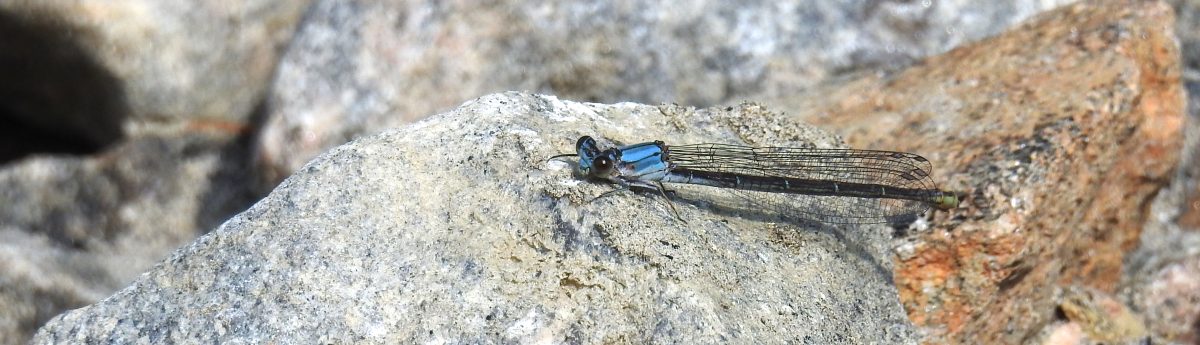
A pruinose Powdered Dancer resting on the rust-coloured rocks really stood out.

So far the trip was turning out to be a success, despite the showers earlier that day. I was seeing a nice variety of birds and odonates, and although our apartment couldn’t compare to the lakeside cottage we had rented last year, it was turning out to be a great home base for all of our adventures.

 OdoNotations