

The weather played a big part in our trip this year. Rainclouds blew in and blew out all week long, bringing rain on most of the days we were there. Fortunately the sun came out long enough to get in a few hikes at the various waterfalls and for me to take some long walks while Doran was out with the car. I spent quite a few hours looking for odonates and other critters around the ponds and the Annapolis Rail Trail, mostly in the afternoons when the sky cleared up. Although they are maybe half as long as the Eagleson storm water ponds by my house and much less diverse in terms of wildlife species, I still managed to find an interesting variety of creatures.
The afternoon after our waterfall search was particularly productive. I found my first Band-winged Meadowhawk and Familiar Bluet of the trip, which are also my first observations in iNaturalist for Nova Scotia for these species.
Fragile Forktails continued to outnumber Eastern Forktails, and I saw quite a few of the immature blue females.

The following day I went out for a walk along the ponds and added another meadowhawk species to my Nova Scotia list, the Autumn Meadowhawk. The yellow legs of this dragonfly makes identification easy!

Low gray skies kept most of the bugs hidden, but the birds were active; I found 30 species in the neighborhood in just under an hour. I also found an intriguing snake hiding in a brush pile next to the walking path. It was brown, but didn’t look like a water snake so I stopped to have a look. It turned out to be a Maritime Garter Snake, a subspecies of Common Garter Snake and the largest snake in Nova Scotia.
The next day was sunny so I convinced Doran to take another drive up to Lilly Lake Road. We drove all the way down to the intersection with Douglas Road and didn’t spot a single large dragonfly cruising over the road, either in the woods or out in the open at the farmland. The emeralds and gliders must have all dispersed, and I was intensely disappointed that my experience a few days earlier was only a one-day wonder. However, when we stopped at a spot that looked out over Lily Lake itself, I saw the usual colourful odes of marsh and pond around the well-vegetated edges: Twelve-spotted Skimmers and Slaty Skimmers in the vegetation along the road, and Calico Pennants in the reeds sticking up out of the water.


A few damselflies hovering near the ground caught my attention, and when one landed I was happy to see an Azure Bluet. These were common at our cottage on Tupper Lake in Nova Scotia last year; it was great to see them again, especially now that we can’t access the sandy pond at the Bill Mason Center in Ottawa any longer.

That afternoon Doran went visiting so I went for my usual walk to the ponds and then on to the Annapolis Trail. A Hooded Merganser was swimming in one of the ponds, and I found an Ebony Jewelwing perched in the vegetation close to the woods. Along the trail I found a Northern Pearly-eye and a Slender Spreadwing in the sun-dappled woods, then took a detour to the rocky area at the base of the bridge. Once again I found River Jewelwings perching in the emergent vegetation in the sun, as well as a few Stream Bluets. Again I didn’t see any dragonflies, so I climbed back up to the trail, crossed the bridge, and continued on towards the sewage lagoons.
This time I did find a dragonfly – a fully mature male Common Whitetail perching in on a stem along the trail. Unlike eastern Ontario, Nova Scotia has two dragonflies with completely white abdomens – the Common Whitetail, and the White Corporal. Closely related to the skimmers, corporals are named for the pair of pale stripes on the thorax of the females and immature males, similar to those used by the military to indicate a person’s rank. White Corporals are smaller than Common Whitetails, and have dark spots on the wings only at the base of each – they lack the full dark bars of the male Common Whitetail and the three smaller splotches on the wings of the females. I would love to see a White Corporal in Nova Scotia one day, and will be examining all Common Whitetails carefully!

I spent some time scanning the sewage lagoons for swallows and waterfowl, but didn’t see anything of interest. Then I noticed a large dragonfly flying in my direction, its shimmering wings catching my attention. It was flying straight toward me, and to my surprise it landed on the fence! With the binoculars I could make out its body hanging down, so I snapped a few pictures. To my amazement it was a Dragonhunter!

I was thrilled with the sighting, especially since it confirmed that there were large clubtails around the Annapolis River! It zipped off, heading toward the water, and I figured that was that – I’d now seen both the largest and smallest clubtails in the province, and would continue to look for others in the area. I was particularly interested in the iNaturalist records of the Zebra Clubtails found right on the Bridge Street bridge, though they were from August rather than mid-July. I headed back across the trail bridge and spent some time scanning the water. Then I saw a large dragonfly come zipping down the river, flying just above the water! It patrolled the area beneath and within sight of the bridge a few times, then darted into the vegetation growing on the bank and landed on a branch. I saw where it landed and was able to confirm that it was a Dragonhunter! I took several photos from the bridge, then hurried down to the rock ledge at the base of the bridge. It turned out that my photos from above were better than the ones from below, even though my photos from below showed that it had caught a River Jewelwing and was busy devouring it!

Whether this was the same Dragonhunter that had landed on the fence will never be known, but I like to think it was!
The next day was our last full day in Nova Scotia. We did some visiting, and I got out for a walk at Riverside Park one last time. The highlight of the walk was a Black-and-white Warbler that responded to my pishing. He flew in and gave me several looks before deciding I wasn’t worth the bother.
There were no new odes at the park (and there were surprisingly few individuals in the vegetation given the proximity of both the river and the sewage lagoons) but I did find two damselflies worth photographing. The first was a Slender Spreadwing, an easy identification based on the long, thin abdomen, the white rounded edges at the tips of the wings, and the shape of the claspers.

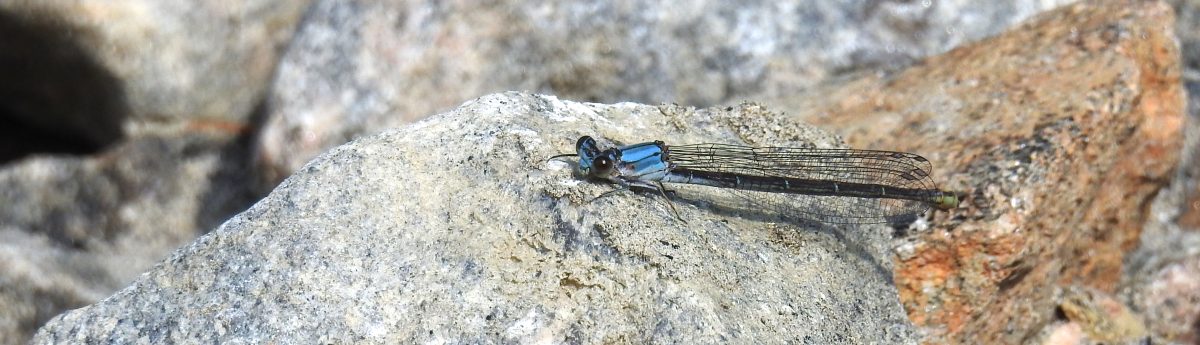
The other damselfly was harder to ID. It was a black-type bluet, which narrowed down the possibilities, but the thin connected eye-spots, thin shoulder stripes, black triangle on top of S9 and entirely blue S10 didn’t match any of the males in my field guides. To me the pattern suggested Stream Bluet, which I had already seen by the river, or Rainbow Bluet, which was a wild guess since the colours did not match that species. However, once I uploaded the photos to iNaturalist it was suggested that it was in fact a female Stream Bluet with an aberrant marking on S9 – usually it has a black W instead of a triangle.

The last new ode species I confirmed for my Nova Scotia list was one that I wouldn’t have gotten if the weather hadn’t turned dangerous. When we woke up on July 22, 2023 we received a message from one of Doran’s relatives that catastrophic flooding had washed away several sections of roadways along our route home. Over 250 mm fell in a 24-hour period, causing severe flash floods that washed out bridges, roads, and a section of the only train track that connects Halifax to the rest of Canada. Thousands were without power, and evacuations were ongoing as the floods threatened to cause breaches in a dam near Windsor. The sky was gray in Kings County, where we were, but more rain was headed to the east of us, which was exactly where we needed to go to start the long drive home.
The west was clear, so we drove to Digby instead and caught the ferry to St. John. I booked the tickets on the drive down using my phone – technology to the rescue! I was a little irked when we had to pay for both the number of passengers and the vehicle itself: $53 for each human passenger, $128 for the car, and a $10 fuel surcharge! While we waited at the parking lot for the ferry to arrive I saw a good number of dragonflies flying overhead – gliders, of course, perhaps thinking that the sunlight twinkling on the cars was water – and had one fly low enough over my head that I was able to identify it as a Spot-winged Glider. These were my last identified species in Nova Scotia, and I was glad to finally confirm the identity of one!
I thought that I might at least be able to see some birds on the ferry ride, but it was too foggy to see all but the closest birds, and they and the ferry moved so fast it was hard to get a long, good look at anything. I didn’t have a lot of time to spend watching for birds in any event, as we spent a good portion of it in line at one of the three food services (we were hungry, and so, apparently, was everyone else).

It was a dramatic end to our time in Nova Scotia, but I was glad I finally got a chance to take the ferry across the Bay of Fundy. It was a fantastic trip for odes, and one I won’t soon forget!

 OdoNotations