
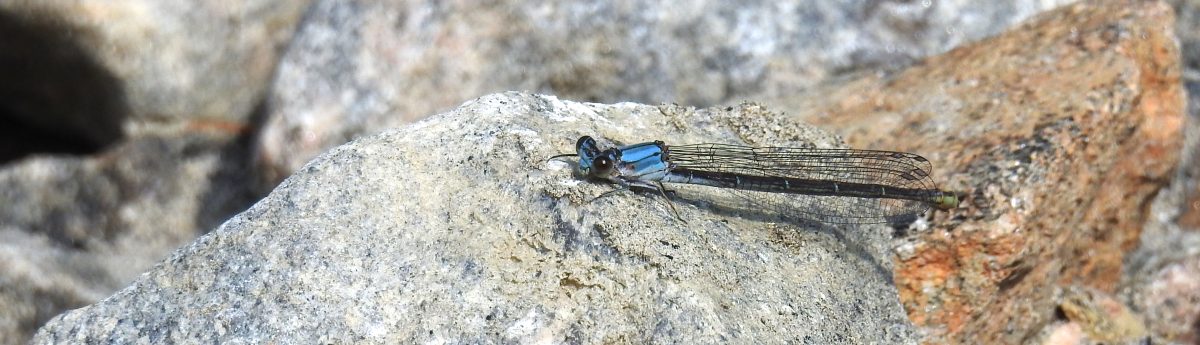

After my successful outing at Andrew Haydon Park on July 29th, I couldn’t wait to return to see the Vesper Bluets again and to look for the elusive Orange Bluet. The two successfully share the same habitat at Petrie Island, so why not in the ponds at AHP? While Vesper Bluet habitat includes the edges of woodland lakes, ponds, and slow rivers rich with emergent vegetation, Orange Bluets are present in those habitats as well as in swamp edges, bogs, slow streams, and degraded wetlands containing varying levels of pollution. I knew they were already on the wing, as I had first seen them at the Eagleson Ponds on July 3rd and have been seeing them there on and off ever since. It was just a matter of returning to Andrew Haydon Park later in the afternoon when they would be at the water, as they spend the early part of the day in the vegetation or trees nearby.
I headed there after work on August 2nd, a beautiful sunny day that was warm enough for some serious dragon-hunting. I began my outing by searching the vegetation around the eastern-most creek, finding a Spotted Spreadwing perched on some Flowering Rush that was going to seed. I then started making my way around the northern shore of the ponds, scanning the emergent reeds as well as the floating lily pads, and finding no signs of any Orange Bluets.
Then I spotted a pair of damselflies in tandem among the flower clusters of the bulrushes. They weren’t blue…in fact, they were same orange colour as the vegetation on which they perched, leaving no doubt as to their identity! I was thrilled to find a pair of Orange Bluets so easily, especially since I so seldom see the females.

I took many photos of the pair, until they flew out to a stem further away from the shore. Then the female brought the tip of her abdomen to the underside of the male’s body near the base of the abdomen, forming the mating wheel in which the male will transfer his the sperm to the female. Odonates are unusual in that the males of both damselflies and dragonflies actually have two sets of sex organs: the primary genitalia at the tip of the abdomen, and the secondary genitalia near the base of the abdomen. Because the male must grip the female with the claspers at the tip of his abdomen, he is unable to transfer the sperm from his primary genitalia to the female in that position. Therefore, prior to mating he will transfer the sperm from his primary genitalia to his secondary genitalia, which will conduct the transfer once the pair form the copulation or mating wheel.

Once the transfer is complete and the female is ready to lay the eggs, she will disengage her abdomen from his and the pair will fly to the water, still in tandem with the male gripping the female just behind her head. The female will lay the eggs in floating vegetation or organic debris, with the male guarding her to prevent other males from mating with her. I did not stay long enough to watch the egg-laying, instead continuing on my way to look for other Orange Bluets.
It was an amazing outing as the more I looked, the more I found! I started noticing males on a lily pad here and an algae-like mat there, their bright citrus orange colour almost glowing in the late afternoon sun. The bluets were in both ponds, and on one mat I saw a male and female in tandem with another male resting beside them! I got only one quick fuzzy shot of the three of them before the pair flew off to another mat of floating vegetation. Unlike the female in the first pair, this one was greenish-yellow, with an orange tip.

Female Orange Bluets are polymorphic, meaning they come in different shades of colour. Young Orange Bluets, both male and female, are blue, though the male’s long cerci at the tip of his abdomen help to differentiate him from the blue bluets. Mature female Orange Bluets may be a duller shade of orange than the male or green like the one in the photo above.
I was also happy to see a male Vesper Bluet sitting on a lily pad as well, confirming their presence in both late July and early August. According to the Ottawa checklist, Vesper Bluets are on the wing from late June to late August. Orange Bluets have a longer season, from early June to mid-September.

However, the Orange Bluets were the stars of the outing, and I was elated to finally confirm the presence of this beautiful little damselfly at Andrew Haydon Park and looked forward to returning to get some better photos, especially of the females. They are usually more difficult to see, spending their days in the trees and vegetation away from the water and only coming to the water to breed where they are most often seen in tandem or in mating wheels with the males.
Eager to continue my survey of both the Orange and Vesper Bluets, I visited after lunch on Sunday, August 6th and spent some time looking at the black and blue bluets around the edges of the pond, catching and releasing a few for identification. I caught four Marsh Bluets as well as one Familiar Bluet, whose deep blue colour and larger size caught my attention. This species is probably the most common and widespread damselfly not only in the northeast, but across the continent south of the Canadian Shield. Its success comes from its ability to adapt to a number of still or slow-moving waters including lakes, ponds, fens, slow streams and man-made wetlands. Like all bluets that are mainly blue in colour, the claspers need to be examined under magnification in order to identify it.

Another bluet that caught my eye was this tiny one perching on a mat of algae, not because of its blue colouration but because it was mostly black. The teardop-shaped eye spots and the blue on top of segments 8 and 9 help to identify it as a Skimming Bluet, a species I had never seen here before! I checked iNaturalist to see if there were any other records, and so far my observation is the first. That really isn’t much of a surprise given how few people take the time to look at and photograph the tiny black and blue damselflies that share the waters with the larger, flashier dragonflies!

Other odonate species observed include a perching Lance-tipped Darner next to the eastern creek, male and female Blue Dashers, at least 11 Halloween Pennants, half a dozen Widow Skimmers, a pair of Twelve-spotted Skimmers, and a male and female Eastern Pondhawk. I did not see any Orange Bluets or Vesper Bluets, but as I was there around 1:00 pm I might have been too early to see them.
It rained on the holiday Monday, so I didn’t get back there until after work on August 14th, another beautiful sunny day in the mid-20s. A Shadow Darner was there instead of a Lance-tipped Darner, and I identified the Marsh, Familiar and Skimming Bluets again, but best of all I counted three Vesper Bluets and over a dozen Orange Bluets around the ponds! It’s amazing how the time of day makes such a big difference in seeing these two near-crepuscular creatures. The Orange Bluets were more likely to be on the floating mat of vegetation while the Vesper Bluets were on the lily pads and short, emergent vegetation.

It was great to see one pair of Orange Bluets in tandem on the mat of vegetation and another pair mating in the sedges surrounding the pond, again perching on flower clusters almost the same colour as their bodies.

So not only are both Vesper and Orange Bluets present at Andrew Haydon Park, the Orange Bluets are attempting to breed there as well. We won’t know how successfully until next season – an investigation I’m looking forward to continuing!

 OdoNotations