

My mother lives in Wallaceburg in Chatham-Kent, which is about a 7.5 hour drive from Ottawa, or a full day train adventure with a transfer in Toronto (my advice for anyone travelling economy on Via: take your own sandwiches and snacks, as the menu was somewhat unpalatable…and chocolate bars/chips alone were $3.00). Being so far south she gets a variety of birds, bugs and plants that we do not get here in eastern Ontario, so I’ve been meaning to visit in the summer when I might see some new southern butterflies and dragonflies for my life list. I took an extra two days off at the end of August so I could spend the Labour Day long weekend with her, though two of the days were lost to travel. As my mother and her husband both enjoyed birds and nature, I knew they’d be interested in taking a few nature walks with me, even if the idea of looking for dragonflies didn’t exactly fill them with delight.
I arrived on Thursday evening and we went out early on Friday, August 31st as it was going to be hot and my mom and step-dad don’t do well in the heat. We revisited Peers Wetland, a place we’d gone birding before, though never late in the summer. This small conservation area owned by the St. Clair Region Conservation Authority is dominated by an 11-hectare wetland along Otter Creek, with a trail winding around the perimeter and eventually through a fairly young plantation of trees and an open meadow. Originally owned by Francis Peers, a local farmer, it was his wish that the last remaining large wetland on the lower reaches of Otter Creek be preserved as a conservation area. It’s an interesting story of how this phragmites-choked marsh became a fantastic place for local nature-lovers to enjoy the variety of plants and critters that call this small fragment of green space home.
The birds weren’t too plentiful, as I only recorded only 11 species, and of those, only one warbler, the Common Yellowthroat; I had hoped that the isolated woodlot in the center of the conservation would be brimming with migrating warblers given the date. A Ruby-throated Hummingbird and a calling cuckoo were the only birds of interest, other than the family of Mute Swans.
The bugs, however, were fantastic! We first walked up the wheelchair-accessible ramp to the viewing platform and right away I noticed some small, dark damselflies flying in the vegetation: most appeared to be Fragile Forktails! This one doesn’t have the double exclamation points (!!) on top of the thorax – the stripe on the left barely seems broken, while the one on the right is fully intact. This is the first time that I can recall seeing this anomaly in this species. It is not an aberrant Eastern Forktail, as the abdomen is fully black.

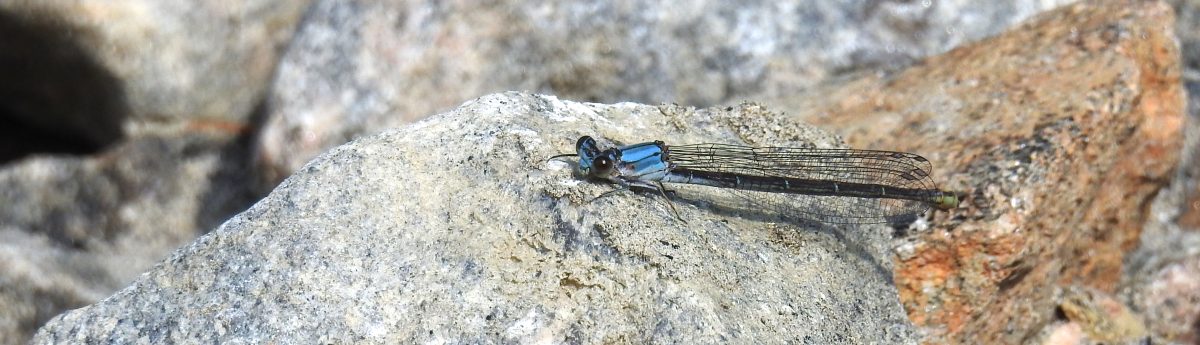
Another damselfly was perching in the sun on the wheelchair ramp. It was much bigger than the Forktails floating in the vegetation, and had a bright blue head and thorax. It was a dancer, and I knew that several species were possible in southern Ontario, including the two found in eastern Ottawa: Violet Dancer and Powdered Dancer. While my first thought was that it looked like a blue form Powdered Dancer, I suspected it was one of the other species possible, notably Blue-fronted Dancer, which I’ve never seen before and had hoped to find. The blue form Powdered Dancer only occurs in females, and this was a male. Secondly, it was a much more intense shade of blue, which extended to the head, face, thorax and final two segments of the abdomen.

Another species present in southern Ontario is the Blue-tipped Dancer. While just as variable in colour as our Powdered Dancers, both sexes have a broad black stripe on the thorax that this damselfly lacked. The males are also dark in appearance, with a dusky purple and black thorax and blue tip – looking not unlike a Violet Dancer. Like the Powdered Dancer, there is a blue form, but it only occurs in females.
The last species of dancer possible in Southern Ontario is Blue-ringed Dancer, which has conspicuous blue rings along the abdomen as well as a black stripe on the thorax. That left Blue-fronted Dancer, the one I was most likely to see. It is found along rivers, creeks, ponds, and large lakes, particularly larger ones with muddy substrates. A true southern species, in Canada it is found is mainly found south of the Greater Toronto Area, with a few strays showing up south and east of Montreal, south of Winnipeg, and even one in Napanee. Perhaps this species, too, is inching its way north as a result of climate change.

I grabbed a few photos of it but it quickly flew off, leaving me thrilled to have seen it but wanting more opportunities to study and photograph it.
We left the observation deck and followed the trail along the berm that separates the creek from the marsh. There were damselflies here, including more Fragile Forktails, an Eastern Forktail, a Slender Spreadwing and two male Orange Bluets! I rescued one struggling individual from a spider web, and found another perching in the vegetation right next to the trail. This was great to see as I’ve never found one doing so at the Eagleson ponds. One of the males had found a nice sunny spot on a dewy blade of grass where he will pass the time until mid-afternoon, when it would be time to go down to the water to look for a female.

Then I saw the sun flash upon a pair of wings as something large drifted past my vision and landed in the vegetation. I wasn’t quite sure what it was until my binoculars landed on a pair of darners in a mating wheel! I walked around them until I could view them from the side, which is always necessary for identifying darners (especially when their appendages are otherwise unavailable for viewing). The slight ripple in the first thoracic stripe clearly identifies these as Lance-tipped Darners. It was interesting to see the bright black and blue male mating with a green form female, demonstrating the variation in colour of the large mosaic darners. Females may be andromorphs (similar in colour to the male) or heteromorphs (which are green or yellow in colour).

Around the back of the wetland we found a brightly-coloured Katydid on a withered milkweed pod and a territorial Silver-spotted Skipper. There were a few more butterflies in the open meadow, including a gorgeous Painted Lady (the butterflies of Chatham-Kent will follow in a separate post)! In the stretch of trail that ran next to the road I saw a Widow Skimmer which flew off before I could take its photo and a female Blue Dasher holding court from her perch at the end of a dead stick.

A small bluet-type blue caught my attention, and I quickly netted it to see what it was. The appendages identified it as a Familiar Bluet; I took some photos in the hand before setting it down in the vegetation.

The last dragonflies I saw at Peers Wetland that day were a Common Green Darner flying by and a male Eastern Pondhawk in the parking lot, resting on the gravel. This brought the number of species up to 11, which was not bad for the time of year but a little disappointing given that I was far enough south that there ought to have been a greater number and variety of species. Still, I did get a lifer, and a beautiful one at that, which more than made up for the number of species seen.
After the outing I started to wonder if perhaps I needed to simply spend more time there to see more. I have always found that the longer I spend in one place, the more species reveal themselves over the course of that time. We were only there about 90 minutes, starting at 10:00 in the morning. After visiting a few other places (more on those later) I decided that I wanted to return there before I went home. I also wanted another chance to photograph some Blue-fronted Dancers as I didn’t find any others during my time there. My mom and I returned after lunch on Sunday, and this time there seemed to be fewer odes. Perhaps it was because of the heat (it was 28°C) but I only found the usual forktails and another Slender Spreadwing between the viewing platform and the back of the trail. There were no Blue-fronted Dancers. At the back, however, I found some butterflies to photograph as well as the Widow Skimmer that had eluded me on my first visit!

Then I started seeing a few meadowhawks (Sympetrum sp.) perching close to the ground, all of them red with black triangular markings down the sides of the abdomen, black legs…and red faces! I knew that Ruby Meadowhawk was a very good possibility here, as it replaces the Cherry-faced Meadowhawk south of Toronto, and set out about catching a few.

I ended up catching two males, (no females were present for me to catch) and tried to photograph the hamules, the secondary genitalia on the underside of the second segment of the abdomen and the best way to separate Ruby from Cherry-faced Meadowhawk. The hamules are paired claw-shaped structures that lock onto the tip of the female’s abdomen during copulation, and they are tiny! I took photos from a few different angles of each insect as I knew that photos taken directly from the side or the underside of the body are not very useful in showing the details necessary to identify the dragonfly to species. When I reviewed my photos later, I was still confused as to exactly what I was looking at, as what I saw in my photos (and in the field) bears little resemblance to the drawings in my field guide. I posted my photos to iNaturalist hoping that what I had photographed was sufficient. It turns out that for one individual it wasn’t but for the second individual it was enough to identify it as a Ruby Meadowhawk – another lifer!
This is the photo that was most useful for identifying the meadowhawk:

As I was told by fellow ode enthusiast, Josh Lincoln, who reviewed my images on iNaturalist (and who has reviewed a lot of my ode photos in Odonata Central as well), “definitive ID (for me) requires ventrodorsal or ventrodorsal oblique view of the hamules. Look for the flare and the little nubbins on the dorsal caudal end in internum [Cherry-faced], while rubicundulum [Ruby] tapers”. He attached some papers and pages from field guides to show exactly what he was talking about, then finished by saying: “Nothing takes the place of looking at hundreds of good images, and good images of hamules and subgenital plates are hard to come by.”
He also quoted Nick Donnelly, a long-time member of the Dragonfly Society of the Americas, saying: “Sympetrum are hard”. I can certainly attest to that!

Peers Wetland was an enjoyable place for ode-hunting as it gave me two southern lifers. While I only found a total of 12 species there, all of which were typical pond species (save for the dancer, which prefers moving rivers to still ponds, and presumably was looking for a mate along the banks of Otter Creek) I enjoyed the close-up views of the mating Lance-tipped Darners, the bright orange colour of the perching Orange Bluet, and the special thrill of seeing two new species for the very first time.
Peers Wetland Odonates
- Slender Spreadwing
- Familiar Bluet
- Orange Bluet
- Blue-fronted Dancer
- Eastern Forktail
- Fragile Forktail
- Common Green Darner
- Lance-tipped Darner
- Blue Dasher
- Eastern Pondhawk
- Ruby Meadowhawk
- Widow Skimmer

 OdoNotations