
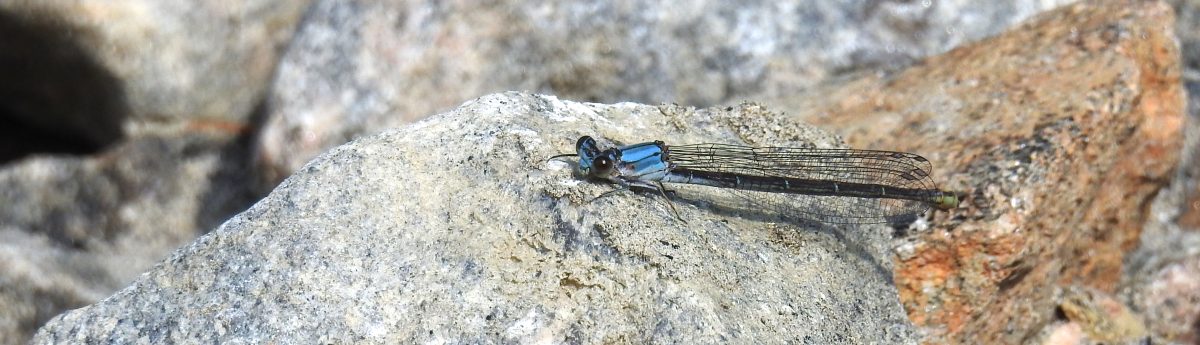
Although it’s been warming up nicely, I haven’t seen many dragonflies since witnessing the wonderful mass emergence of Spiny Baskettails at Mud Lake on May 12th. So when Chris T. told me he was thinking about going to Mer Bleue on the weekend, I decided to join him. Mer Bleue is ecologically significant as one of the few accessible bogs in eastern Ontario, hosting many different species not found in typical forests or wetlands. There were a couple of butterflies in particular I was hoping to see, the Brown Elfin and Jutta Arctic which I last saw in 2012, as well as the aptly-named day-flying Black-banded Orange Moth (Epelis truncataria). Several bog-loving odes were high on my list, chiefly Sphagnum Sprite, Ebony Boghaunter, Harlequin Darner, and Hudsonian Whiteface, all of which I’d seen here in my early ode-hunting days with Bob Bracken and Chris Lewis. I was also secretly hoping to stumble upon a Somatochlora emerald or two, as they are more likely to be found in the Mer Bleue bog than on the side of a random house in Nepean….or so I hoped!
It was a beautiful, bright, warm morning when I arrived at the boardwalk parking lot at 10:00. I scanned the edges of the parking lot while I waited for Chris to arrive, finding nothing of interest except for a few Northern Spring Azures that flew off whenever I tried to get a photo of one. It was already getting busy by then, so we headed out to the boardwalk right away, following it clockwise to avoid the crowds. I saw a Wilson’s Snipe fly out of the reeds as though flushed, and heard the usual Common Yellowthroats, Swamp Sparrows, White-throated Sparrows, and Nashville Warblers that called the boardwalk home as we made our way over the open water and onto the bog proper. A pair of Broad-winged Hawks flying over was thrilling to see.
We scanned the vegetation slowly as we walked along, looking for the diminutive Sphagnum Sprites and tiny Brown Elfins. At first the only bugs that we found were several small bees dancing among the tiny white blossoms of the bog flowers; a colourful Pink Lady’s Slipper stood out from among them.

Not far along the boardwalk we started seeing several small brownish lepidopterans – either butterflies of moths – fluttering along the boardwalk edges and over the vegetation. We hadn’t seen any odes yet, and while I stopped to take pictures of the leps in order to identify them, Chris continued on, hoping to scare up an Ebony Boghaunter or Harlequin Darner, both of which like to perch on the ground. It took a long time before one of the leps – a rusty-yellowish moth – finally did settle on some vegetation close enough to the boardwalk edge to take a few photos. It wasn’t until I got home that I was able to identify it as Yellow-washed Metarranthis Moth (Metarranthis obfirmaria) with the help of my Peterson field guide and iNaturalist.
Then I spotted an insect land in the vegetation that held its wings together over its back like a gossamer-winged butterfly…such as an elfin. When I got my binoculars on it I noticed that the outer edge of the forewings and hindwings were distinctly reddish instead of the frosty gray I am used to seeing in Henry’s Elfins. It also lacked the small white marks at the top and bottom of the line that separates the inner and outer halves of the hindwing, which helped me to identify this as my first Brown Elfin in 12 years!
Happy to have finally seen and gotten a decent photo of this butterfly, I caught up with Chris who reported no luck with any of our target dragonflies. In fact, even the common whitefaces and skimmers seemed to be missing. We spent much time idling on the boardwalk in the open bog, watching for dragonflies flying over (a few passed by but came nowhere near us) and damselflies in the vegetation, stirring the curiosity of the large number of passersby who stopped to ask us about our nets.

Because the visitors were many and odes were few, Chris suggested we try looking for them at the end of Dolman Ridge Road. I had never been there before and was eager to explore a new place. We parked at the gate, and walked the 2.7 km length of the road, seeing and hearing a variety of birds such as multiple Veeries, a Scarlet Tanager, Black-throated Green Warbler, Tennessee Warbler, Baltimore Oriole, Ruffed Grouse, and a few Rose-breasted Grosbeaks. Almost immediately we stumbled upon (figuratively) a large Snapping Turtle out for a stroll. There were quite a few butterflies out, too, including Silvery Blues, Red Admirals, and even a Henry’s Elfin.
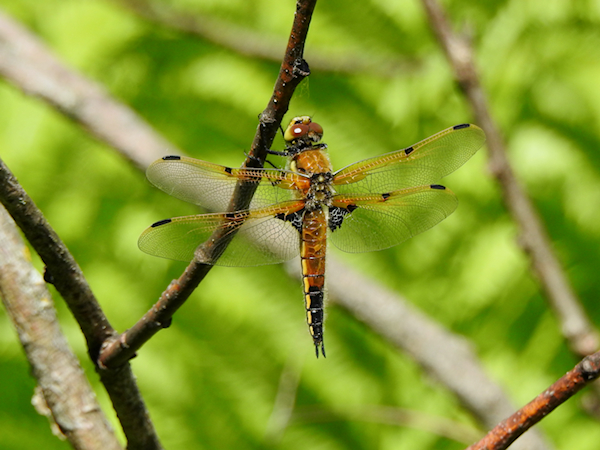
And there were dragonflies! Quite a few were flying up and down the road and over the vegetation in the ditch, most of which appeared to be baskettails. When I checked the grasses and shrubs of the ditch I noticed a few dragonflies resting on perches, hunting, including one Racket-tailed Emerald and a few teneral whitefaces which were black and yellow. My favourite was this beautifully fresh Four-spotted Skimmer, an eye-catching dragonfly that is bright golden-orange when it emerges.
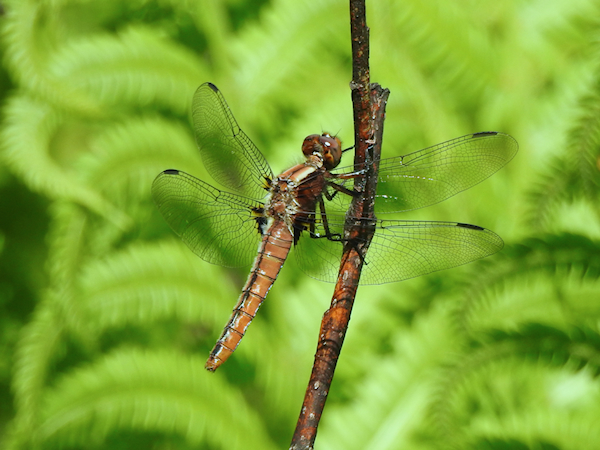
Two teneral Chalk-fronted Corporals were hunting along the side of the road as well. These dragonflies are a light pinkish-brown colour when they emerge, with white shoulder stripes and a black stripe down the middle of the abdomen. They turn black when they mature, developing a white pruinescence on the top of the thorax and at the base of the abdomen. I am used to seeing dozens when they emerge, so I was surprised to find only two on our walk.
We continued on our way to the bog, and as we walked some of the baskettails flew close enough to us that eventually I snapped out my net and caught one. When I took it out of the net I saw that it had the angular claspers of a male Beaverpond Baskettail, as well as the yellow colouration at the back of the head. I was happy to see him as it seems most of my baskettail sightings these days are of Spiny Baskettails. I did catch a Spiny Baskettail a little later; without catching more I couldn’t say whether one species predominated or if the numbers were equal.
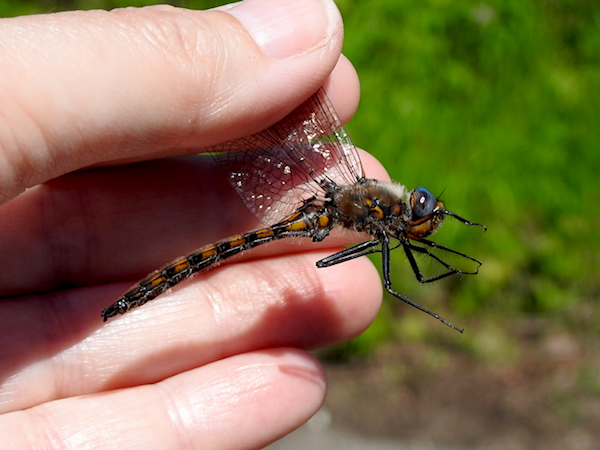
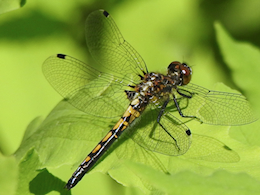
One of the black and yellow whitefaces was sitting nicely out in the open, so I took some photos even though I find them difficult to ID without the help of iNaturalist’s AI program (Computer Vision). This one lacked the slim yellow streaks of a Frosted Whiteface (or a Canada Whiteface, for that matter, though that is definitely not an expected species here!) and the final yellow spot on the abdomen was triangular, not appearing to be any wider than the yellow spot above it, ruling out Dot-tailed Whiteface. However, one field mark I learned recently confirms it as a Hudsonian Whiteface, and that is the distinct yellow veins within the triangular black marks at the base of the hindwing. This was one of the species I’d been hoping to find; now to find a mature male!
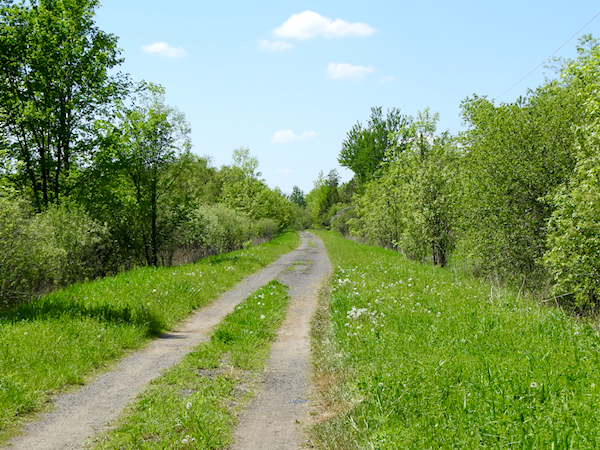
It was a longer walk than I anticipated, with not much variation in scenery. Fortunately the songs of the birds in the thickets and the insects buzzing or fluttering their way by kept us entertained as we strolled along.
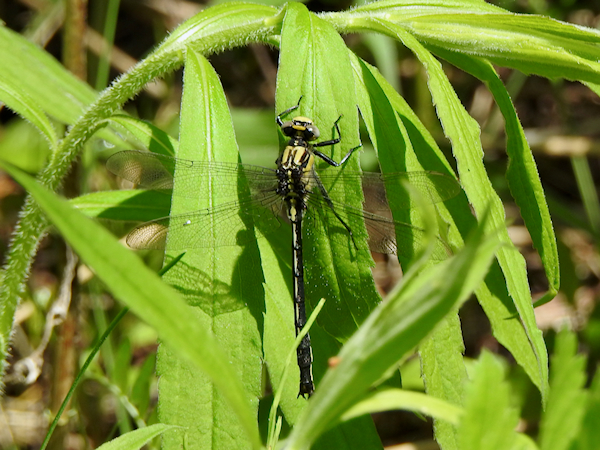
We finally came to a bend in the road that was only a short distance from the water; however, we were transfixed when we spotted a clubtail perching awkwardly in the vegetation. Most clubtails perch horizontally on the ground or atop logs or on a branch, but this one appeared to be hanging from a leaf. There is actually a group of clubtails known as “hanging clubtails” – Genus Stylurus – not because they execute lawbreaking odes with a rope, but because, unlike most gomphids, they perch vertically while hanging from the vegetation – just like this one was doing.
I wasn’t prepared to see any clubtails today; it was my first clubtail after many months, and so of course my memory was rusty from disuse and I was unable to identify it until Chris caught it. At that point the claspers clearly showed that it was a male Horned Clubtail, which I should have expected as that’s usually my first or second clubtail of the year depending on whether I find a Dusky Clubtail.
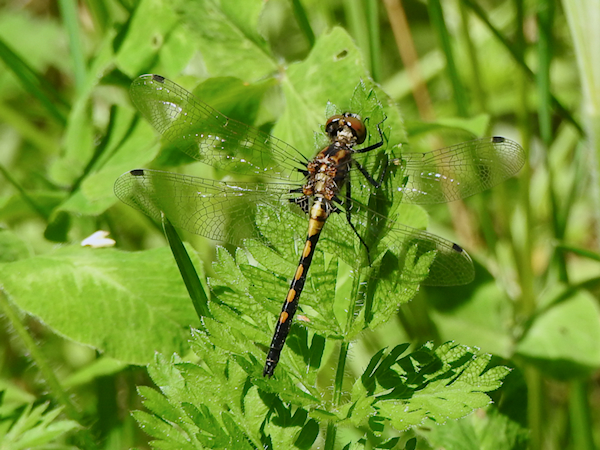
We left the taxonomically confused clubtail to its own devices, then spent some time exploring a small clearing on the other side of the trail where we found a few more immature whitefaces. One was a yellow-form female Hudsonian Whiteface – I hadn’t realized until reading up on them later that (like certain darners) female Hudsonian Whitefaces can come in two different colour forms: black and yellow like immature whitefaces, and red and black like mature males. She still had the prominent yellow veins within the black triangular wing markings, making her easy to identify.
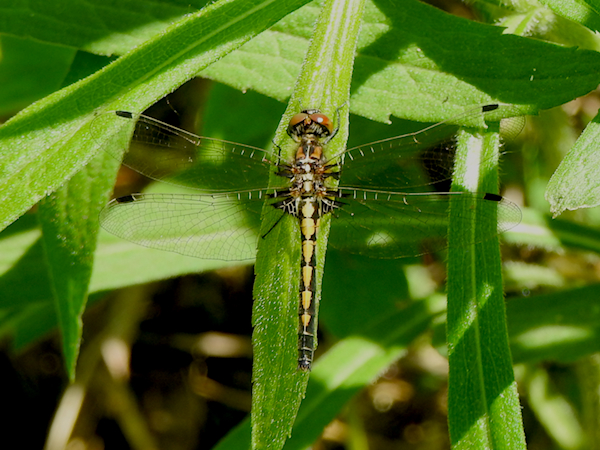
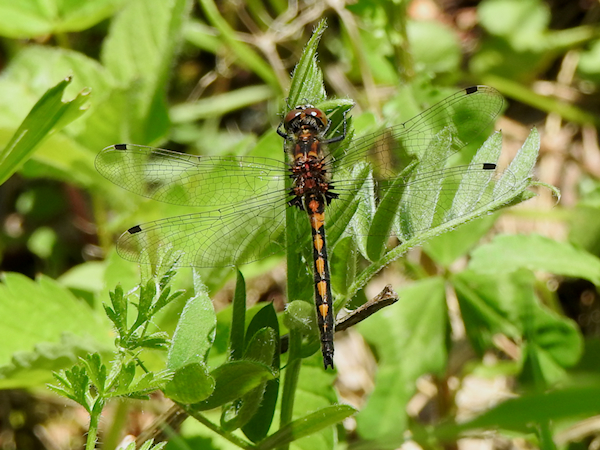
Then I found a male whiteface whose yellow spots were in the process of turning red, resulting in a dull orange colour. Seeing a transitioning dragonfly is always neat as they can show some unique colours not always found in books or field guides – such as the male Eastern Pondhawk that is half green and half blue. This fellow had the pale veins in the black basal triangles as well, though they weren’t as pronounced as those of the female I had seen earlier.
After giving the clearing a thorough scan for other odes, we returned to the trail then made our way down a short forested slope to the edge of the water. As is typical with most bogs, a “moat” of standing or slow-running water, called a lagg, separates the bog from the land surrounding it. This transition zone receives run-off from the domed bog and helps to maintain the bog’s water level. To our disappointment the water of the lagg was so high that parts of the boardwalk were submerged at least an inch below the surface. Chris took off his shoes and started walking across, warning me that although the water was warm, the boards were slippery. He also noted that there were a few mature male Hudsonian Whitefaces perching in the vegetation close to the boardwalk.
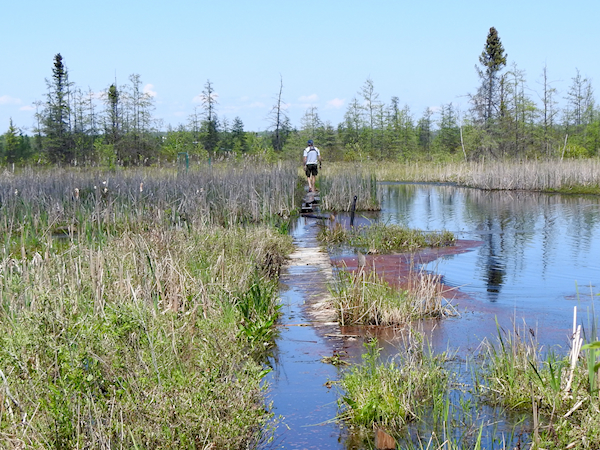
I didn’t want to have to cross the boardwalk with my shoes on top of all my other gear, but I did want to see the dragonflies that were flying in the reeds so I took my shoes off and walked out into the water with only my camera, leaving the net behind. There I spotted the Hudsonian Whitefaces, and what a treat it was to see their bright red colours and glittering wings among all the green of the vegetation! Unfortunately they weren’t as close to the boardwalk as I would have liked, but I did enjoy watching them hunt and chase each other from a favoured perch.
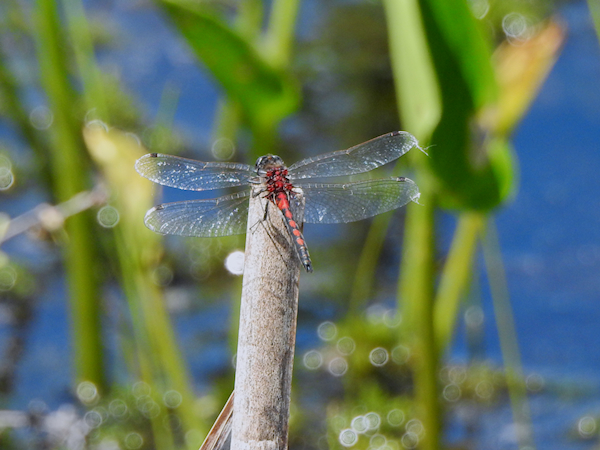
Hudsonian Whitefaces love water bodies with denser vegetation than most whiteface species, inhabiting marshes, sedge meadows, vegetated lakes, fens, and bog ponds containing sphagnum, which explains why there seem to be so many at Mer Bleue. Despite their love of sphagnum bogs, however, they can be found throughout Ottawa, although in low numbers – I’ve seen them in Marlborough Forest, the Morris Island Conservation Area, the Bill Mason Center, even one in Stony Swamp! Males set up small territories over the water, perching on vegetation where they can watch for intruders or potential mates. Females, like other skimmers, are usually found in clearings away from the water where they hunt for food – just as we saw today. Interestingly, I didn’t see any yellow Hudsonian Whitefaces at the water, or any mating pairs.
I was thrilled to see so many Hudsonian Whitefaces today, both mature and immature individuals, males and females. Normally I see only one or two at most per year; they are definitely not as abundant as the other whitefaces I come across.
Mer Bleue is such a wonderful spot to look for odonates, and I regret not going there more often during the summer. Even though we didn’t find our other target species or anything truly rare, in nature every day is different – perhaps next time we’ll find those Sphagnum Sprites, the Ebony Boghaunters, and surprise Somatochlora emerald!

 OdoNotations