
Sheila McKee Memorial Park has been on my mind all winter. I haven’t been there since 2020, and when thinking of good spots to look for clubtails close to home, I remembered seeing Cobra Clubtails, Lancet Clubtails, and Black-shouldered Spinylegs there later in the summer on my previous visits. The open, rocky shoreline makes it a better spot to see them perching than Mud Lake, and as it isn’t as far as Gatineau Park it was high on my list of places to explore. I started poring over iNaturalist sightings over the winter and was delighted by the additional clubtail species that had been observed there – not only the Midland Clubtail my mentor Chris mentioned seeing back in 2019, but also two rarities: Mustached Clubtail and Arrow Clubtail. I’ve seen Mustached Clubtail once at Sugarbush trail in Gatineau Park, but Arrow Clubtail (Stylurus spiniceps) is so rare that it’s not even on my mental dashboard, let alone my radar. This clubtail is one of the hanging clubtails referred to in a previous post; it perches by hanging vertically from a leaf or branch instead of horizontally on the ground. Perhaps that’s the reason I’ve never seen one, then: I don’t spend too much time looking in trees for odes, unless I happen to see one fly in and land!
The Mustached Clubtail was seen on May 24 (2021) which is quite early in the season, so I planned a visit toward the end of the month before my trip to the East Coast. Victoria Day (May 20th) promised to be another sunny day so I made plans to visit then. As usual I spent some time exploring the open areas of the top of the escarpment before heading down to the water, looking for adult dragonflies hunting in the vegetation away from the river. Right away I noticed that dozens of dragonflies were soaring in the air above the clearings. I could identify them as baskettails, but as they were so high up I couldn’t begin to identify them.
There weren’t too many dragonflies perching in the vegetation at the edges of the clearings, but I was happy to spot my first American Emerald of the year among them.
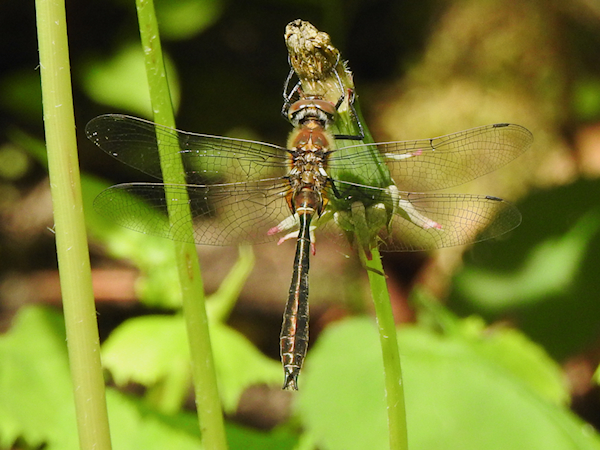
This is one of the earliest flying dragonflies in our region, and one of the first emeralds most beginners see and learn to identify as it breeds in accessible beaver ponds, marshes, lakes and fens, particularly those adjacent to forest, and perches often. The dark, moderately clubbed abdomen has a whitish-yellow ring at the base, and its thorax is bronzy-brown with metallic green areas. The thorax is furry in appearance, which helps keep the body warm during those cool spring nights, and lacks the yellow lateral stripes and spots of the Somatochlora emeralds. While males often patrol their territories along the shoreline, both males and females can be found perching vertically in the vegetation away from the water, usually below knee-height – just as this one was doing.
There were also at least two Chalk-fronted Corporals lurking on the ground along the corridors atop the escarpment – I saw this one when it flew up to a branch. It has the pinkish-brown body of an immature, though the pruinosity has already started developing on top of the thorax and the base of the abdomen.
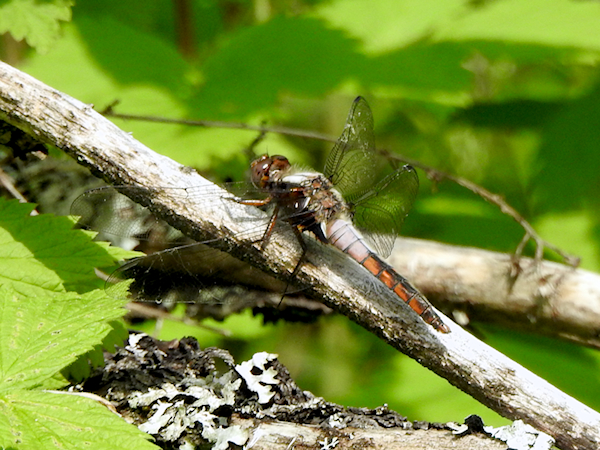
Then I really looked down the length of the opening in front of me and noticed a few dead trees with branches extending out into the clearing. Some of the larger limbs of the trees had fallen, creating a sizeable network of bare, dead branches. I recalled how the baskettails at Mud Lake liked to perch on bare branches fairly close to the ground and wandered over to take a look. Sure enough I started seeing perching baskettails on branches hanging out over the clearing! I took several zoomed-in photos trying to capture the shape of the claspers and the colour of the back of the head, and every one that I could identify turned out to be a Spiny Baskettail!
They were perching on branches just above my head all the way up to the top-most twigs. Although there were only about two or three dozen in sight at a given time (including the ones still hunting the sky above the clearing) it was incredible to watch them landing and taking off from branches where multiple individuals were already perching – it was like watching shuttles docking and undocking every few seconds on the enormous space stations in Star Trek !
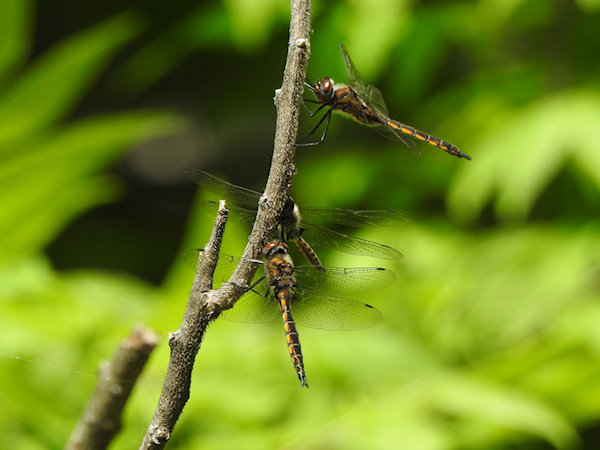
I also found a single Racket-tailed Emerald perching with the baskettails, bringing the total of odonate species up to four: three emeralds and one skimmer. When I took a walk along the shore I found no emerging odes, and no damselflies. More baskettails were flying along the shoreline and out over the water, and I presume these were all Spiny Baskettails as well. It amazed me that the two Chalk-fronted Corporals, usually a species found in great numbers, were completely outnumbered by the emeralds. It had never occurred to me that this small park with so much woodland and a tiny sliver of rocky shore would be a fantastic place for Corduliidae, even if all three species can be abundant just after emergence in the right habitat!
After that visit I had one free day left before my two-week trip to the East Coast and chose to spend it at Sheila McKee in case another mass emergence had taken place. However, the weather on May 26th wasn’t as cooperative – it wasn’t as warm as the Victoria Day weekend, with temperatures reaching only 21°C, and it was mostly overcast, though it looked at times as though the sun was about to succeed in breaking through.
When I arrived, the first dragonfly I noticed was an immature Chalk-fronted Corporal on the ground in a small clearing halfway between the parking area and the first large opening. I took a few photos for iNaturalist then continued on my way. I spent some time checking the edges of the corridor, scaring up a Juvenal’s Duskywing butterfly, a couple of Sedge Sprites, and a Common Whitetail as I went. This is an immature male, which I see less often than females and mature males. You can identify it as a male by the thick, solid dark brown patch on each wing and as an immature by the yellow spots down the sides of the abdomen.
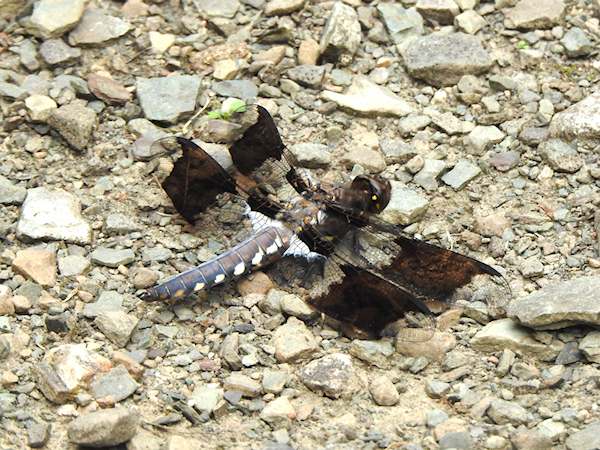
When I entered the second corridor leading off the first, I flushed a couple of immature whitefaces and spent some time trying to photograph them. And that’s when I got into trouble: from the brief glimpses I got it seemed there were at least two or three different species present, but the more I looked at them, the harder I found it to distinguish them! I settled for trying to photograph each individual that I saw in order to identify it later at home.
One was a clear Hudsonian Whiteface, identifiable by the pale yellow veins within the black triangles at the base of the hindwings. This appears to be a heteromorph female. The yellow abdominal spots are wide and long; in Belted Whiteface the spots would be narrower, and in Dot-tailed Whiteface the final spot would be squared-off and longer than it is wide.
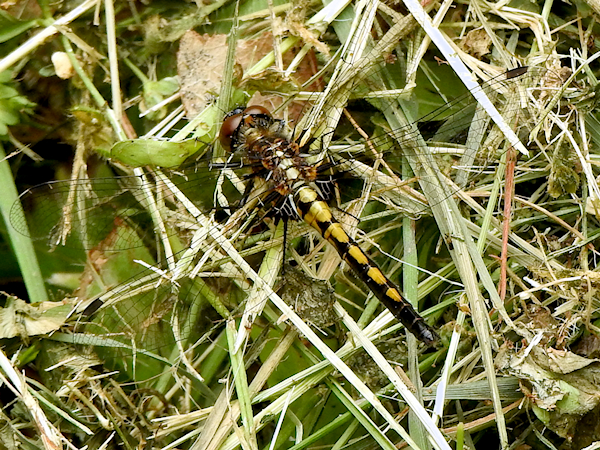
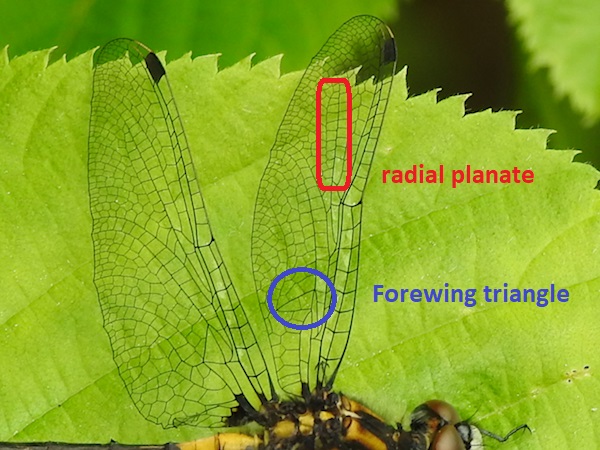
I was able to identify the next whiteface, a female, as a Belted Whiteface. The yellow abdominal streaks are too narrow for Dot-tailed Whiteface or Hudsonian Whiteface, and terminate in a yellow triangle on S7 which is lacking in Frosted Whiteface. In addition, you can see on the forewing that there are three cells adjacent to the forewing triangle, whereas there are only two cells adjacent to the forewing triangle in Frosted Whiteface. Finally, while female Crimson-ringed Whitefaces have a similar pattern of spots down the abdomen, there is a single row of cells in an area of the forewing called the radial planate in all species except Crimson-ringed Whiteface…in that species this area contains two rows. That feature is not quite visible in this image, but is noticeable in the enlarged image on iNaturalist.
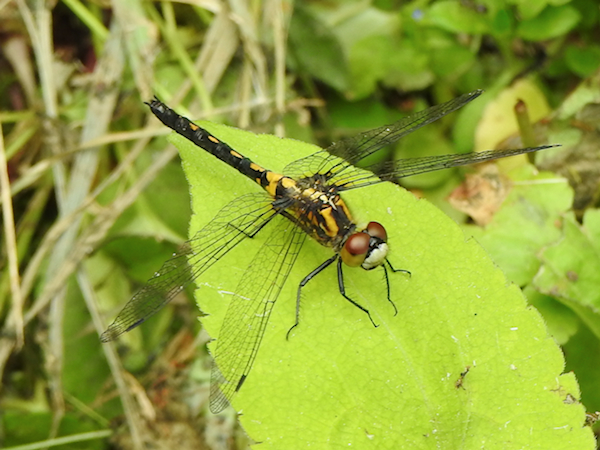
Another immature black and yellow whiteface had the claspers of a male and lacked any yellow spots along the abdomen. This pointed to either Belted Whiteface or Crimson-ringed Whiteface, which breeds – or used to – just west of Sheila McKee Park at the sandy pond at the Bill Mason Center.
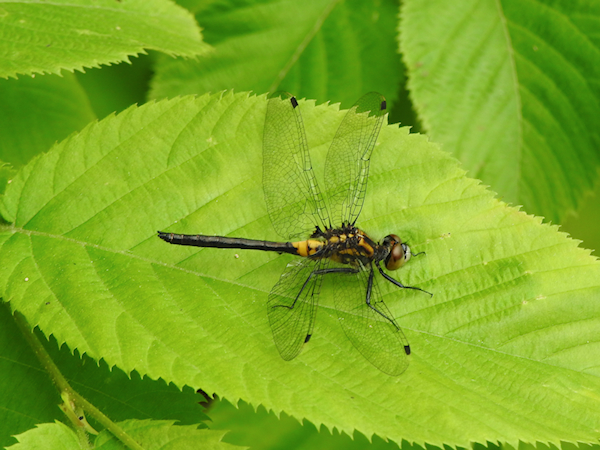
Fortunately I got a crisper image of the forewing which helped me to definitively identify this as a Belted Whiteface. In the enlarged image below I have labelled the forewing triangle which, according to Ed Lam’s field guide to all the dragonflies of North America, has three rather than two cells on the distal (furthest from the body) side. It also shows the single row of cells called the radial planate that “hangs” from the fourth line of cells extending from the nodus to the outer edge of the wing. There are two rows of cells in this area on Crimson-ringed Whitefaces.
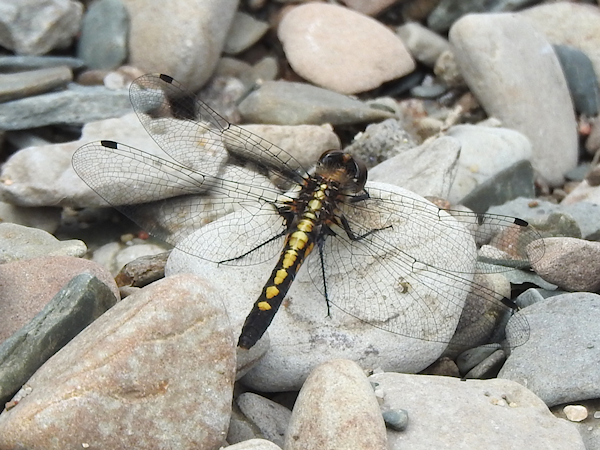
The last immature whiteface I photographed was a Dot-tailed Whiteface on the beach. The yellow abdominal spots are wide and run almost the full length of each segment except for the spot on S7, which was much shorter and wider than the ones above it. It most resembles the Hudsonian Whiteface but lacks the yellow veins in the black patch at the base of each hindwing. Note also that its abdomen is shorter than that of the Belted Whiteface: not as much of the body protrudes beyond the lower edge of the hindwing as it does in the Belted Whiteface.
Although I saw what looked like a Frosted Whiteface, it landed too high on a leaf for me to get a good look at it and then quickly took off before I could even get a photograph from the awkward angle below it. Still, that’s three confirmed whiteface species – a nice diversity!
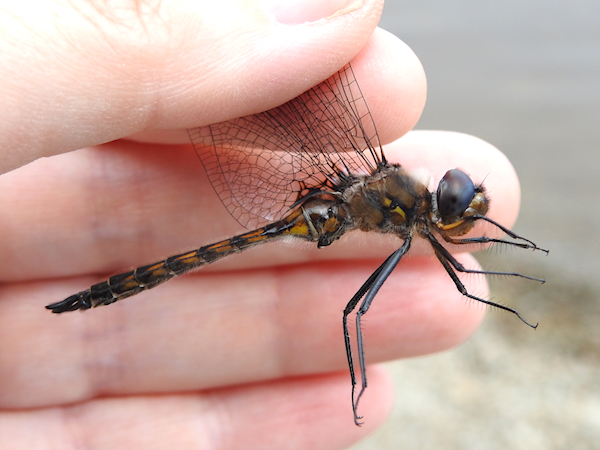
There weren’t as many emeralds active on this visit, but I did see several baskettails flying over the water again. I netted another Spiny Baskettail. I never noticed this until I saw it on this photo, but it has what looks like a yellow eye right in the middle of the thorax! I thought that this might be a new field mark but apparently all the small baskettails have this yellow eye.
There were still no Powdered Dancers present yet, and the only other species I saw in flight was a couple of Four-spotted Skimmers pretending they were baskettails as they flew by my outstretched net. I don’t need to catch them to identify them, but I did want one to land so I could photograph it and submit the image to iNaturalist. It took some time, but one did.
Although there were no clubtails flying just yet, it was great to spend a couple of days at the end of May looking around Sheila McKee Memorial Park just to see just what was present. I wasn’t expecting so many individual emeralds nor so many different whiteface species, making this a much more interesting park for ode-hunting than I had originally anticipated!

 OdoNotations